
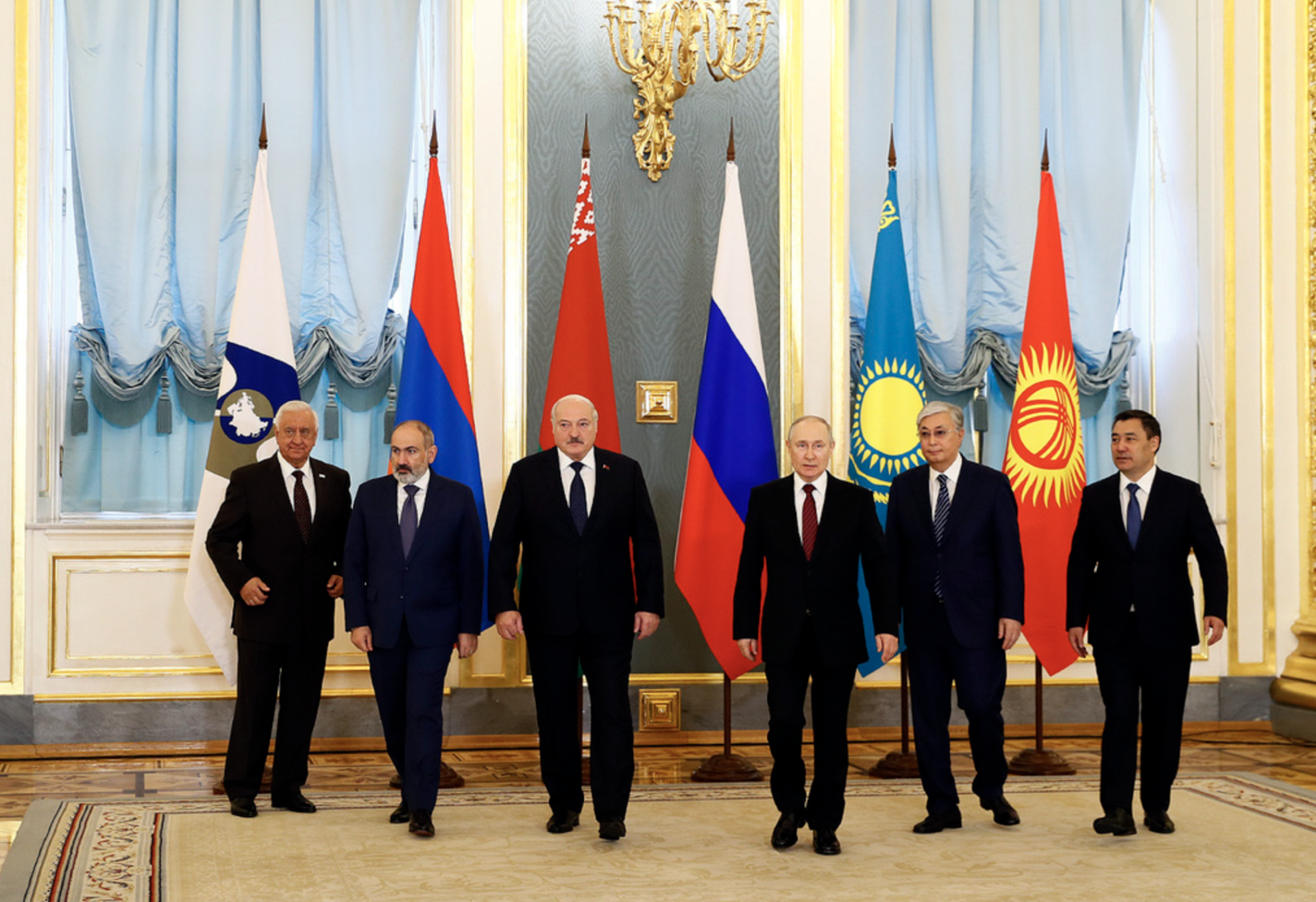

Prime Minister Nikol Pashinyan has pushed back against a joint call by the other leaders of the Eurasian Economic Union (EAEU), the Russia-led trade bloc Armenia has belonged to since 2014, for Armenia to hold a referendum on whether to remain in the union or pursue European Union (EU) membership. Speaking as Yerevan deepens its engagement with Brussels, Pashinyan said such a vote makes no sense while the choice between the two blocs remains hypothetical.
The demand came in a statement adopted at the Supreme Eurasian Economic Council in Astana on May 29 and signed by Russian President Vladimir Putin, Belarusian President Alexander Lukashenko, Kazakh President Kassym-Jomart Tokayev, and Kyrgyz President Sadyr Japarov. The four said Armenia’s preparations to join the EU pose significant risks to the economic security of the bloc’s members, called on Yerevan to hold a referendum in the shortest possible time, and ordered a report, due at the council’s next session in December 2026, on the possible consequences of suspending the EAEU Treaty with respect to Armenia. Pashinyan did not attend the summit, citing the election campaign, and was represented by Deputy Prime Minister Mher Grigoryan, who said Armenia does not intend to leave the union.
Responding in a video on social media, Pashinyan said Armenia would keep working within the bloc until the moment a decision could no longer be put off. “We are working within the Eurasian Economic Union and will continue to do so until the point when making a choice between the European Union and the Eurasian Economic Union becomes unavoidable, and, naturally, that decision must be made by the people of the Republic of Armenia through a referendum,” he said. He argued that the timing matters as much as the principle, and that the conditions for a vote do not yet exist. “Until the point when Armenia has either officially applied for EU membership or is very close to obtaining candidate status, holding any referendum would be unreasonable,” he said, describing the choice as theoretical at this stage and a theoretical question as ill-suited to a referendum.
Putin framed the same question from the opposite side. Speaking to reporters in Astana, he said it would be logical to put the matter to Armenian citizens and to act on their answer, describing the goal as a “soft, civilized and mutually beneficial separation” should Armenia choose the EU. He said Russia would respect whatever Armenians decide, citing the two countries’ special relationship, but warned that an exit would carry a price. “We would have to suspend almost all of our work with Armenia in the economic sphere that relates to integration processes,” he said. By his account, leaving the bloc would cost Armenia its preferential access in agriculture, manufacturing, customs, and labor migration; Armenian workers in Russia would need permits and face restricted access to health insurance, and rail freight rates would rise. Putin said expert estimates put the potential loss at no less than 14 percent of Armenia’s GDP if the change forced energy prices up, and noted that accumulated investment in Armenia stands at $4.9 billion according to the EAEU Bank, most of it Russian in origin, against a €2.5 billion investment pledge from the EU. He said he had asked that any referendum be held as soon as possible.
The constitutional backdrop helps explain why the question is live now in a way it was not a decade ago. Armenia joined the EAEU in 2014 under then-President Serzh Sargsyan without a referendum, which was permitted at the time. The following year, a constitutional amendment introduced a requirement that accession to supranational bodies be put to a popular vote. In 2024, Armenia’s parliament adopted a non-binding law declaring the country’s intention to seek EU membership, without fixing a timeline, the step the EAEU statement now cites as its trigger. Pashinyan also described relations with Moscow as undergoing a transformation he views positively, saying Armenia is building new ties with Russia that are open and sincere, with “no dark corners.”
The exchange has unfolded amid a mix of diplomatic courtesy and economic pressure. On June 1, Pashinyan, who turned 51, spoke by phone with Putin, who passed on birthday greetings. The Armenian readout said Pashinyan thanked him for the call and for his “balanced positions on a number of issues that have given rise to misinterpretations,” along with his friendly tone, and the two agreed to meet in person soon. The Kremlin said the leaders also reviewed the outcomes of the Astana session, where Putin had said that whatever Armenia decides would not damage the political and humanitarian ties between the two countries.
Those gestures sit against weeks of Russian measures targeting Armenian goods. Moscow has suspended sales of 64.5 million bottles of Jermuk mineral water and restricted imports of Armenian vegetables, strawberries, cut flowers, wine, and brandy, each justified on sanitary or phytosanitary grounds, while Russian officials have warned that Armenia could lose access to discounted natural gas if it continues toward the EU. The pressure has sharpened in the approach to the June 7 parliamentary elections. Putin also invoked Ukraine in connection with Armenia’s choice, recalling the 2014 ouster of President Viktor Yanukovych after he declined to sign an association agreement with the EU, an episode Russia followed by annexing Crimea and backing war in eastern Ukraine before its full-scale invasion eight years later. Pashinyan has maintained that the Russian measures pose no threat to Armenia’s developing economy.


