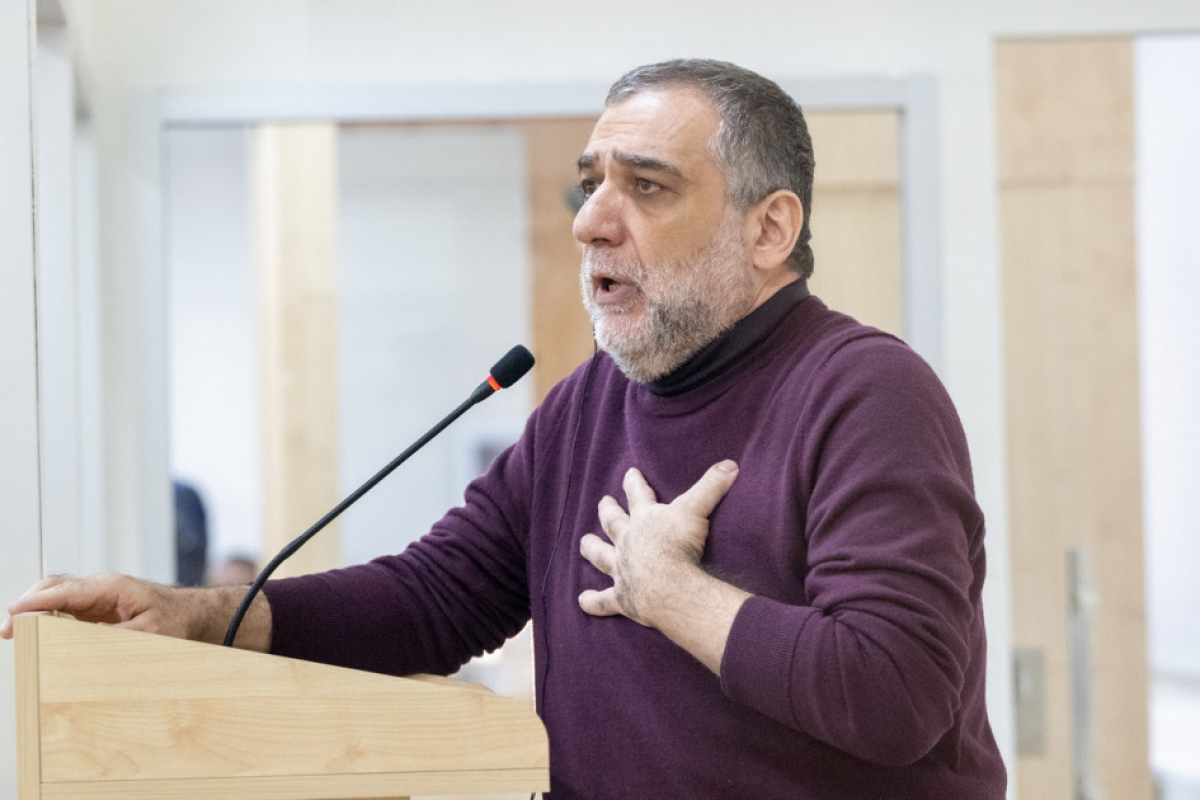

Ruben Vardanyan’s lawyer Siranush Sahakyan has filed an application with the European Court of Human Rights (ECHR), appealing her client’s 20-year prison sentence from the Baku Military Court, after he was unjustly imprisoned in Azerbaijan for about 22 months, citing violations of eight articles of the European Convention on Human Rights. The application also reveals that the verdict rested on a finding that Vardanyan joined a so-called Artsakh “criminal community” in December 2020, at a time when he was living in Moscow.
Vardanyan, an Armenian businessman and philanthropist who renounced his Russian citizenship before moving to Artsakh in 2022, has been unjustly imprisoned in Azerbaijan since September 2023, and served as the State Minister of occupied Artsakh (Nagorno-Karabakh), the second-highest post in the region’s leadership, from November 2022 to February 2023.
The application was filed on July 19 in Strasbourg by Sahakyan, president of the International and Comparative Law Center and legal representative of Armenian hostages before the European Court of Human Rights, on behalf of Vardanyan, who is currently held at the Umbaki Penitentiary Complex in Azerbaijan. She announced the filing in a statement released Wednesday, saying she will represent Vardanyan’s interests before the court and that the application is supported by comprehensive legal and factual arguments.
The move follows Vardanyan’s decision not to appeal his sentence within the Azerbaijani judicial system, which he and his legal team have characterized as a staged and predetermined show trial in which domestic remedies are ineffective. It is impossible to protect one’s rights within a system that inherently denies the right to a fair trial, Sahakyan said, adding that Vardanyan had chosen to seek justice through international legal mechanisms instead.
The Baku Military Court sentenced Vardanyan to 20 years in prison on February 17, 2026, on trumped-up charges of terrorism, financing armed groups, and other fabricated crimes, in a proceeding held separately from the mass trial of fifteen other former Artsakh leaders. According to Sahakyan, the court did not read the judgment in its entirety during the hearing. The full text was later obtained through Vardanyan’s family, at which point it became clear that he had been found “guilty” on 41 counts under 21 articles of Azerbaijan’s Criminal Code.
The findings inside that verdict are what have now been made public for the first time, and they read as a case built to fit a political conclusion rather than as a legal document grounded in evidence. According to Sahakyan, the court did not substantiate Vardanyan’s individual guilt with facts or evidence in the verdict. Instead, it concluded that the administration of the unrecognized Republic of Artsakh constituted a “criminal community” that had operated in Artsakh since 1988, and asserted that Vardanyan joined this “community” in December 2020, though he had no operational role in Artsakh at the time.
The court’s other interpretations follow the same pattern. Vardanyan’s assumption of a civilian administrative post in Artsakh was characterized as a violent seizure of power. His decades of internationally recognized commercial and philanthropic work, including the founding of the UWC Dilijan College and the Aurora Humanitarian Initiative, were reframed as illegal entrepreneurship and financing of terrorism. His entry into Artsakh through the Lachin Corridor, then the only route open to Armenians accessing their homeland during the Azerbaijani blockade, was treated as an illegal crossing of Azerbaijan’s state border.
Vardanyan is the first among the senior Artsakh officials sentenced by Baku to bring his case to the European Court of Human Rights. Sahakyan told RFE/RL earlier this month that Azerbaijani authorities had finally provided Vardanyan’s legal team with the full text of his verdict, making the appeal possible, while remaining reluctant to provide the same to the legal teams of the seven other former Artsakh leaders serving sentences of 20 years to life. Former parliament speaker Davit Ishkhanyan has publicly said his own defense team has still not received the complete verdict or indictment despite repeated requests.
The European Court of Human Rights application is the latest development in a series of moves aimed at pressing Vardanyan’s case internationally. His wife, Veronika Zonabend, on July 8 sent open letters to Azerbaijan’s Human Rights Commissioner, ICRC President Mirjana Spoljaric Egger, Armenian Prime Minister Nikol Pashinyan, and EU High Representative Kaja Kallas to advance a women’s humanitarian delegation to Baku aimed at restoring contact between the Armenian hostages and their families. Vardanyan himself has issued a series of statements from his prison cell in Baku since the February verdict, including a May 25 birthday address in which he accused the Armenian government of failing to organize any coherent mechanism on behalf of the hostages. Ishkhanyan has gone further, publicly accusing Pashinyan’s government of not wanting Baku to free the hostages at all.
Vardanyan is one of 19 Armenian hostages currently held in Azerbaijan, seized in September 2023 when, following a nine-month blockade and a military assault on occupied Artsakh, Azerbaijani forces detained members of the region’s former military and political leadership in the days surrounding the ethnic cleansing that forced the entire Armenian population from their homeland. Five former Artsakh leaders are serving life sentences: former President Arayik Harutyunyan, former Foreign Minister Davit Babayan, former National Assembly Speaker Davit Ishkhanyan, former Defense Army commander Levon Mnatsakanyan, and former deputy commander Davit Manukyan. Former presidents Arkadi Ghukasyan and Bako Sahakyan received 20-year terms alongside Vardanyan. Other officials and civilians received prison terms ranging from 15 to 19 years. Amnesty International condemned the verdicts as a travesty and a mockery of justice.