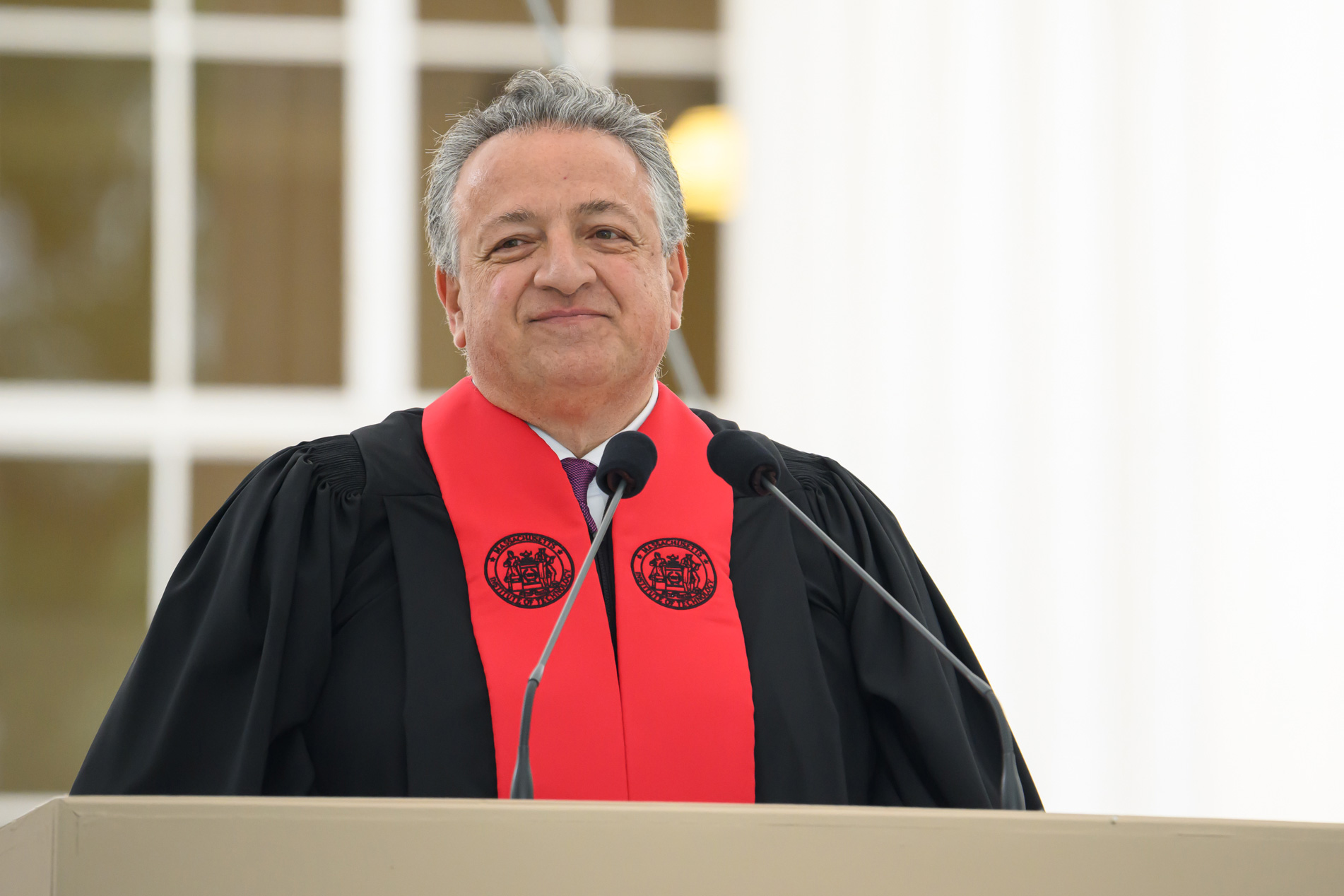

Armenian-American entrepreneur Noubar Afeyan, the scientist and investor who helped bring the world one of its first mRNA vaccines, has been ranked 32nd on Forbes‘ list of America’s 250 Greatest Innovators, a list released to mark the United States’ 250th anniversary. He stands among names that define modern American industry, with Elon Musk topping the ranking, followed by Jeff Bezos of Amazon, Nike’s Phil Knight, NVIDIA’s Jensen Huang and filmmakers George Lucas and Steven Spielberg, reports Zartonk Media.
Forbes compiled the list through an unusual process, scoring nearly a thousand nominees on creativity, disruption, and commercial impact through a panel of judges, then asking artificial intelligence tools to rank them before editors set the final order. For Afeyan, the placement marks formal recognition of a career that turned a refugee child’s improbable arrival in North America into one of the most consequential records in American science.
Through Flagship Pioneering, the firm he founded in 2000, Afeyan has helped create more than one hundred science companies, each beginning from a single question, “What if?” The most consequential answer came in 2010, when he co-founded Moderna, at a time when using messenger RNA as medicine was almost unheard of. A decade later that idea became a vaccine deployed to billions of people across more than seventy countries during the COVID-19 pandemic. Afeyan serves as Moderna’s board chairman, and for his body of work he received the National Medal of Technology and Innovation, the highest honor the United States grants for technological achievement.
Afeyan’s roots trace to Beirut, where he was born in 1962 to Armenian parents, his grandfather a survivor of the Genocide. His family fled the Lebanese Civil War for Montreal in 1975, and he went on to study at McGill University before completing a doctorate in biochemical engineering at MIT in 1987, entering biotechnology at the very moment it was becoming an industry. He speaks Western Armenian, and he has long pointed to his immigrant background as the engine behind his scientific, business, and philanthropic work, the kind of formation that shapes a person before they go on to build careers of their own.
In 2015, alongside the late Vartan Gregorian and Ruben Vardanyan, the Armenian philanthropist now held hostage in an Azerbaijani prison after the ethnic cleansing of Artsakh, Afeyan co-founded the Aurora Humanitarian Initiative and its Aurora Prize for Awakening Humanity, an award that honors those who risk themselves to save others, rooted explicitly in the memory of the Armenian Genocide and the survivors who were once saved by strangers. He is a founding backer of the Foundation for Armenian Science and Technology, a board member of the UWC Dilijan International School, a co-founder of the Future Armenian initiative, and an early architect of efforts to chart the country’s long-term development. Most recently he has turned toward Armenia’s technological future, serving as a founding partner and strategic advisor to Firebird, the company building a roughly half-billion-dollar AI data center in the country together with NVIDIA and the Armenian government, with his Afeyan Foundation for Armenia among its founding investors.
There is something fitting in seeing an Armenian name on a list defining American ingenuity at the nation’s 250th year. The American story has always been, in large part, the story of who arrives and what they go on to build. Afeyan arrived as a boy with a displaced family and a foreign name, and he became one of the people that name is now used to celebrate. For the Armenian nation, scattered across the world and accustomed to building its institutions on borrowed ground, his place on that list is a milestone worth marking.