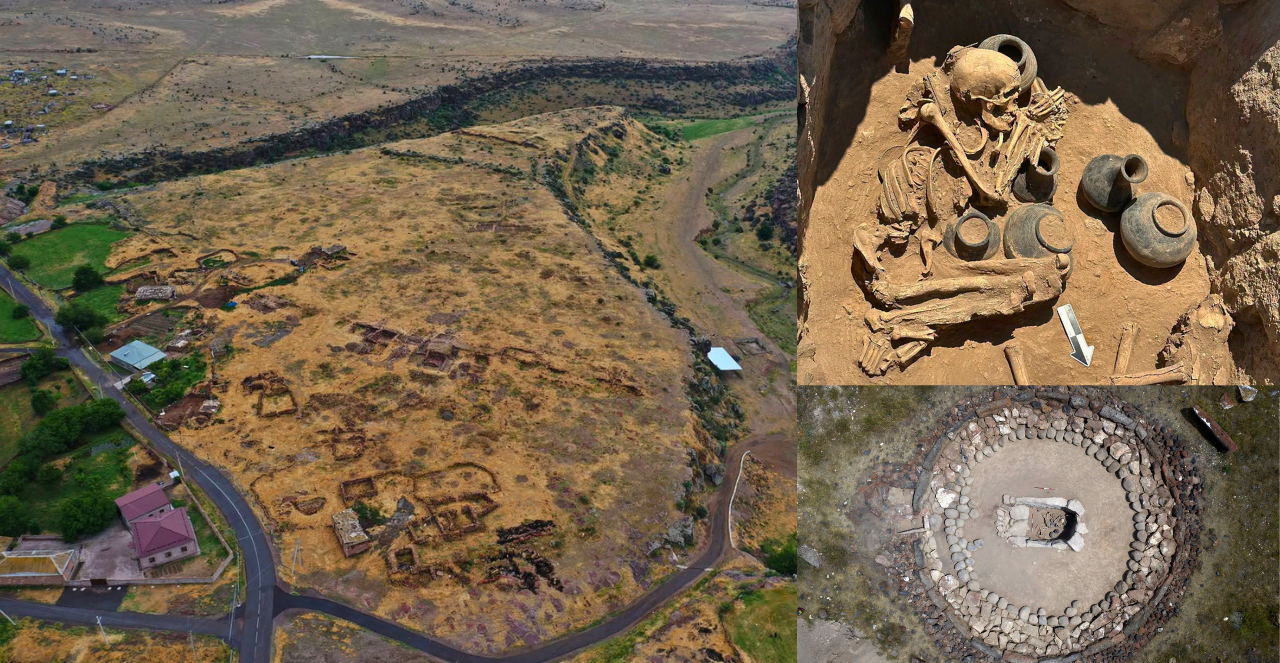

Armenian and Italian archaeologists have uncovered a monumental Late Bronze Age elite tomb, complete with rich grave goods and the remains of a ritually sacrificed horse, at the Shamiram archaeological site in Armenia’s Aragatsotn Province, according to the Institute of Archaeology and Ethnography of the National Academy of Sciences of Armenia.
The excavation revealed a Middle Iron Age structure predating the rise of Urartu, monumental Urartian fortifications and traces of medieval life built atop the ancient walls, offering new insight into the rise of local elites, ancient burial traditions and how the site was settled, defended and transformed across thousands of years.
The new evidence confirmed the site’s exceptional continuity of occupation across multiple historical periods, spanning the Late Bronze Age, Iron Age, Urartian, post-Urartian, Hellenistic, Late Antique, medieval and post-medieval eras.
The latest discoveries further reinforce Shamiram’s status as one of Armenia’s most important archaeological sites for studying the long-term history of central Armenia, from Late Bronze Age burial customs and Iron Age communities to Urartian monumental architecture and the settlement’s continued reuse in later periods.
The excavations were carried out by the Armenian-Italian Archaeological Mission as part of a long-standing scientific cooperation between the Institute of Archaeology and Ethnography of the National Academy of Sciences of Armenia and the International Association for Mediterranean and Oriental Studies (ISMEO). The project is co-directed by Varduhy Melikyan on the Armenian side and Roberto Dan on the Italian side.
The 2026 excavation season, conducted from May 26 to June 25, focused on several key areas of the multi-layered archaeological complex to better understand the chronology, function and development of Shamiram, which is known for its extensive fortified rocky plateau, monumental defensive systems, large residential areas and important burial complexes.
One of the most significant discoveries was the continued excavation of Tomb No. 3, a monumental Late Bronze Age burial complex featuring concentric stone circles, a central stone burial chamber, bronze weapons, obsidian and metal arrowheads, rich funerary offerings and the remains of a ritually sacrificed horse.
The discovery provides valuable new evidence for understanding the social status of local elites, Late Bronze Age funerary traditions and the symbolic role horses played in ancient communities in Armenia.
Researchers also uncovered important remains dating to the period before the establishment of the Kingdom of Urartu. Behind one of the towers of the Urartian fortress, archaeologists discovered a Middle Iron Age room bearing clear traces of fire and destruction, built above an earlier burial that predates the construction of the Urartian defensive system.
The sequence offers a rare opportunity to study how a local Iron Age center in the Ararat region evolved before and during the expansion of the Urartian kingdom.
Excavations also continued in the settlement’s fortified areas. Investigations at the Wall 2 gate complex indicate that the visible L-shaped entrance was most likely rebuilt during the Hellenistic period, replacing an earlier Iron Age gateway.
Meanwhile, excavation and conservation work at Tower 3 confirmed the monumental scale of the Urartian fortifications, exposing a well-preserved megalithic tower measuring approximately 8.5 by 8.5 meters.
The 2026 campaign also yielded new evidence of Shamiram’s post-Urartian development. Column bases uncovered in Area 7, architectural remains adjoining Urartian towers and well-preserved medieval buildings demonstrate that the ancient fortifications continued to influence the settlement’s layout and development for centuries after the fall of Urartu.
The archaeological mission thanked the institutions and partners that supported the 2026 field season. The project is co-funded by the Italian Ministry of Foreign Affairs and International Cooperation, with support and coordination from the Embassy of Italy in Yerevan. Researchers noted that ongoing archaeological, anthropological and other specialized analyses of the finds are expected to provide an even deeper understanding of Shamiram’s history and its place within Armenia’s ancient cultural landscape.