

Armenia’s Economy Minister Gevorg Papoyan on Friday urged the country’s leading agribusiness firms to diversify their exports, following a week of Russian restrictions that have hit Armenian flowers, vegetables, and strawberries amid heightened tensions between Moscow and Yerevan.
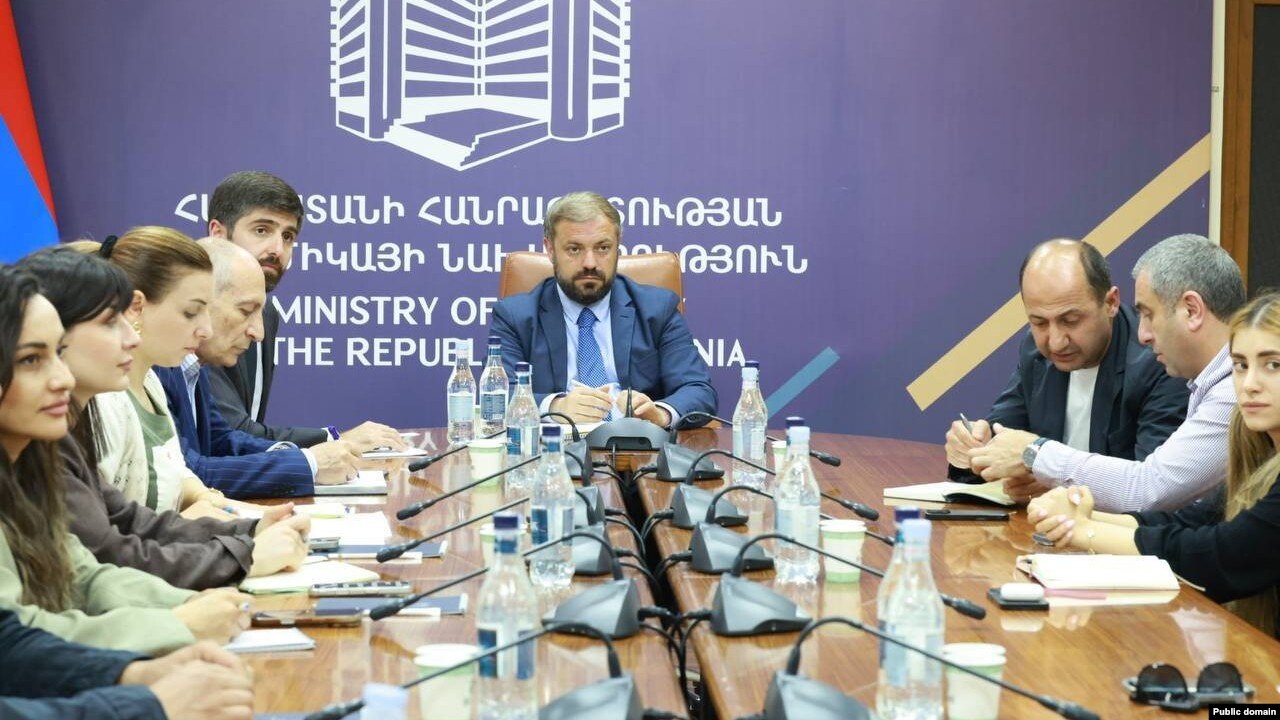
The bans were the clear focus of Papoyan’s meeting with the owners and senior executives of major Armenian greenhouses, though they were not named directly in the official readout from the Economy Ministry. According to the statement, Papoyan discussed “the current situation in the greenhouse construction sector” and “possible ways to solve current problems.” The minister said that beyond traditional export markets, steps were needed to ensure Armenian products reach international ones, and that the government “is already implementing numerous programs and is ready to take additional steps to complete the diversification of the economy.” No specifics of those steps were provided in the readout.
The most concrete move disclosed so far concerns flowers. Papoyan told RFE/RL’s Armenian Service earlier in the week that Yerevan has asked the European Union to allow large-scale exports of Armenian cut flowers into member states. “If they love talking about support for Armenia, then let them help us, including with financial instruments, sell our roses in the European market,” he said, adding that the EU had responded by asking for calculations, which Armenia has since provided. Papoyan has separately argued that roses grown in Armenia’s high-technology greenhouses match the quality sold at the Dutch auction platform that anchors the European trade, and that the government is weighing support mechanisms for exporters, including help with transportation costs and the intellectual-property fees attached to specific flower varieties.
The scale of the challenge is considerable. The Netherlands, the world’s largest flower exporter, accounts for roughly half of the global cut-flower trade. Armenia’s greenhouse sector, by contrast, has expanded dramatically over the past 15 years largely on the strength of rising agricultural exports to Russia, which has become the leading market for Armenian fruits, vegetables, alcohol, flowers, and processed food.
Reducing that dependence has been a stated government priority without yet showing measurable results. Shortly after his appointment in early 2024, Papoyan said easing Armenia’s heavy reliance on Russia for trade would be among his top objectives. Russia’s share of Armenian foreign trade has not fallen since then, standing at almost 36 percent last year, up from 35 percent in 2023.
The diversification push follows the wider wave of restrictions detailed in recent days, including Russia’s suspension of sales of 64.5 million bottles of Jermuk mineral water on sanitary grounds. Moscow has framed each measure in terms of safety and quality, while Armenian officials read them as economic pressure on Prime Minister Nikol Pashinyan’s government, which Russia accuses of pursuing an anti-Russian foreign policy. Pashinyan said on Thursday that the Russian measures pose no threat to Armenia’s developing economy. His critics expect the impact to be severe.


