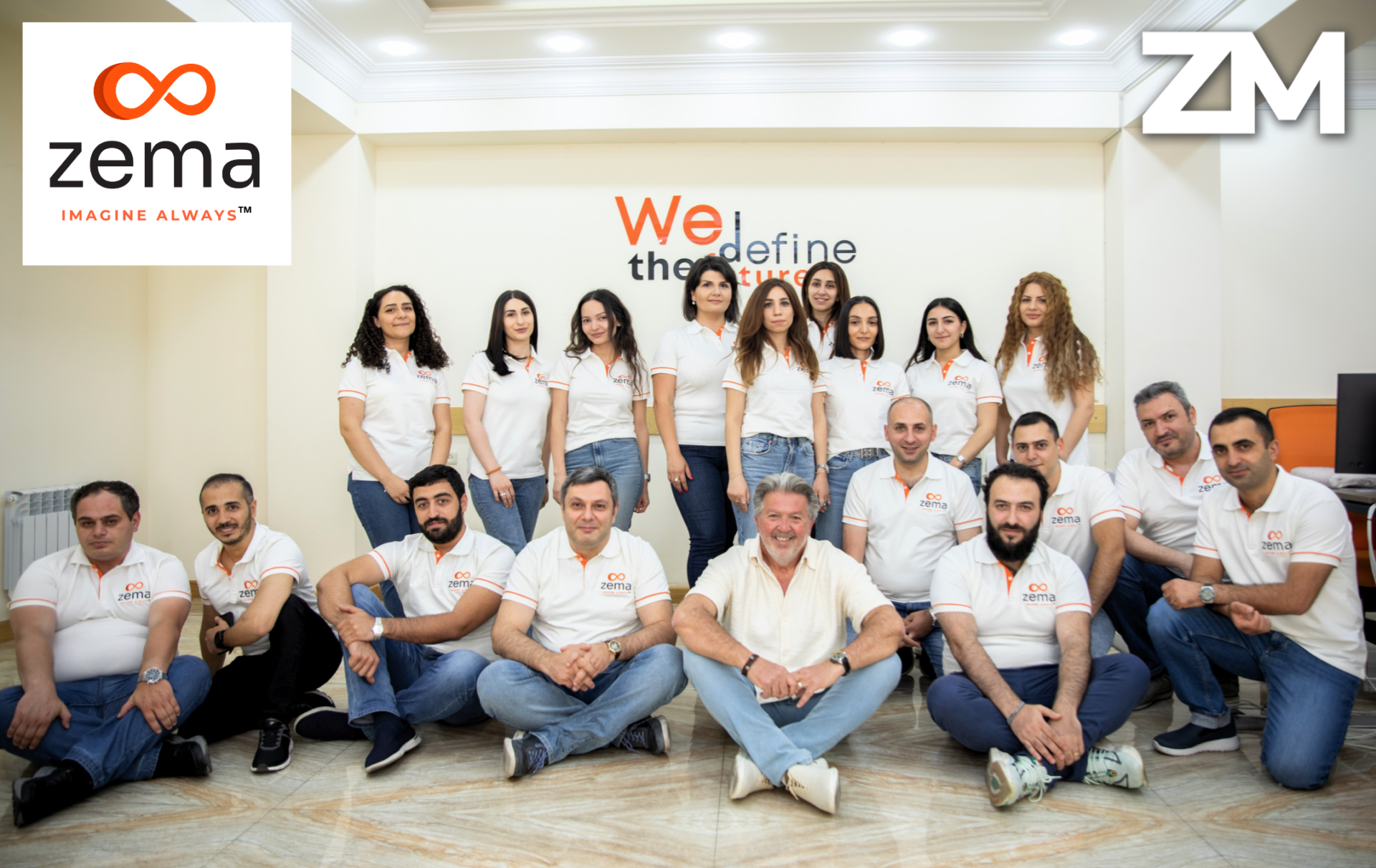

A Company Built with Armenia at its Core
When Dr. Zarik Boghossian founded Zema Group, the mission was clear: build meaningful technology solutions alongside ambitious founders, and do so with a team rooted in Armenia.
Over the last several years, that vision has taken shape through a growing Armenia-based technical operation connected to U.S. leadership and clients. What began as a small engineering presence in Yerevan has grown into a team of 45 across Armenia and the United States, serving clients across industries ranging from trucking and insurance to medical tourism, augmented reality, music, real estate, retail, and beyond.
Zema’s story is not simply about outsourcing or offshore development. It is about building with Armenians, training Armenian talent, and proving that a company can be both globally competitive and deeply rooted in Armenian human capital. That philosophy has shaped the company’s culture and its long-term trajectory.
The Founder Behind the Vision
Dr. Zarik Boghossian’s life story is central to understanding Zema. An Armenian born in Iran, he immigrated to the United States alone in 1978 with just $500 in his pocket. To survive, he worked multiple jobs while attending college, all while supporting family back home. Those years of hardship became formative, shaping the discipline, resilience, and clarity that would later define his career as a technologist, founder, investor, and educator.
Over the past four decades, Dr. Boghossian has designed, developed, and invested in advanced technologies across aerospace, artificial intelligence, augmented reality, digital media, e-commerce, on-demand services, and more. Among his most significant professional achievements was leading development of the mission-critical Electric Power System Flight Software for NASA’s International Space Station, launched in 1998 and still in operation today. He has also served for more than 18 years as a professor at Pepperdine University, teaching venture initiation, international management, and social entrepreneurship.
Beyond the resume, Dr. Boghossian’s philosophy is unusually personal. He frames leadership around kindness, respect, and mutual transformation. In his telling, Armenia is not merely a labor market. It is a place where lives should be changed on both sides of the relationship. That worldview has become part of Zema’s identity.
How Zema Grew in Armenia
Dr. Boghossian’s involvement in Armenia’s technology sector dates back more than two decades. His early work in Yerevan began in 2005, and since then he has helped hire and nurture more than 200 Armenian technical professionals while also mentoring founders and investing in Armenian-led startups around the world. Over those two decades, that team helped deliver work for enterprise clients including EPSON and Lincoln Motor Company, as well as Wovenmedia — whose content management platform was deployed with Sam’s Club, a Walmart company — and the American University of Armenia, establishing Zema’s capacity to deliver at scale across both US and Armenia-based organizations. According to the company materials, Zema’s competitive edge is not driven primarily by marketing spend, but by what it describes as its culture, its value system, and a leadership approach rooted in respect and loyalty.
That approach matters because it stands in contrast to a more extractive model that often defines offshore development. Zema’s internal philosophy emphasizes paying people well, building real relationships, training and mentoring teams, and treating employees as colleagues rather than anonymous resources. Whether one sees that as corporate culture or founder ethos, it has clearly become a central part of the company’s self-definition.
A Defining Moment: Mount Ararat
Before Zema’s evolution into an AI-driven company, there was a moment that helped define its future direction.
Father and son, Dr. Zarik Boghossian and Alex Boghossian, climbed Mount Ararat together on the 100-year anniversary of the Armenian Genocide in 2015— a journey later captured in a documentary. The experience became more than symbolic, marking a turning point in how they would work together and ultimately leading to a deeper professional partnership and shared vision for the company’s next chapter. That journey—rooted in heritage, endurance, and perspective, now echoes in Zema’s trajectory: a company built on Armenian foundations, but looking outward, toward global impact and technological transformation.
Zema’s Next Chapter: Building in the Age of Agentic AI
Zema’s transformation into an AI-driven company is a deliberate bet being led by Alex Boghossian — who joined as co-founder in July 2023. The ultimate goal is to ensure that Zema is not simply keeping pace with how AI is reshaping software development, but actively defining how that shift works in practice.
The company has made a series of concrete investments to back that bet: access to leading AI platforms, dedicated hardware for private model training, and structured AI literacy coursework assigned to every team member. Senior engineers are now implementing agentic AI workflows across the full software development lifecycle — from early client conversations to final deployment. The stated goal is structural: reduce cost, accelerate delivery, and improve output quality through a fundamentally redesigned process rather than simply speeding up old habits. That work is already underway across active engagements spanning medical tourism, trucking, insurance, and real estate — including platforms like MEDam, LoadConnex, CIBA Insurance Services, and Sohomey.
Crucially, Zema’s AI philosophy is explicitly human-centered. In its own framing, AI agents should handle repetitive and structured tasks, while human engineers and designers remain the orchestrators, reviewers, and strategic decision-makers. That distinction is important. Zema is not presenting AI as a substitute for human talent. It is presenting it as a tool that expands what human teams can do.
From App Development to AI Transformation Partner
Zema’s evolution is not just changing how it builds products. It is changing what the company offers. Historically, Zema’s value proposition was straightforward: a U.S.-based software company with a strong Armenia team building web and mobile applications for founders. That remains true. But the company has now expanded into AI transformation services for businesses whose biggest problems are not necessarily app-related, but operational.
According to the company’s materials, Zema now works with clients to map business operations, identify where intelligent automation can deliver the greatest return, build the relevant systems, and then train the client’s workforce to use them effectively. In other words, Zema is not merely selling software. It is trying to redesign how organizations function, with AI integrated into real workflows. That repositioning marks a significant shift: from product builder to long-term transformation partner.
Zema’s ambition here is specific: to become the team that builds the solution and ensures the people inside a business are genuinely part of it — not bypassed by it. That means designing AI workflows that fit how an organization actually operates, training the client’s own workforce to work alongside them with confidence, and staying on to manage and evolve the system as the business grows. The goal is not to automate a workforce out of existence. It is to make that workforce more capable than it has ever been.
The Broader Ecosystem: 301 AD and the Armenian AI Future
The Zema story also extends beyond the company itself. Alex Boghossian co-founded 301AD alongside Erica Der Mesropian, a Los Angeles-based 501(c)(3) nonprofit focused on mentoring the next generation of creative entrepreneurs in both the diaspora and Armenia. Through its RenAIssance Readiness™ curriculum, the nonprofit teaches participants how to build apps & products using the same AI tools that are reshaping the software industry. Dr. Zarik Boghossian serves as chairman of the board of 301AD. Due to this natural partnership, Zema Group’s AI specialists are taking the lead for bringing the same technical expertise they apply daily at Zema into the live workshops for students across Armenia.
This overlap matters because it reveals the broader family thesis behind Zema: that Armenians should not simply react to the AI era, but help lead it. Company and nonprofit become two expressions of the same underlying conviction — one in commerce, one in community formation. The through-line is the same: AI should expand human capability, not diminish human purpose.
The Values Underneath the Brand
What makes Zema distinct is not only its technical ambition, but the language it uses to describe itself. Dr. Boghossian has long emphasized ideas such as “Imagine Always” and “Leadership as a Service,” trademarks that reflect his view that innovation is inseparable from human character. The same biography that highlights NASA and patents also underscores kindness, imagination, and dignity as core ideas in both business and life.
That may sound unusual in a tech profile, but it helps explain why Zema’s Armenia model is presented in almost civic terms. The company is framed not merely as an employer, but as a long-term vehicle for Armenian talent development, founder mentorship, and economic opportunity. Whether through staffing, startup advising, or nonprofit education, the larger point remains consistent: Armenia is not peripheral to the future of technology. It is part of that future.
Why Zema Matters Now
Zema arrives at a moment when AI is forcing nearly every company to ask the same questions: how to adapt, how to remain competitive, and how to make technological change serve people rather than displace them. Zema’s answer is still being written, but its direction is clear. It wants to be more than a software firm. It wants to be an Armenia-rooted AI transformation company with a global footprint and a human-centered philosophy.
That matters for Armenians as much as it does for business. For years, discussions about Armenia’s tech future have focused on talent, outsourcing, and startup promise. Zema’s model points toward something more ambitious: building globally relevant technology while treating Armenian engineers, designers, and founders not as background support, but as central actors in the next wave of innovation.
Closing
For Zema Group, the future is not a single product, a single market, or even a single company. It is a posture: to keep building, keep adapting, and keep betting on Armenian talent in a world being reshaped by AI. In that sense, Zema is both a company profile and a larger proposition — that the Armenian story in technology is still unfolding, and that some of its most important chapters may be ahead.