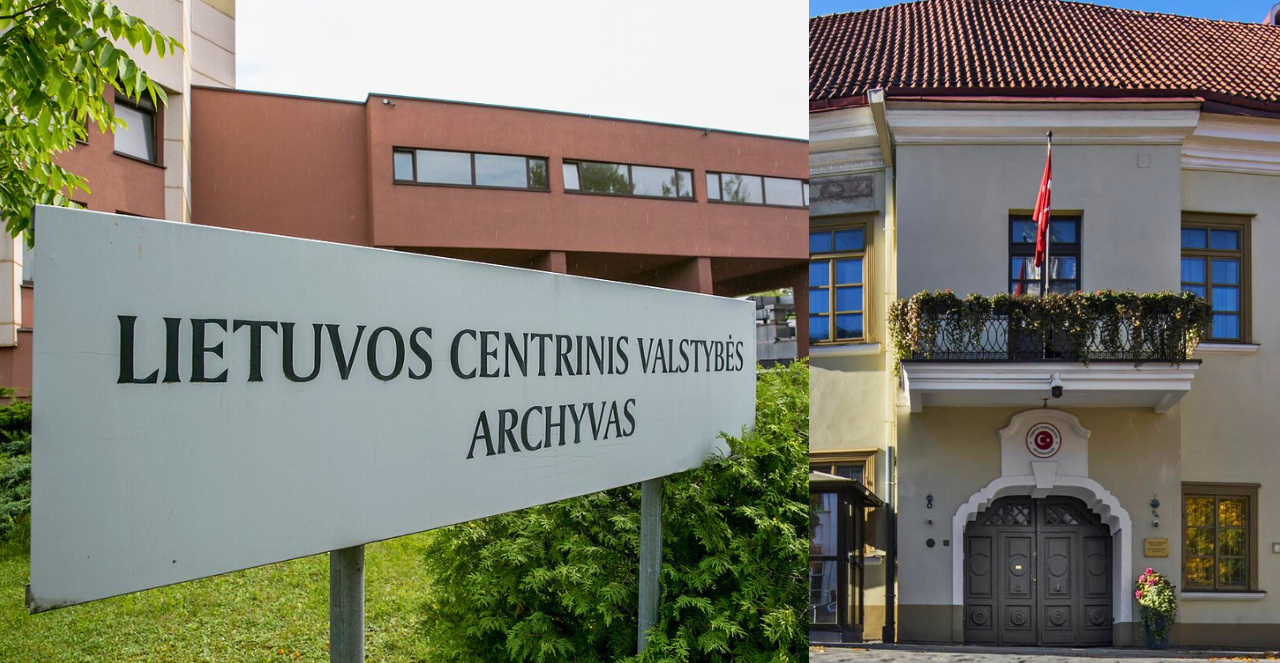

Publications dedicated to the Armenian Genocide have been restored on the website of Lithuania’s state archives, days after they were quietly removed following pressure from the Turkish embassy and informal contacts attributed to the Lithuanian Foreign Ministry. Sources in Lithuanian government circles confirmed on May 8 that all publications had been reinstated.
“On May 8, information was received from Lithuanian government circles that all publications dedicated to the Armenian Genocide had been restored on the archive’s website,” the report said.
The removal of the materials became public in early May, when Lithuanian national news agency ELTA published an investigative report by journalist Gabriel? Žimantait? — subsequently republished by LRT.lt — based on an account from a person working at the archive.
The head of Lithuania’s central archive service, Inga Zakšauskien?, confirmed that an urgent meeting with representatives of the Turkish embassy had taken place on April 28. During the meeting, the archive was allegedly accused of politicizing the issue of the Armenian Genocide.
“Concern was expressed about why the State Archives were allowing themselves to publish and disseminate what may be political issues,” Zakšauskien? told ELTA.
Zakšauskien? stressed that both her service and the archive remain apolitical, and drew a sharp comparison to other contested historical issues involving Lithuania.
“I do not see that the archive has gotten involved in politicizing any issue with its publication. Russia also does not recognize that it deported Lithuanians to Siberia, but we do not discuss that. Turkey also has this view on the Armenian genocide question, but that is their view,” she said.
“My current position is that this is absolutely not a political issue. It is a record of historical facts confirmed by scientific research,” Lithuania’s chief archivist stressed.
She also said she had received no official letters or phone calls regarding the matter, describing the embassy meeting as an exercise in soft power.
“I received absolutely no official letter or phone call. It was simply a visit, which I would describe as an instrument of soft power, aimed at politely explaining their position while reminding us that we could look for common points in Turkish and Lithuanian history — of which, frankly, we do not have many,” Zakšauskien? said.
Regarding the Lithuanian Foreign Ministry’s involvement, the head of the central archive’s document dissemination department, Džiuginta Abromaitien?, said she had received an informal phone call from ministry representatives.
“The Foreign Ministry expressed concern that the publication posted on the archive’s website could damage long-term relations between Lithuania and Turkey,” she said in a response sent to ELTA.
However, the Foreign Ministry denied issuing any recommendations or instructions to state institutions on the matter, stating it “has not provided any recommendations to the Archives Department, to the Chief Archivist’s Service, or to any other state institution on this issue.”
Turkish Embassy Disputes Genocide Recognition
The Turkish embassy issued a detailed statement to ELTA defending its objection to the archive’s publication and rejecting the 2005 Lithuanian parliamentary resolution as “biased.”
“Neither a parliamentary resolution — which in any case is not binding — nor a statement by a politician or official expressing that person’s political view can determine whether the events of 1915 constitute genocide,” the embassy said. It argued that the term “genocide” is a legally defined crime that “only competent courts can determine” under the 1948 UN Genocide Convention, and that no such court has ruled on the 1915 events.
The embassy further claimed that the nature of the 1915 events “remains a legitimate subject of discussion, as established in European Court of Human Rights rulings,” calling the framing of the genocide a “narrative” rather than an “indisputable fact.”
“Turkey objects to this tragic episode of history, which led to the collapse of the Ottoman Empire, being distorted as an act of aggression by one side against the other,” the embassy stated. “Such a misrepresentation not only contradicts historical facts but also disregards the suffering of others, including nearly five million Turks and Muslims. Compassion becomes problematic when it is selective.”
The embassy added that Turkey does not deny Armenian suffering during World War I, noting that President Recep Tayyip Erdo?an has sent an annual letter of condolence to the Turkish Armenian Patriarchate every April 24 since 2014.
The statement reiterated Turkey’s standing 2005 proposal to Armenia to establish a joint historical commission composed of independent experts from Turkey, Armenia, and third countries, and called for all archives — including those “not yet fully opened” — to be made available to researchers.
The embassy also urged third parties not to use the issue for political purposes, framing its objection within what it called the “atmosphere of peace and reconciliation taking shape in the South Caucasus.”
Historical Recognition
Lithuania’s Parliament, Seimas, adopted a resolution on December 15, 2005, condemning the Armenian Genocide committed in the Ottoman Empire between 1915 and 1923. The European Parliament formally recognized the Armenian Genocide in a resolution on April 15, 2015.