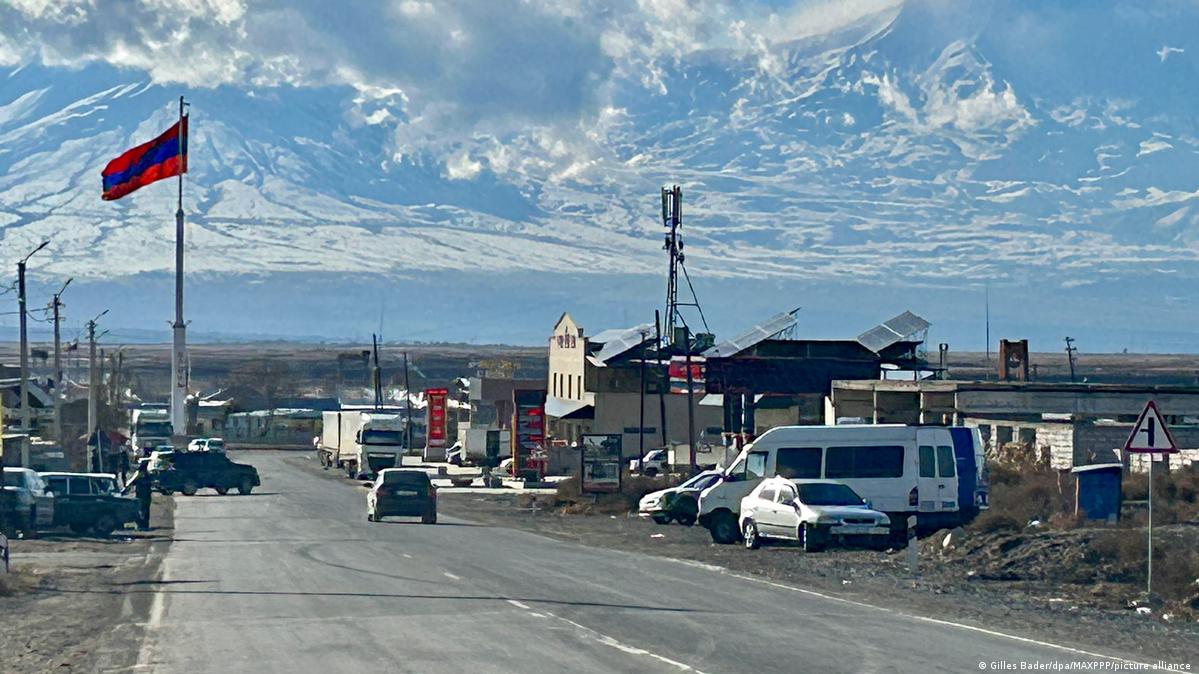

The Turkish Foreign Ministry announced on Wednesday that it has completed the bureaucratic preparations required to launch direct trade with Armenia, lifting a longstanding restriction that for three decades had forced Turkish goods bound for Armenia to be routed through a third country and re-exported, effectively erasing Armenia from Turkish customs paperwork.
The change, which took effect on May 11, 2026, allows goods moving between the two countries to officially list Armenia or Turkey as the country of origin or final destination, marking the first concrete regulatory result of the Armenia-Turkey normalization process that resumed in 2022 and the substantive policy that Foreign Minister Ararat Mirzoyan was overheard previewing in a hot-mic moment in Yerevan on Tuesday.
Turkish Foreign Ministry spokesperson Oncu Keceli said that “the necessary technical and bureaucratic work aimed at opening the common border between the two countries is ongoing,” repeating language that has been in circulation for years without producing an actual border opening.
The statement framed the move as part of a broader regional vision, stating that Ankara would continue to contribute to the development of economic ties and the deepening of regional cooperation in the South Caucasus for the benefit of all countries and peoples in the region, language that mirrors Erdogan’s broader posture of positioning Turkey as the connective infrastructure of the region.
The Substance Of The Change
Under the previous Turkish system, Armenia did not appear on Ankara’s list of countries with which it conducted direct trade, a reflection of Turkey’s posture of non-recognition rather than any logistical necessity. Turkish exporters were required to document their goods as bound for a third country, typically Georgia, before the shipments were re-exported into Armenia. Armenian importers absorbed the cost and the time of that detour for years.
Under the new regulation, goods transported between the two countries via third countries may now be officially documented with Armenia or Turkey listed as the country of origin or final destination. In customs terms, direct trade between the two countries without re-registration has become possible for the first time.
Armenia’s Response
Yerevan welcomed the move and used the moment to keep the larger normalization agenda visible. Armenian Foreign Ministry spokesperson Ani Badalyan said the ministry welcomed Turkey’s decision to lift the restrictions, calling it “another result of the process of normalization of relations between Armenia and Türkiye.”
She added that the decision is “significant from the perspective of expanding trade and ties between the business circles of the two countries, promoting economic connectivity and ensuring peace and prosperity in the region,” and emphasized that it represents “an important step towards the development of full-fledged and normal relations between the two countries, which can find its logical continuation through the opening of the Armenia-Türkiye border and the establishment of diplomatic relations.”
Ruben Rubinyan, the Vice Speaker of the Armenian National Assembly and Special Representative for Negotiations with Turkey, framed the development for the business community on social media. “Good news for businesspeople,” Rubinyan wrote, confirming that direct trade in customs terms, without re-documentation, has become possible. He added that work continues toward opening the land border, including the restoration of the Gyumri-Kars railway.
The Armenian Ministry of Economy issued a formal notice to businesses outlining the change and providing a dedicated hotline for questions, telling exporters and importers that the new regime “will contribute to a significant reduction in costs and delivery times and the expansion of new markets and cooperation opportunities for business.”
The Bigger Picture
The shift is the most concrete deliverable of the normalization track since it restarted in 2022. The Armenia-Turkey border has remained closed since 1993, when Turkey unilaterally shut it in solidarity with Azerbaijan during the Artsakh liberation war, sealing Armenia off from one of its two land routes to Europe and imposing what has functioned as a decades-long blockade. The two countries have not had diplomatic relations since 1991.
Turkey continues to deny the Armenian Genocide of 1915, the foundational unresolved issue between the two states, and has historically conditioned any opening of the border on Armenian concessions, from constitutional changes to a peace agreement with Azerbaijan on Baku’s terms.
The current normalization process, led on the Armenian side by Rubinyan and on the Turkish side by Serdar Kilic, has produced a steady accumulation of incremental confidence-building steps over the past two years.
These include the launch of daily Istanbul-Yerevan flights by Turkish Airlines in March, an agreement in January to ease visa procedures for diplomatic and service passport holders through free e-visas, the signing on May 4 of a memorandum on the joint restoration of the medieval Ani Bridge during the European Political Community summit in Yerevan, and a third meeting of the working group on restoring the Gyumri-Kars railway.
For Yerevan, the working assumption remains that Armenia will continue engaging in good faith, but the burden of proof on whether normalization translates into open borders, full diplomatic relations, and an honest reckoning with the past sits squarely with Turkey. Wednesday’s announcement is one of the first tangible deliverables of that engagement that has the shape of an actual policy. Whether it becomes the start of a sequence or another isolated gesture is the question the next twelve months will answer.