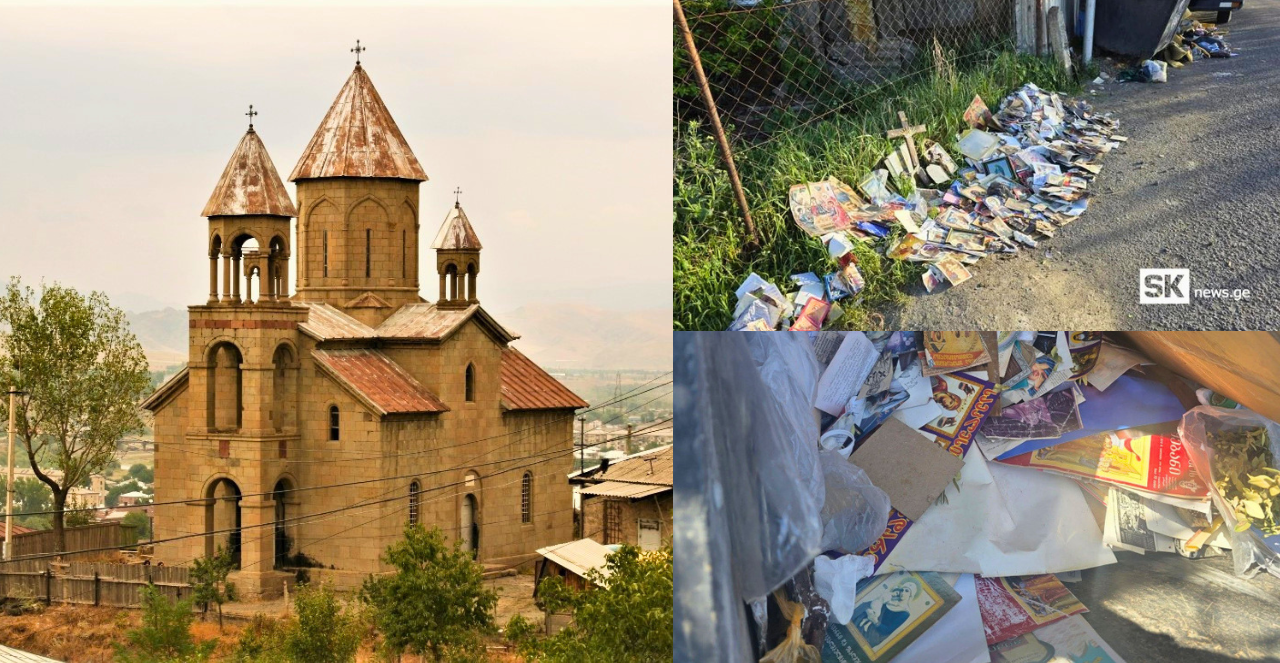

Unidentified individuals removed icons overnight from the historic Surb Nshan Armenian Apostolic church in Akhaltsikhe, Georgia, and left them inside a trash container, according to local outlet sknews.ge. Local Armenian residents recovered the icons and returned them to the church the same day.
The incident took place in the early hours of Tuesday in Akhaltsikhe, a city in Georgia’s Samtskhe-Javakheti region that sits inside historically Armenian Javakhk and remains home to a substantial Armenian population.
The Georgian Ministry of Internal Affairs has opened a criminal investigation under Article 155 of the Criminal Code, which prohibits the unlawful obstruction of religious ceremonies. Father Hakob Sahakyan, a clergyman of the Armenian Apostolic Church serving the Akhaltsikhe region, told sknews.ge that he does not know who removed the icons or for what purpose.
Surb Nshan is an Armenian Apostolic church built in 1862 by Armenian survivors who fled Karin for Akhaltsikhe. Construction was funded entirely by Akhaltsikhe citizen Vardan Vardanyants, after whom the church is also known as St. Vardanants, and it was consecrated in 1864 by the Armenian Diocesan Primate. Soviet authorities officially closed the church in 1938 and converted the building into a regional archive, installing two-story wooden shelves inside the sanctuary for storage. It was later turned into an ethnographic museum and has remained closed to active worship ever since.
The contemporary dispute over the church traces to a specific date. On April 24, 1989, the 74th anniversary of the Armenian Genocide, local Armenian clergy and the Armenian community held a Response for Souls service inside Surb Nshan. The service triggered a confrontation with the Georgian population of the city, and the compromise reached at the time was that the church would be kept equally open to both communities until a final resolution. That resolution has never come. The Georgian claim rests on an assertion, advanced by some Georgian scholars, that Surb Nshan was built on the foundations of an earlier Georgian church. The Armenian Apostolic Diocese in Georgia notes on the record that “some of the Georgian intellectuals and clergy are trying to spread this misconception to other churches of Armenian origin in Georgia.”
Surb Nshan is one of the historic Armenian churches the Diocese has formally requested be returned to Armenian custody, alongside Surb Norashen, Surb Gevorg of Mughni, Yerevantsots Surb Minas, and Shamkhoretsots Karmir Avetaran in Tbilisi, all confiscated from Armenians during the Soviet period. The Georgian government has not responded.
The Akhaltsikhe incident lands inside a much larger pattern. The Armenian Diocese in Georgia has identified more than 440 historic Armenian churches across Georgian territory in similar limbo. Some sit in ruins. Others have been reconsecrated as Georgian Orthodox, with their Armenian inscriptions, khachkars, and architectural identifiers removed or covered. Others still have had their land swallowed by new construction.
The Surb Shamkhoretsots Karmir Avetaran in Tbilisi was gutted by fires in 2002 and 2012; one of its walls collapsed and the Georgian government declined to restore it.
The Norashen church in Tbilisi has been at the center of a public reconsecration dispute since the early 1990s. Georgia’s own former ombudsman criticized the treatment of Norashen, and the issue has at times produced diplomatic friction between Yerevan and Tbilisi. The United States State Department has reported on the record that the Armenian Apostolic Church has been unable to recover places of worship closed during the Soviet era and later transferred to the Georgian Orthodox Church.
Armenians built more than 600 churches across the territory of present-day Georgia between the 7th and 19th centuries. Today only a handful are still permitted to function as Armenian Apostolic churches, including Saint George’s and Echmiadzin in Tbilisi, Saint Gregory the Illuminator in Akhaltsikhe, Surb Khach in Akhalkalaki, and Saint Sarkis in Ninotsminda. The rest sit somewhere on the spectrum between disputed and erased.
The Tbilisi numbers are the starkest. The city once had between 24 and 29 Armenian churches. Two remain in active Armenian Apostolic use today. This was not a marginal community in decline. Armenians were the demographic and civic backbone of Tbilisi for most of the modern era, and 96 percent of the city’s mayors up until 1918 were Armenian. The most visible symbol of the reversal sits in the heart of the city: Tbilisi’s Holy Trinity Cathedral, the largest religious building in Georgia, was built in the early 2000s on top of the Khojivank Armenian Pantheon, the burial ground of generations of Armenian clergy, intellectuals, and benefactors.
Taken together with the disputed status of Surb Nshan, the ruined state of Surb Shamkhoretsots, the reconsecration fight over Norashen, and the more than 440 churches the Diocese has catalogued in similar limbo, the pattern is not incidental.