

Konstantin Sokolov, a Russia-born American businessman and private equity investor from Chicago, has been appointed chairman of the new U.S. State Department TRIPP+ enterprise fund that will oversee the spending of more than $200 million intended to develop TRIPP across Armenia and Central Asia, according to a report by The Guardian.
The fund will invest in Armenian energy and telecommunications, the same sectors where Sokolov holds major stakes. He is a beneficial owner of Viva Armenia, the country’s largest telecommunications company, held through a company registered in Cyprus that controls 80 percent of the operator. He has also been publicly linked by RFE/RL to the purchase of Teghut, Armenia’s second-largest mine, from a sanctioned Russian bank.
The $201 million fund is authorized to make loans, equity investments and grants to promote private sector development across eight countries: Armenia, Azerbaijan, Georgia, Kazakhstan, Kyrgyzstan, Tajikistan, Turkmenistan and Uzbekistan. Its stated priorities are transportation, energy infrastructure and the extraction of critical minerals. The State Department confirmed the appointment on July 10.
TRIPP+ is the financing arm of the Trump Route for International Peace and Prosperity, a 27-mile route through Armenia’s Syunik province connecting mainland Azerbaijan to its Nakhichevan exclave and onward to Turkey. Vice President JD Vance, visiting Yerevan in February, called the fund part of a “historic transformation” that would “open up a whole new world of trade, transit and energy flows,” as The Guardian reported.
The appointment lands as Armenia begins the ratification process. Today, Thursday July 16, the government approved the draft ratification law, which now goes to the Constitutional Court to be checked against Armenia’s Constitution before it can reach the National Assembly for a vote.
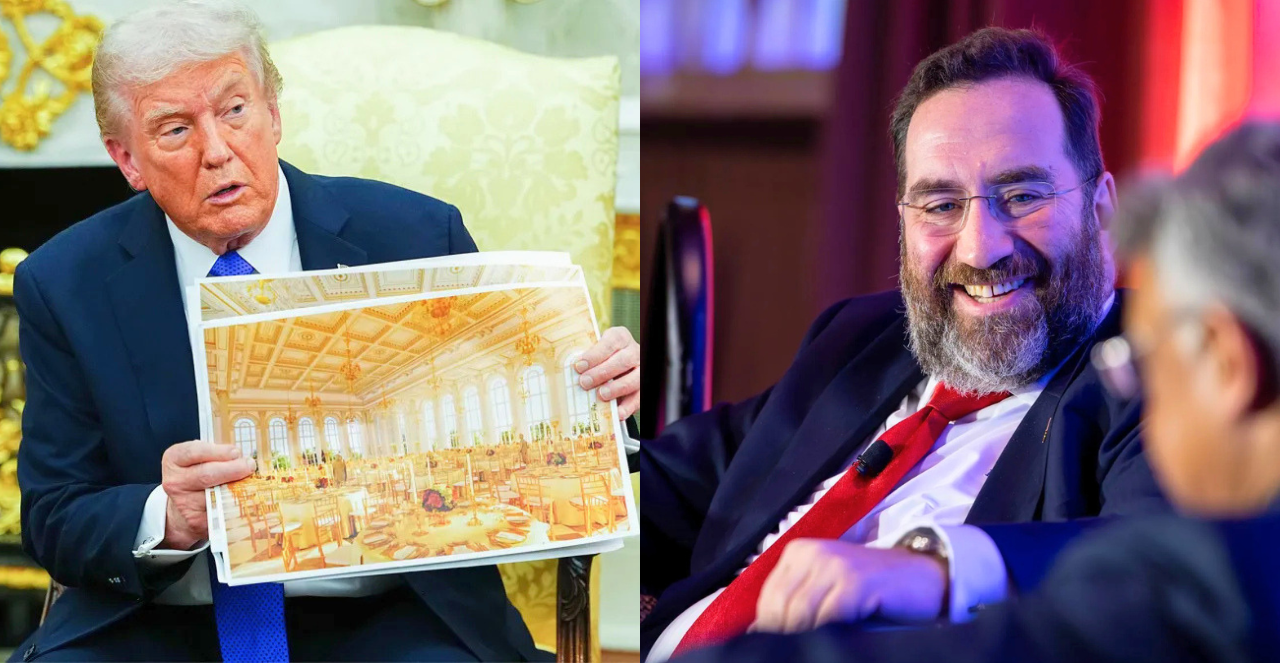
Sokolov was among the donors who, according to Donald Trump, contributed more than $350 million to the White House ballroom project; the size of his gift has never been disclosed. Two-thirds of the corporate donors on that list have since received government contracts, according to Public Citizen research cited by The Guardian, and several individual donors received advisory roles or political appointments. During Trump’s second term Sokolov has given more than $12 million to Republican campaigns and political groups, including $11 million to MAGA Inc., the president’s super PAC. He was previously a modest Obama donor. He has never held a government job before.
It is unclear whether Sokolov will be compensated for the role, or whether he or his businesses could benefit from the fund’s investment decisions.
Four U.S. foreign assistance experts told The Guardian it is customary for the White House to select enterprise fund boards, and that appointees often have ties to the administration as well as business ties relevant to the fund.
Don Niss, a former program officer for U.S. enterprise funds in eastern Europe, told The Guardian it is not unreasonable for politically connected people to get involved — the issue, he said, is when those people lack expertise in investment banking, private equity, or industries related to the investments they’ll be making. Sokolov has more than twenty years as an investor and clears that bar. He clears it because his money is already in the industries his fund will invest in.
A second former USAID administrator, speaking anonymously, told The Guardian that wealthy political donors have run enterprise fund boards before, citing private equity founder Michael Granoff, a major Democratic donor whom President Clinton appointed to chair the Albanian-American Enterprise Fund in the 1990s. Asked about Sokolov, the same administrator said the question is whether he has the ability to personally benefit from investment decisions, and that the answer should be no.
The law says the same thing. TRIPP+ was established under the Support for East European Democracy Act of 1989, the legislation that created the first two U.S. enterprise funds with $300 million for Poland and Hungary; Congress extended that authority in 1992 to cover the former Soviet states, which is why Armenia qualifies. The statute, codified at 22 U.S.C. § 5421, prohibited any part of an enterprise fund’s money from benefiting a board member, officer or employee, except as salary or reasonable compensation for services. Congress wrote that prohibition into the law thirty-seven years ago, and the Trump administration invoked that same law to create TRIPP+.
A State Department spokesperson told The Guardian the fund would comply with applicable statutory requirements, including annual reporting and independent audits to ensure transparency and accountability, as well as grant provisions covering conflict of interest. The spokesperson did not say how those provisions would apply to a chairman whose holdings overlap the fund’s mandate. Sokolov declined The Guardian’s interview request and did not respond to written questions. The White House referred questions to the State Department.
Who is Konstantin Sokolov?
Sokolov, 50, was born into a Russian Jewish family in St. Petersburg, in the last years of the Soviet Union. He studied mathematics and computer science at St. Petersburg State University, then emigrated to the United States in 1997 at 21. He was a managing director for strategy and mergers and acquisitions at the British energy company Centrica, and has advised governments, sovereign wealth funds and central banks. He completed an executive MBA at the University of Chicago’s Booth School of Business in 2005 and founded IJS Investments, a Chicago private equity firm focused on telecommunications, energy and financial infrastructure. In April 2025 he gave Booth $100 million — more than 10 percent of his net worth, according to the Chicago Tribune, and among the largest gifts in the school’s history. The executive MBA program he graduated from now bears his name. He sits on the board of trustees of the Munich Security Conference Foundation. Sokolov has explicitly stated that he is proud of his Jewish heritage.
Sokolov’s Investments in Armenia
Sokolov holds two significant Armenian assets. He is the beneficial owner of Viva Armenia, the country’s largest telecommunications company, through a Cyprus vehicle that owns 80 percent of it — an acquisition Armenian regulators blocked on national security grounds before reversing themselves seven months later. And he has been publicly linked to the purchase of Teghut, Armenia’s second-largest mine, from a sanctioned Russian state bank, in a transaction whose buyer remains formally unnamed.
Viva
Every account of Sokolov’s Armenian holdings, including The Guardian’s, describes him as a “major shareholder” in Viva. That phrase comes from Sokolov’s own website.
Viva’s own corporate record is more specific. Its shareholder is Fedilco Group Limited, a company incorporated in Cyprus in April 2022 whose ultimate beneficiaries are Zhe Zhang and Konstantin Sokolov, and which holds 80 percent of the operator. Fedilco acquired Viva from Russia’s MTS Group in January 2024, ending seventeen years of Russian ownership of Armenia’s largest mobile network. So an American citizen and a second investor jointly control a Cyprus vehicle that owns four-fifths of Armenia’s dominant telecom.
The chain does not stop in Cyprus. The Armenian investigative outlet Hetq found that Fedilco is itself held by two further Cyprus companies — Nofal Holdings Limited with 75 percent and Ortasano Investments Limited with 25 percent — whose ultimate owner, via a company called Wimthed Limited, is a man named Andreas Ourris. All four companies were registered in 2022, and almost nothing is publicly known about any of them beyond their connection to this transaction.
The approval was not routine. In April 2023, Armenia’s Public Services Regulatory Commission rejected the transfer of MTS Armenia’s shares to Fedilco on the grounds that the transaction “harms or may harm national security and state interests,” according to the commission’s own published decision, based on an assessment by the Ministry of High-Tech Industry working with interested bodies — likely including the National Security Service. Armenia’s Commission for the Protection of Competition separately prohibited the acquisition that same month. In November 2023, the same bodies approved the same deal. The ministry said it had no objections. The NSS said it had no comments. Neither explained what had changed.
Sokolov has since had direct access at the highest level of the Armenian government. On March 15, 2024 — two weeks after the cabinet accepted Fedilco’s 20 percent stake as a gift — Prime Minister Nikol Pashinyan received Sokolov and Viva board chairman Tigran Gasparyan at his office to discuss the company’s development and the donated shares, according to a readout from the government press service. Pashinyan also attended Viva’s 20th anniversary celebration in Yerevan in July 2025, alongside members of the government and representatives of regulatory bodies, where Sokolov presented the company’s strategy.
Teghut
The second asset is a mine, and the reporting on it is unsettled. VTB, the sanctioned Russian state bank, has completed the sale of Teghut, Armenia’s second-largest mining company, a copper and molybdenum operation in the northern Lori province that owed the bank roughly $440 million.
RFE/RL’s Armenian Service reported on July 11 that the buyer is Kuprar RA, a company founded this February by Sergey Virabyan, a former government official and bank executive with no record of ever managing or owning shares in a mining company. Armenia’s Competition Commission approved the deal on July 7 without publishing anything about Kuprar’s shareholders or assets, and Kuprar has still not filed beneficial ownership information in the public register. Kuprar’s general director since June is Artyom Gegamyan, who spent years as legal director of Vallex Group — Teghut’s owner before VTB took it.
Virabyan told RFE/RL he is not Teghut’s new owner and no longer owns Kuprar. He confirmed he had taken VTB’s debt and sold it on, personally rather than as anyone’s representative. Asked to whom, he said it was a commercial secret. Asked directly whether Sokolov is the buyer, he said he could not say. Sources told RFE/RL earlier this year that Sokolov was showing interest in Teghut; the service’s April report on the sale was headlined “Russian Bank Selling Armenian Mining Giant to Sokolov.”
Whether Sokolov bought the mine, and what he paid, remains unknown. What is not in dispute is the shape of it: Russian capital exiting Armenia, an unnamed buyer, and the chairman of a U.S. fund whose mandate includes critical minerals publicly linked to the purchase. It would be the second time he has been the buyer standing where Russian money leaves, in the second sector Washington has decided matters most.
What Armenia Is Signing
The route restores a Soviet-era link severed since the early 1990s during the Artsakh Liberation War. It emerged from the peace declaration Nikol Pashinyan and Ilham Aliyev signed at the White House last August, where Pashinyan pledged the United States exclusive rights to it. The framework agreement was initialed in Yerevan on May 26 during Marco Rubio’s visit, signed in Washington on June 1, and signed in Yerevan by Rubio and Foreign Minister Ararat Mirzoyan on June 4 — three days before Armenia’s parliamentary elections. Mirzoyan told reporters the two sides were laying groundwork for economic engagement that would let Armenians make money and find prosperity, and Americans do the same.
The framework establishes the TRIPP Development Company as a joint venture incorporated in Armenia, but the American partner, TDC US, is a commercial entity to be incorporated in Delaware as a wholly owned subsidiary of the U.S. International Development Finance Corporation. TDC US holds 74 percent and Armenia holds 26 percent, for an initial term of 49 years, extendable by mutual consent for another 50, at which point Armenia’s stake rises to 49 percent. Under Article 6, Armenia grants the TDC “exclusive land use rights, development rights, related permissions, and all other rights” for that 49-year term, fully assignable to subsidiaries the company creates. The shareholders’ agreement governing the venture is to be written under the laws of the United States and the state of New York. The DFC board approved the venture on June 3 as part of a $2.5 billion package of new strategic investments, and its board documents project the route could yield up to roughly $100 million annually in transport cost savings for Armenian trade, lift real GDP by 0.5 to 1 percent, and grow aggregate exports by about 3 percent.
The agreement states that Armenia retains full sovereignty, including legislative, regulatory and judicial authority over all TRIPP areas within its territory, along with border control, customs, taxation and law enforcement. There will be no U.S. military presence. The American commercial stake is itself understood in Yerevan as a form of deterrence: Syunik sits between Azerbaijani territory to the east and Nakhichevan to the west, and business interests are harder to invade than empty road.
The agreement is not yet final. Today, at its July 16 meeting, the Armenian government approved the draft ratification law, launching the domestic process. Foreign Minister Ararat Mirzoyan, presenting it to the cabinet, said the government will now apply to the Constitutional Court to determine whether the obligations the treaty enshrines comply with the Armenian Constitution; Deputy Foreign Minister Vahan Kostanyan has been appointed the government’s representative before the court. Only if the court rules the obligations consistent with the Constitution does the initiative reach the National Assembly for a ratification vote. The court will be ruling, among other things, on whether a 49-year grant of exclusive land use and development rights to a Delaware subsidiary — to be governed by New York law, and assignable — is consistent with Armenian constitutional law. Mirzoyan also told the cabinet that two documents remain to be agreed: the shareholders’ agreement and the charter of the TRIPP Development Company.
Mirzoyan addressed TRIPP+ itself at the same meeting, two days after The Guardian reported Sokolov’s appointment. The fund, he told the cabinet, is a U.S.-based investment vehicle created to attract financing for the project, has only an indirect relationship with the TRIPP Development Company to be established in Armenia, and exists to satisfy American legal and institutional requirements.
The View From Tehran
The route runs along Armenia’s border with Iran, and Tehran’s objection is not only to an American presence but to what that presence does to Armenian control of the border itself. On July 8, Iranian Ambassador to Armenia Khalil Shirgolami said Iran’s concern was legitimate and required a clear response. Pashinyan answered the next day, arguing that TRIPP would open a railway from the Persian Gulf to the Black Sea and directly serves Iranian interests, and that he hoped work would begin on the ground this autumn.
TRIPP is one piece of a broader American turn toward Yerevan. Since last August, Washington has committed $9 billion to Armenia’s nuclear energy sector and sold the government $11 million in reconnaissance drones, the first sale of U.S. military technology in the country’s history. On the same day the TRIPP framework was initialed, Rubio and Mirzoyan also signed a Framework for Securing of Supply in the Mining and Processing of Critical Minerals and Rare Earths.
The fund will grow. Jeremy Lewin, a senior State Department foreign aid official, told the Council on Foreign Relations in April that the department had secured $400 million for TRIPP+, nearly double the $201 million currently authorized. He described it, according to The Guardian, as one test case of many in how the administration is trying to reorient foreign assistance, particularly in economic investment. And in its 2027 budget request, the administration has asked Congress to lift the geographic limit on enterprise funds entirely, and authorize them anywhere in the world.
The State Department says the fund will be audited. It has not said whether its chairman can profit from the investments he oversees — which is the question the former USAID administrator put to The Guardian, and answered in the same breath: the answer should be no.


