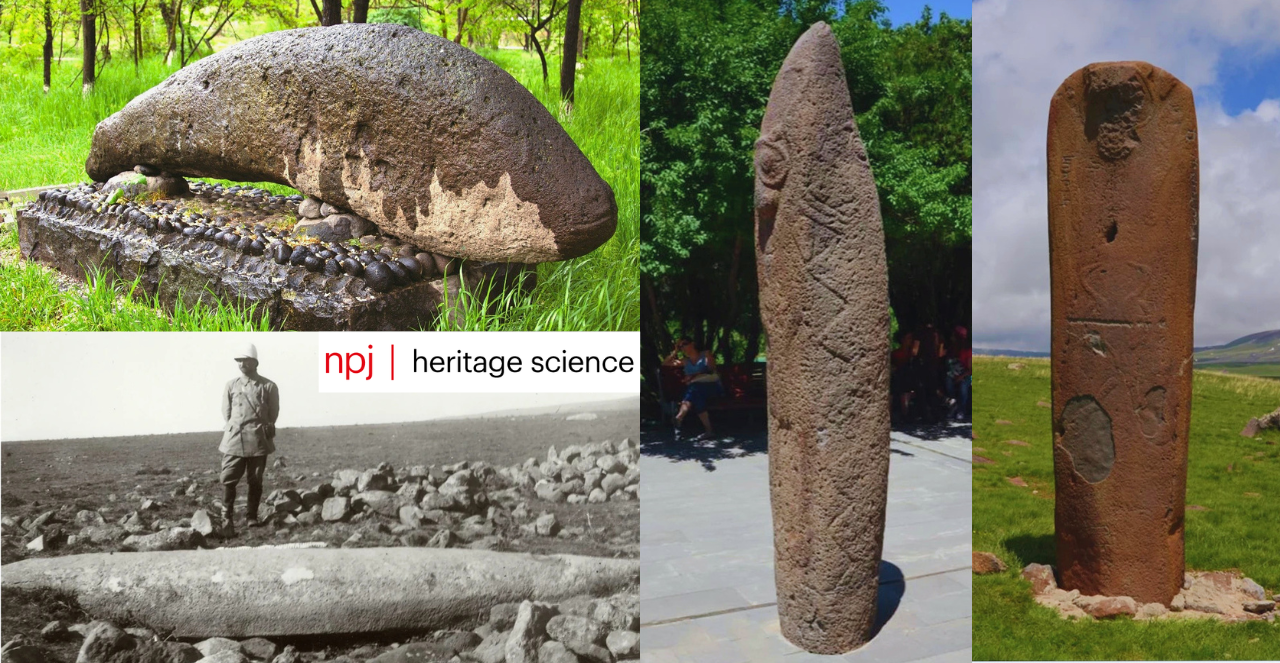

A new study in the Nature Portfolio journal npj Heritage Science argues that the people who carved and raised the Vishap (Dragon) stones in the Armenian Highlands belonged to a single, highly organized society—one capable of mobilizing enormous human and material resources for large-scale ritual and irrigation projects around 4000 BC. They were among the first to thrive in these mountains—the same homeland that would later cradle the Kingdom of Van, the Armenian kingdoms, and the Armenians who live there today.
The finding pushes the evidence for coordinated, settled civilization in these mountains back some 6,000 years. The conclusion rests on a statistical analysis of where these massive stones were placed and how much labor their placement demanded.
The paper, titled “Vishap epoch unitary society in Armenian Highlands, c. 4000 BC: data analysis consequences,” was authored by physicist and cosmologist Professor Vahagn Gurzadyan of the Center for Cosmology and Astrophysics at the Alikhanyan National Science Laboratory, and archaeologist Professor Arsen Bobokhyan of the Institute of Archaeology and Ethnography of Armenia’s National Academy of Sciences. It builds directly on the pair’s widely discussed 2025 paper in the same journal, which used the first statistical analysis of the vishaps to tie the monuments to a prehistoric cult of water.
The vishaps—stelae carved from volcanic andesite and basalt, standing roughly two to five meters tall (about 6.5 to 16 feet)—are unique in the ancient world for their animal iconography and their deliberate placement in remote, water-rich high-mountain meadows. Roughly 115 are documented across the Republic of Armenia, concentrated on Mount Aragats and in the Geghama Mountains, and they fall into three types: piscis (fish-shaped), vellus (a stylized bovine hide), and hybrida (a combination of the two).
A Homeland Older Than Its Kingdoms
The vishap builders belong to the deep prehistory of the Armenian Highlands, among the most continuously inhabited regions on Earth. The same mountains, springs, and river valleys that these people organized themselves around would, thousands of years later, become home to the Kingdom of Van—known to its own people as Biainili and to history as Urartu—between the ninth and sixth centuries BC, and the Armenian kingdoms that rose after it. Scholars trace the emergence of a distinctly Armenian language and identity to those later millennia; what the vishaps establish is that the highlands were already home to complex, coordinated societies six thousand years ago. It is an unbroken thread of habitation in one landscape, running from these stone sentinels through Urartu and historic Armenia to the Armenians who live among the same mountains today.
The Weight of the Evidence
The heart of the new study is labor. Some vishaps weigh as much as seven to nine tons, and the researchers treat their size and elevation as measures of the effort required to produce, move, and raise them. The larger the stone, the more work to quarry, shape, and transport it; the higher the site, the shorter the snow-free window each year in which that work could be done.
Analyzing the 115 stones, the authors found that their elevations form an unexpected bimodal distribution—two distinct altitude clusters rather than a random spread. Crucially, the larger and most labor-intensive vishaps were concentrated at the higher elevations, and their sizes did not shrink as altitude rose, despite the steeper logistical demands. That pattern, the researchers argue, points to deliberate, cult-driven motivation rather than convenience or chance.
Water at the Center of a Society
The stones’ positions line up with the nodes of ancient mountain irrigation systems—networks of canals, ponds, and reservoirs that captured spring snowmelt and rainwater and channeled it toward agriculture on the Ararat Plain below. Those systems were first documented in detailed fieldwork by archaeologist Ashkharbek Kalantar in the 1920s and 1930s, and later scholars came to see the vishaps as guardians of water and patrons of canal-building.
Sustaining both a resource-hungry water cult and an extensive high-altitude irrigation network, the authors argue, would have required a coordinated community with shared beliefs and the organizational capacity to marshal labor across a wide region. In their words, the vishaps “convey a message about the existence of a unitary society in the Armenian Highlands during their period,” one that placed water management and its associated cult at the center of its cultural life.
Tirinkatar: A Ritual Landscape in the Clouds
The richest evidence comes from Tirinkatar, a site of more than 40 hectares (about 100 acres) on the southern slopes of Mount Aragats, at an altitude of roughly 2,700 to 3,100 meters (8,900 to 10,200 feet). Known locally as “Karmir Sar,” or “Red Hill,” it holds the largest single concentration of vishaps—twelve in all—and is possibly one of the highest-altitude archaeological complexes in the world.
Radiocarbon dating of two vishaps at the site places their erection at roughly 4200–4000 BC, in the Chalcolithic period, though the campsite itself was in use as far back as the Neolithic, from the end of the sixth millennium BC. Over the following millennia the site accumulated cromlechs, “giant’s houses,” barrows, and petroglyphs, layering into an evolving sacred landscape.
Among the Oldest Monumental Art on Earth
Carved on all four sides, the vishaps are the earliest known figurative monumental art in the Armenian Highlands and the Caucasus—and rank among the earliest monumental statues anywhere in human history. Their iconography is so specific that it has no known parallel in the ancient world.
The authors place Tirinkatar in global company, comparing it to celebrated high-altitude ritual sites such as Machu Picchu, Tiwanaku, and Chavín de Huántar in the Andes. But those sites are largely dated from the Late Bronze Age through the medieval era; Tirinkatar was already in use in the Neolithic, making the Armenian Highlands a strikingly early case of humans domesticating and sacralizing high-mountain terrain.
Taken together, the two vishap studies offer one of the clearest pictures yet of how an early society in the Armenian Highlands organized itself around the water that sustained it—and of the extraordinary, coordinated effort it was willing to invest to honor that water in stone.