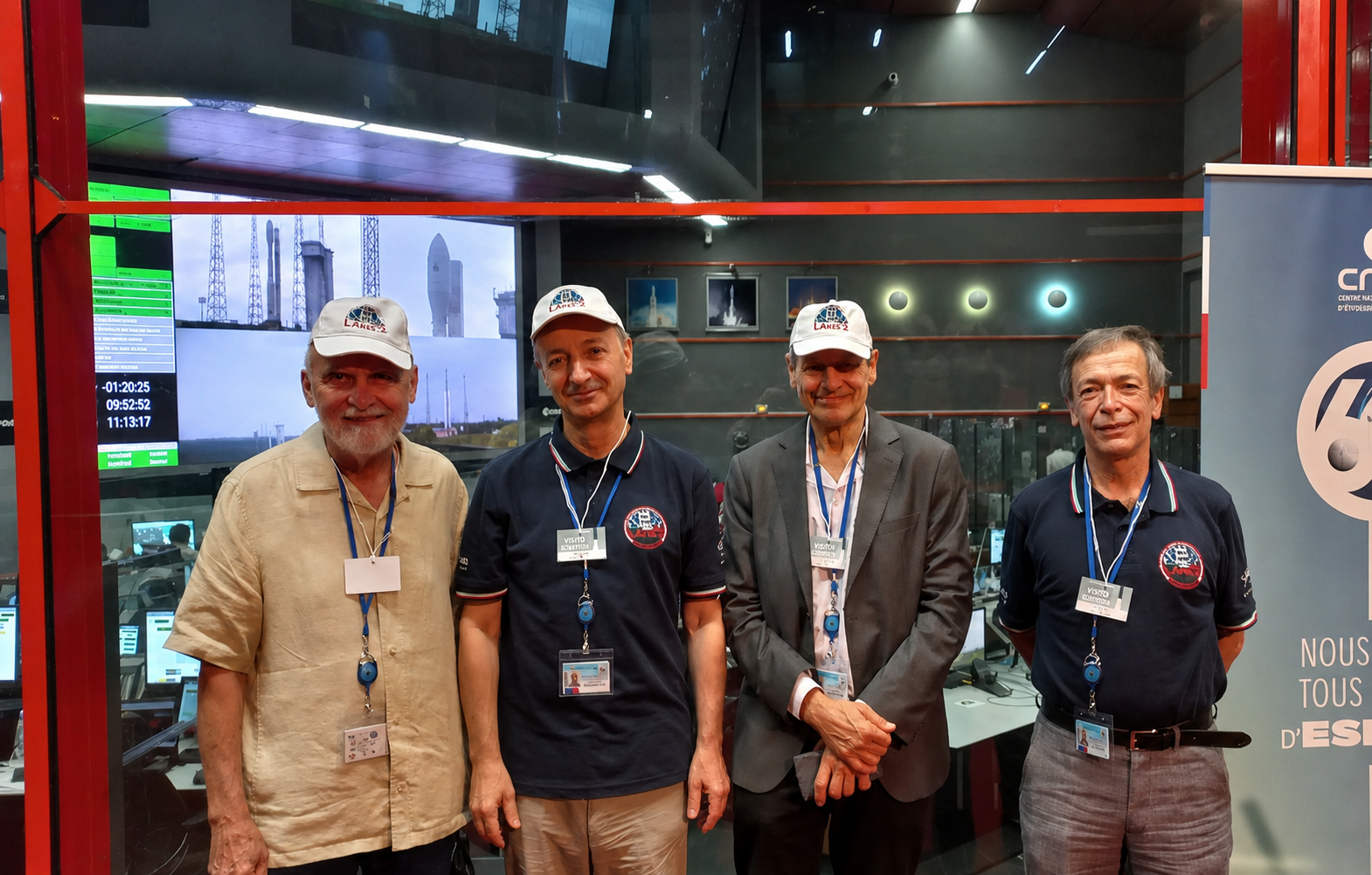

Armenian astrophysicist Professor Vahagn “Vahe” Gurzadyan has co-authored a landmark study in Nature that measures one of the strangest predictions of Albert Einstein’s general theory of relativity with the greatest precision yet achieved. Earth, the theory holds, does not simply sit in spacetime: as it spins, it drags spacetime around with it, like a spoon turning in honey. Einstein predicted that twist a century ago.
The paper — “LARES-2 satellite measures frame-dragging effect around the Earth,” published on July 8, 2026 in Nature (vol. 655, pp. 332–335) — now reports it with an uncertainty of one part in a thousand, ten times sharper than any previous measurement in the Solar System.
Professor Gurzadyan heads the Center for Cosmology and Astrophysics at the A.I. Alikhanyan National Science Laboratory (Yerevan Physics Institute) and works with Yerevan State University. Among his co-authors is Sir Roger Penrose, the Oxford mathematician awarded the 2020 Nobel Prize in Physics and a long-standing collaborator. The study was led by Ignazio Ciufolini of Sapienza University of Rome, who heads the LARES mission.
What Was Measured
Frame-dragging, or the Lense–Thirring effect, is the twisting of spacetime by a rotating mass. A spinning body such as Earth does not merely curve spacetime but winds it up, carrying nearby space slightly around with the spin. The effect is minute at Earth’s scale, which is what makes it such a demanding test of the theory.
How They Did It
The measurement rests on LARES-2 (Laser Relativity Satellite 2), a 295-kilogram nickel-alloy sphere, 42 centimeters across, covered in 303 mirrored reflectors. Its extremely low surface-to-mass ratio makes it almost immune to the atmospheric drag and radiation pressure that push lighter satellites off course. It carries no instruments and no moving parts — the sphere itself is the instrument: ground stations fire lasers at it and time the return pulse, fixing its position to millimeter accuracy.
LARES-2 launched on July 13, 2022 from French Guiana, on the maiden flight of the European Space Agency’s Vega-C rocket, as the primary payload of an Italian Space Agency (ASI) mission. It orbits at roughly 5,900 kilometers, above the traces of atmosphere that would perturb its path.
Its orbit was designed as a mirror image of NASA’s older LAGEOS satellite — same shape, opposite tilt. Combined with data from the GRACE satellites, the two orbits cancel out the distortions caused by Earth’s uneven gravity field, leaving frame-dragging as the residual signal. In effect, the satellite’s entire orbit works as a single gyroscope.
“We improved by a factor more than 10 the measurement of frame-dragging — and in physics that’s a lot,” Ciufolini told Scientific American. “This measurement helped us to put validity limits on alternative theories of gravity.”
Daniel Holz, a University of Chicago astrophysicist not involved in the work, compared the result to NASA’s $750-million Gravity Probe B, launched in 2004 to hunt for the same effect: “This thing is 100 times better, and cost a lot less, because they’re treating the entire orbit of the satellite as a gyroscope.”
Why It Matters
Several alternative theories of gravity predict a frame-dragging strength different from general relativity’s. The new precision constrains them sharply, including scalar–tensor models such as Chern–Simons gravity, invoked to explain dark energy.
The measurement was made in Earth’s comparatively weak gravitational field. “The work presented here is a more pristine measurement,” said Paul Lasky, a Monash University astrophysicist not involved in the study, “albeit one that does not probe regimes of stronger gravity where any deviation from general relativity would be more likely to show up.”
There is a payoff for geophysics too. To isolate the relativistic signal, the team tracked how the Sun’s and Moon’s tidal pull nudges the satellites — in particular a lunisolar tide known as K1 — for three years, placing new limits on its strength and improving models of Earth’s tides and gravity field.
The Armenian Contribution
Gurzadyan’s role in the mission is long-standing. He co-authored, with Ciufolini, Richard Matzner and Penrose, the 2017 European Physical Journal C paper that set out the case and orbital design for LARES-2, nearly a decade before the data arrived. The Alikhanyan National Science Laboratory participates in the international LARES collaboration alongside ASI, ESA and other institutions.
International Coverage
Scientific American reported the result as a best-yet measurement and “another feather in Einstein’s cap.” The study has also been covered by Ars Technica, Italy’s Rai Radio 3 and MeteoWeb, Russia’s TASS and other outlets.
It is the second high-profile publication involving Gurzadyan in under a year. In September 2025, npj Heritage Science published a study he co-authored with archaeologist Arsen Bobokhyan on Armenia’s vishapakars, the “dragon stones” of the Armenian Highlands — a statistical analysis of 115 monuments that linked them to a prehistoric water cult and drew wide international coverage.