
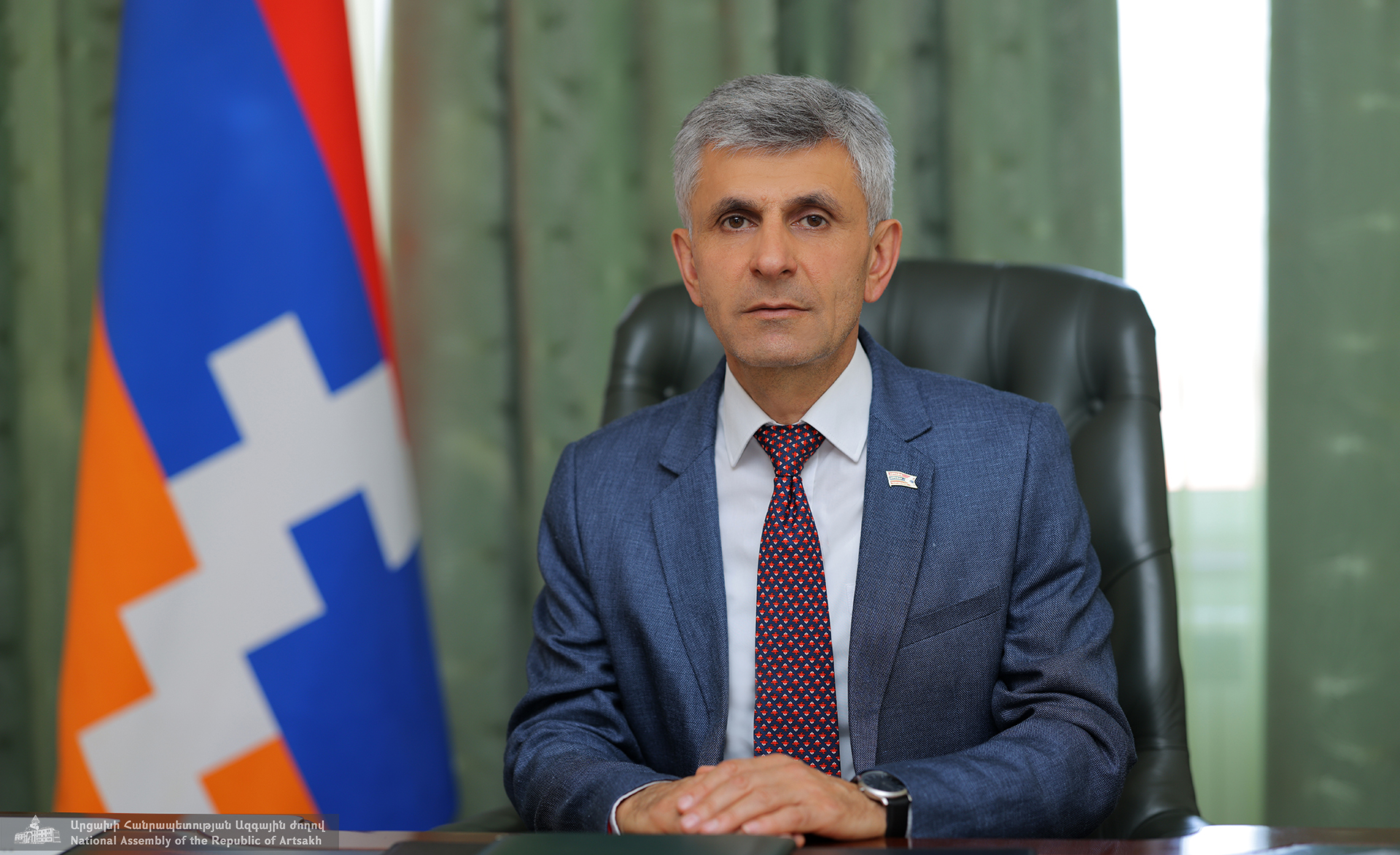

Former Artsakh National Assembly Speaker Davit Ishkhanyan, sentenced to life imprisonment by an Azerbaijani military court, issued an audio message on May 27 from his prison cell in Baku accusing Armenia’s own government of standing in the way of his and other captives’ return, saying Azerbaijani officials told the prisoners more than a year ago that they would be held “as long as the Armenian authorities want,” a claim he once dismissed and now believes.
The message, relayed to his family by phone and posted online, came as preliminary hearings on the prisoners’ appeals opened at the Baku Court of Appeal. Ishkhanyan said the defense had appealed the February 5 verdict and that the first full hearing was scheduled for June 2, describing the appeal as a continuation of a process he characterized as fully controlled, a prolonged proceeding adjusted to political processes.
The heart of his message, however, was an accusation aimed not at Baku but at Yerevan. Ishkhanyan said that during interactions in early 2024, individuals involved in the process had suggested that the continued detention of the former Artsakh (Nagorno-Karabakh) leaders depended on the will of the Armenian authorities, telling them: “You are here for as long as the Armenian authorities want you to be here.”
At the time, he said, the prisoners did not take it seriously, unable to believe their own state would not want them home. “At first we did not pay attention to it, we were surprised, how could that be possible, how could our own national authorities not want us to return immediately,” he said. “But from today’s perspective everything is already clear and understandable, that unfortunately it is so.” He tied that conclusion to the political climate in Armenia ahead of the June 7 parliamentary elections, pointing to what he called fresh untrue claims about the people of Artsakh coming from the highest levels of government.
Those claims have a clear referent. On May 18, during a campaign confrontation in Yerevan, Prime Minister Nikol Pashinyan turned on Artur Osipyan, leader of the Artsakh Revolutionary Party, after Osipyan raised the question of where billions in aid to Artsakh had gone. Pashinyan accused him of “plunder” and told the displaced Artsakh community to “get the hell out,” branding them “pseudo-elites.” Osipyan was detained by police the same day on suspicion of hooliganism. The episode, one of several in which Pashinyan has publicly clashed with displaced Armenians from Artsakh, has fueled a perception that the government views the region’s former leadership and its people as a political liability to be managed rather than citizens to be defended.
Ishkhanyan also detailed the procedural conditions of the case, saying the defense had still not been provided with the full text of the verdict or the indictment, only excerpts, despite repeated requests, and that motions submitted by the defense, including requests for access to the complete case materials, had been rejected by the court. He said the defense had still not received the complete indictment filed in December 2024, despite what he described as a prolonged legal process, arguing that this alone undermined any possibility of a fair trial. He added that requests for open proceedings, including live online broadcasting of hearings, had also been denied, as was a motion to restrict the presence of certain Azerbaijani media outlets in court.
He described the process as lacking transparency and called it a “fiction” of an open trial, alleging it is fully censored and controlled, with public perception shaped through selective media coverage aimed at misleading both Azerbaijani society and the international community. During the hearing, he said, one of the defense lawyers had broken off during his own remarks to declare that those staging it would “be ashamed before future generations for organizing such a trial.” Ishkhanyan called the proceedings a “tragicomedy” and compared them to Franz Kafka’s The Trial.
In the same message, Ishkhanyan said he had submitted oral requests to both the Armenian and Azerbaijani ombudsmen regarding the transmission of full judgment documents to his family in Armenian and Azerbaijani, contacting Armenia’s Human Rights Defender on May 6 and handing a letter to the Azerbaijani ombudsman earlier this month, and had received no response from either.
After nearly three years in captivity, Ishkhanyan said he and the other prisoners remained unbroken. “Neither principle, nor reason, nor spirit and will have abandoned us,” he said, thanking those individuals and organizations who had called for their release and continued to believe in their innocence and demand their return to their families. He closed by marking May 28, the anniversary of the First Republic of Armenia, congratulating the Armenian people and urging unity, strength, and resilience. “Be strong,” he said. “For now, that is all.”
Ishkhanyan’s message is the latest in a string of statements from senior figures unjustly held in Baku. On May 25, former State Minister Ruben Vardanyan, marking his 58th birthday in captivity, accused the government of doing nothing in any organized way for the prisoners. Ishkhanyan’s statement, naming the betrayal outright, has now drawn the line that Vardanyan traced. Pashinyan and other officials maintain that Yerevan is doing everything it can to secure the captives’ release, and the prime minister has gone so far as to publicly blame the Armenian opposition, and the Armenian Revolutionary Federation (Dashnaktsutyun), of which Ishkhanyan is a member, for their continued imprisonment, a charge the party rejects, saying it champions only the right of Artsakh’s Armenians to return to their homeland.
Ishkhanyan is one of 19 Armenian prisoners unjustly held in Azerbaijan, seized in September 2023 when, following a nine-month blockade and a military assault on occupied Artsakh, Azerbaijan detained members of the region’s former military and political leadership in the days surrounding the ethnic cleansing that forced the entire Armenian population from their homeland. He was among five former Artsakh leaders sentenced to life imprisonment, alongside former President Arayik Harutyunyan, former Foreign Minister Davit Babayan, former Defense Army commander Levon Mnatsakanyan, and former deputy commander Davit Manukyan. Former presidents Arkadi Ghukasyan and Bako Sahakyan received 20-year terms, as did former State Minister Ruben Vardanyan, whose case was tried separately, and Amnesty International condemned the verdicts as a travesty and a mockery of justice.


