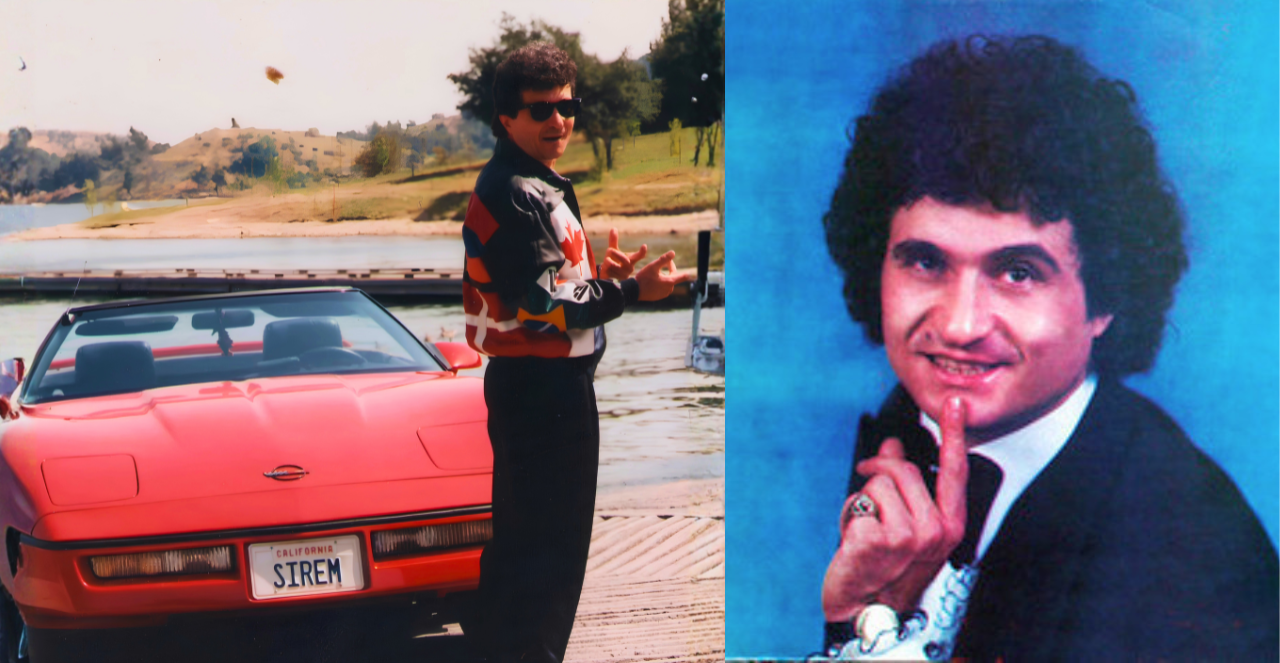

73 years ago today, on July 10, 1953, the Aleppo-born singer whose voice would carry the longing of an entire diaspora was born. Paul Baghdadlian sang in Western Armenian, sang of love and exile and homeland, and became the voice every Armenian community from Beirut to Glendale to Paris turned on when they wanted to remember who they were. His songs are still played in every Armenian household. They are still sung at every Armenian wedding. The voice endures. The soundtrack carries on.
From Aleppo To The World
Paul Baghdadlian was born Krikor Baghdadlian in Aleppo, Syria, into a family of Armenian Genocide survivors who had built a new life in the great Armenian community of Aleppo. Struggling to make ends meet as a teenager, he began performing to support himself, and released his first album, “Antzrev E Kalis,” in 1976, on the eve of the Lebanese Civil War. In 1977, he moved to Los Angeles to launch an international career, and his family eventually settled in Pasadena, California.
Within a few years, his voice would travel with the Armenian diaspora as it scattered across the world, becoming a fixed point of cultural identity in every community it reached. He recorded more than 25 studio albums, 7 live albums, and dozens of collaborations across his career, performing in concert halls and community centers from Beirut to Damascus to Aleppo to Australia to Amsterdam to Los Angeles, and earned the affection of multiple generations of Armenians for whom his songs became the language of their longing.
Paul The Prince
Before he was Paul Baghdadlian, he was Paul the Prince. In the early 1970s in Beirut, the cultural capital of the Armenian Middle Eastern diaspora at the time, he performed entirely in English under that stage name. Then he heard the music of fellow Armenian diaspora singer Harout Pamboukjian, and made the decision that would define the rest of his life: he would sing in Armenian. The love songs that followed would become the foundation of his global success and the soundtrack of an entire diaspora.
The Voice Of Western Armenian
In a diaspora where Western Armenian is increasingly endangered, Baghdadlian sang almost exclusively in it. His lyrics carried the dialect of the Armenian Genocide survivors, the Armenians of Cilicia, the Armenians of Lebanon and Syria, and the Armenian quarters of Istanbul. He was, in effect, the last great popular musical voice of a language that UNESCO has now classified as endangered.
His songs spoke of the homeland in the present tense, even when his audience had never seen it. Love songs, exile songs, songs about Armenia as a place that existed in the body even when it could not be reached. For the diasporan Armenian, his music was not just entertainment. It was continuity.
A Soundtrack Of The Diaspora
There are songs every Armenian knows by heart without ever having been taught. “Mayrig Jan,” his tribute to his mother, has become a cultural artifact, played at every diaspora gathering where mothers are honored. “Siretzi Yes Megin,” “Sev Acher,” “Sirem,” “Naz Aghchig,” and dozens of others carry the same weight.
His voice has played at engagements, weddings, baptisms, and funerals from Beirut to Buenos Aires to Boston for nearly five decades. It is impossible to grow up Armenian in the diaspora and not know him.
A Voice That Carries Forward
Paul Baghdadlian passed away on June 28, 2011, in Glendale, California, at the age of 57, after a long battle with lung cancer, just 12 days short of his 58th birthday. He died in the heart of the Armenian-American community he had called home for 34 years, and was survived by his wife, his children, and a global diaspora that had taken his songs as its own.
Today, on what would have been his 73rd birthday, his music is still pressed into every Armenian wedding playlist. Still played in every Armenian household kitchen. Still sung by Armenian grandmothers teaching their grandchildren the words of a homeland they have never seen.
The man was born 73 years ago today. The voice still carries.