
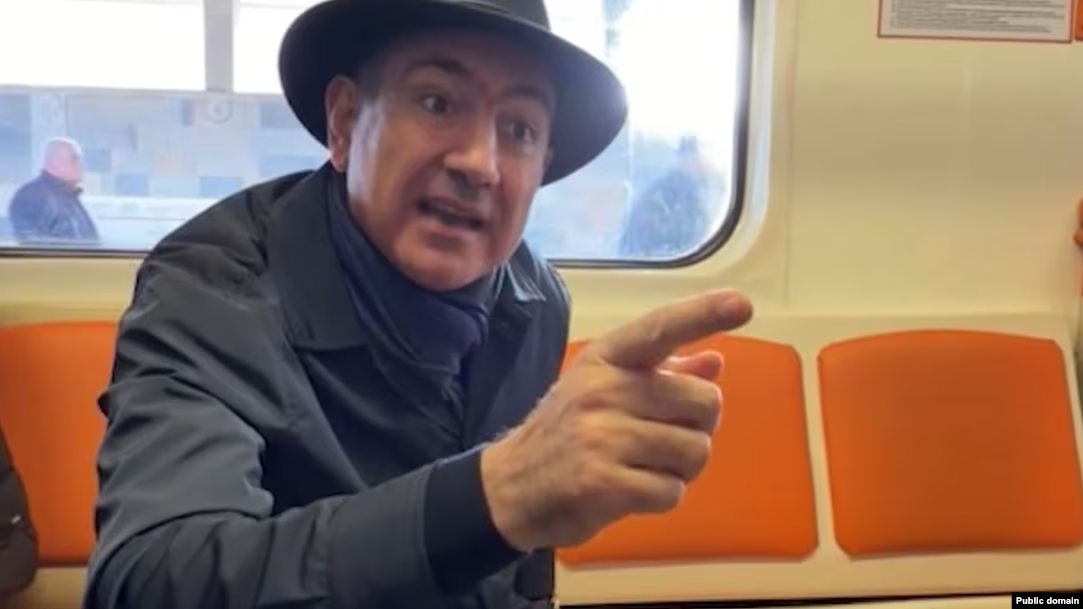

16 Armenian civil society organizations have condemned Prime Minister Nikol Pashinyan over remarks and conduct during a live-streamed March 22 campaign event in the Yerevan Metro involving a woman forcibly displaced from Artsakh and her young son, calling his behavior “intolerant” and “unacceptable,” warning that it fueled renewed hostility toward displaced Artsakh Armenians ahead of Armenia’s June parliamentary elections, and urging authorities to refrain from divisive rhetoric and uphold human rights protections.
The incident took place during one of the weekly campaign outings staged by Pashinyan and his political allies in the run-up to the elections. During the metro ride, Pashinyan approached a woman traveling with her child and offered them a badge depicting the map of the Republic of Armenia. According to the statement, the woman, later identified by other outlets as 36-year-old Armine Mosiyan, declined, saying she was from Artsakh and identified with a different map. Other reports said she also refused to allow him to give the badge to her young son.
Civil society groups say the exchange escalated when the prime minister raised his voice, gestured at the woman in a reprimanding manner, and responded in an accusatory tone. When the woman asked him not to speak that way, Pashinyan reportedly insisted he would continue, reproached her by saying that millions from Armenia’s state budget had been spent to sustain Armenians in Artsakh, and added: “Next time, you runaways, don’t try to say that I gave away Karabakh.”
In a joint statement issued on March 23, the signatories said the incident violated standards expected of a public official, reflected a breach of public ethics, and amounted to “hate speech” directed at a vulnerable and forcibly displaced population.
They further raised concerns about the continuation of filming despite the woman’s request not to be recorded together with her child, even after she indicated that she did not want to continue the conversation. The statement said other representatives of the ruling party, along with members of the prime minister’s security detail, were present during the incident. Civil society groups argued that, because the prime minister is always perceived as acting in his official capacity and embodying public authority, such conduct could be assessed as “psychological violence” against the woman.
The organizations said the presence of the child made the exchange especially troubling, arguing that he was exposed to inappropriate behavior toward his mother and directly involved in a political campaign. They said such incidents shape future generations’ perceptions of power, public speech, and interpersonal relations, while sending a broader signal that “legitimizes violence and polarization,” particularly during the pre-election period.
Although Pashinyan later issued an apology, the groups say the incident led to targeting against displaced Artsakh Armenians, particularly on social media. Other reporting said Pashinyan apologized to the woman and her son, cited “heightened emotion,” acknowledged “inappropriate remarks, gesturing and facial expression,” and said he wanted to meet her again for a calm conversation, including by inviting her to his office to personally apologize.
The signatories also pointed to an article published by Civic.am, a media outlet affiliated with the ruling Civil Contract party, which they say contributed to targeting and discrediting the woman.
The statement notes that such rhetoric is not isolated, citing similar language by public officials, including National Assembly Speaker Alen Simonyan. Civil society representatives said this pattern of hate speech, targeting, and offensive rhetoric toward Armenians forcibly displaced from Artsakh is deeply alarming because it undermines social cohesion and results in the “re-victimization” of a population already affected by forced displacement.
The organizations further warned that intolerance and hate speech against displaced Artsakh Armenians, especially on social media, constitute a serious and ongoing problem. They argued that effective measures are not being taken to address it and that such rhetoric is, in some cases, being shaped and encouraged by representatives of public authority. They also noted that public speech containing hate, discrimination, intolerance, or hostility may, depending on intent, contain elements of a criminal offense.
The organizations also reiterated their position that the Armenian population of Artsakh was subjected to ethnic cleansing and forced displacement by Azerbaijan as part of a deliberate state policy implemented through a broader strategy aimed at removing both the ethnic Armenian population and the historical-cultural Armenian presence from Artsakh. They said that policy was accompanied by prolonged and grave violations of the rights and freedoms of the population of Artsakh, as well as serious war crimes.
According to the statement, the ongoing policy of intimidation against the population of Artsakh, the prolonged blockade, and Azerbaijan’s September 19, 2023 military offensive marked the culmination of that policy, making safe and dignified life in Artsakh impossible and resulting in mass forced displacement. The groups also highlighted ongoing violations in the territory, including what they described as the erasure of Armenian cultural and historical presence through the planned or already executed destruction of Armenian cultural monuments, churches, cemeteries, and residential areas.
In light of these developments, the signatories called on Armenian authorities, and in particular Prime Minister Pashinyan, to refrain from using rhetoric that spreads hatred, intolerance, discrimination, or insult, including through social media and affiliated media outlets; ensure accountability for individuals who express and disseminate hate speech against forcibly displaced persons from Artsakh; exercise restraint in public speech and adhere to the ethical standards and rules of conduct expected of public officials; ensure that public officials and media outlets moderate hate speech in posts and comments on their social media platforms; and more broadly guarantee respect for human rights, the implementation of the rule of law in the Republic of Armenia, and the protection of the right to privacy.
The statement was signed by 16 civil society organizations: Protection of Rights Without Borders NGO, New Justice Culture NGO, Armenian Progressive Youth, Public Journalism Club, Yerevan Press Club, Media Diversity Institute, Regional Centre for Democracy and Security, Community Mobilisation and Support Centre NGO, Helsinki Association for Human Rights NGO, Helsinki Citizens’ Assembly Armenian Committee, Asparez Journalists’ Club, For Equal Rights NGO, Media Initiatives Centre, Ecolur Information NGO, Transparency International Anti-Corruption Centre, and Law Development and Protection Foundation.
Earlier, Armenia’s Human Rights Defender, Anahit Manasyan, also urged public officials to exercise restraint in public discourse when addressing issues affecting displaced persons and refugees. Various opposition groups in Armenia likewise condemned Pashinyan’s conduct and remarks regarding Artsakh Armenians.


