

In the world of enterprise software, the strongest products are often assumed to come from giant corporations with vast resources, global sales teams, and massive R&D budgets.
Megaladata challenges this assumption.
From Yerevan, an Armenian team has built the world’s fastest AI-ready, low-code platform for advanced analytics and Enterprise ETL – a data analytics tool that, in benchmarks, processes large datasets many times faster than some of the best-known international analytics tools.
But the story is not just about speed. For many companies, the real barrier to using data is not the lack of information; it is the cost: servers, specialists, waiting time, and the price of every new experiment.
Megaladata’s promise is simple: make large-scale data analysis faster, more accessible, and more affordable – without forcing companies to build heavy Big Data infrastructure for every analytical task.
The Cost of Processing Data
Over the last decade, companies have collected more data than ever before. Sales transactions, customer behavior, banking operations, logistics events, website logs, CRM records, ERP data, API streams – almost every business process now leaves a digital trace. In theory, this should make companies smarter. In practice, many still use only a fraction of the data they already have.
The reason is not always that the task is impossible. Often, the reason is that the task is too expensive to try. In 2025, Gartner found that over 60 percent of organizations say slow data processing directly limits their decision-making. McKinsey adds that companies that act on data in real time outperform competitors by up to 20 percent in revenue growth.
A company needing a dedicated Big Data infrastructure, several data engineers, complex cluster configuration, and weeks of work just to test a new analytical hypothesis will not experiment often. Large-scale data processing is reserved only for the most critical cases.
This creates a gap in the market.
Small datasets can be handled in Excel or simple BI tools. Extremely large datasets are handled by specialized Big Data analytics platforms. But between those two extremes sits a huge layer of real business problems, and in practice, around 99% of real business data tasks fall somewhere in between: hundreds of millions of rows, tens or hundreds of gigabytes of data, complex transformations, recurring models, and practical analytical workflows that need to be built quickly.
That “middle zone” is where many companies struggle, and where the barrier is less about technical impossibility and more about cost, complexity, and access.
Why Cost of Processing Data Matters
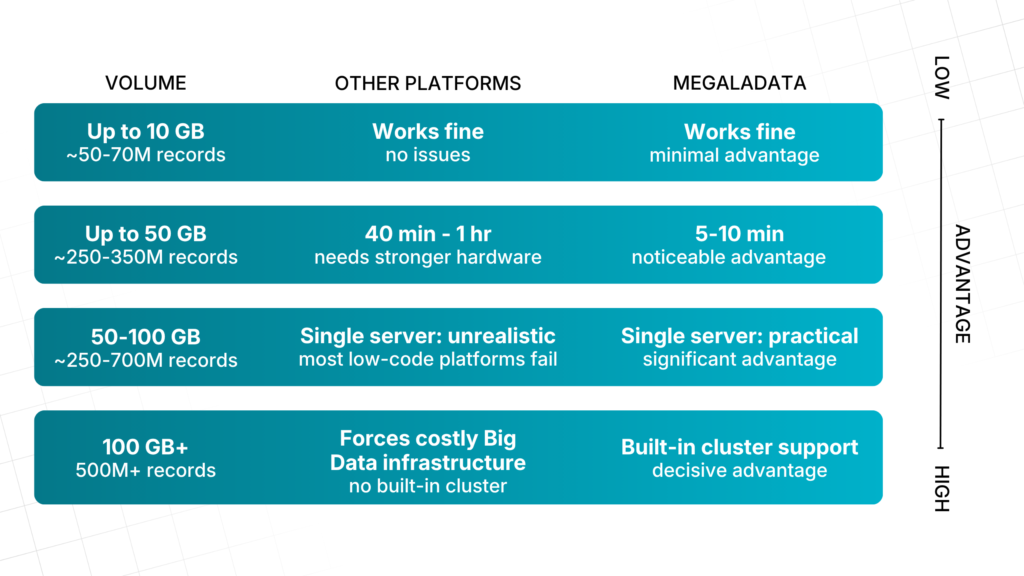
A dataset of up to 10 GB is usually not a strategic infrastructure problem. Many tools can handle it, and the difference between platforms may not be decisive.
But as data volumes grow, the economics change.
Data volume and number of records are not the same metric. A 50 GB dataset may contain very different numbers of records depending on the number of columns, field types, text length, and data structure. Still, for readers who do not work with data infrastructure every day, an approximate record range helps make the scale more concrete.
This is the key point: Megaladata is not just about making an existing task faster.It is about making more tasks economically possible.
When processing large datasets becomes cheaper, teams behave differently. They test more hypotheses. They run more workflows. They compare more options. They can analyze not only the one question that management already believes is important, but also the ten additional questions that might reveal a better opportunity. Megaladata is the perfect business analytics platform to do that.
This changes the nature of analytics. If every experiment is expensive, a business becomes conservative. It asks fewer questions. It avoids uncertain ideas. It waits until a hypothesis looks “important enough” to justify the cost. If experiments become cheaper, the business can explore. It can test, reject, improve, and adapt faster. That is why the cost of processing data is not a technical detail. It directly affects how often a company can learn.
When Speed Creates New Markets
Speed does not matter only because it saves time. In many industries, once a process becomes fast enough, entirely new tasks become possible.
A useful example is accelerated computing. NVIDIA became one of the world’s most valuable companies not because its chips saved users a few seconds, but because it made entire categories of computation faster and economically viable before many competitors could match that performance. Graphics processors changed the economics of cryptographic calculations, scientific simulations, machine learning, and later, AI model training. In each case, speed did not simply reduce waiting time. It opened new categories of work that were previously too slow or too expensive to perform at scale. A similar pattern emerged in mobile technology. Early smartphones could take photos, browse websites, and run applications, but many tasks were limited by processing power. As chips became faster, phones did not merely open the same apps more quickly. They enabled mobile video editing, real-time translation, advanced photography, augmented reality, and AI-based features that would have been unrealistic on earlier devices.
The same logic applies to data analysis – when processing becomes fast and affordable enough, companies stop avoiding questions and start asking more.
What Makes Megaladata Different
Most low-code data analytics software makes a compromise: it simplifies the interface but sacrifices performance. The user gets visual workflows, but the engine struggles as data volumes grow.
Megaladata was built around a different idea: low-code should not mean slow.
The platform allows users to build workflows visually, while the execution engine is optimized for high-performance data processing.
A business user or analyst can work with data pipelines, transformations, models, and rules in a visual environment, while the platform handles large volumes efficiently in the background.
This matters because companies do not only need tools for data scientists. They need tools for departments that understand the business problem: risk teams, sales analysts, operations managers, banking specialists, logistics experts, and product teams.
The lower the barrier to working with large data, the more people can participate in analytical decision-making.
The Benchmark Behind The Claim
Megaladata’s performance claims are supported by benchmark tests. In a standard sales analysis test, the platform processed 7.5 GB of data and 51 million records in 41 seconds on a standard workstation (AMD Ryzen 5 5600G, 32 GB RAM, NVME SSD Storage). Other platforms ranged from 218 seconds to 2005 seconds.
In a larger test with 58 GB of data and 320 million records, Megaladata completed the task in 2 minutes and 8 seconds. No other platform completed the task within two hours.
A third test simulated real production conditions. Using a realistic ETL pipeline – JSON messages from Apache Kafka, parsed, transformed, and loaded into ClickHouse – Megaladata processed 120 GB of data in 4 minutes and 2 seconds on a single server (24 CPU cores, 64 GB RAM), with no Spark cluster, no JVM tuning, and no custom code.
These results show what is possible without expensive Big Data infrastructure, and for a startup from Armenia, they carry a broader message: Megaladata competes in a field dominated by companies with large teams, long histories, and major financial resources. Yet, its benchmarks show performance differences measured not in percentages, but in tens of times.
That is a serious result.
A Real-Time Analytics Platform Built For Real Work
Megaladata is not a narrow reporting tool. It is designed as a full analytical environment.
Companies can use Megaladata for:
- ETL and data integration;
- Data cleaning and preparation;
- Advanced analytics;
- Machine learning workflows;
- AI nodes and MCP support;
- Predictive analytics tool;
- Business rules;
- Workflow automation;
The platform connects ERP systems, CRM platforms, databases, APIs, files, and other sources into a single workflow. Megaladata can be used by technical teams, but the platform is also accessible to advanced business users because of its low-code approach.
That combination is important: performance for large workloads, but accessibility for teams that do not want every analytical task to become a software development project.
Megaladata also offers a free desktop version, Megaladata Community Edition, with no time limits, no data volume caps, and no restrictions on available algorithms. For companies, students, analysts, and educational institutions, this lowers the barrier to trying professional analytics without an immediate budget decision.
From Armenia to Global Markets
Megaladata is headquartered in Yerevan and built by a team working from Armenia for international markets. The company was recently accepted into Plug and Play, one of the world’s most recognized startup accelerators.
This is not just a story about software – it is a story about Armenia’s ability to produce serious engineering for global enterprise markets, alongside its culture, history, and resilience.
Megaladata is part of that story.
As previously covered by Zartonk Media, the company is expanding globally from Yerevan, working with clients and partners across several international regions and preparing for further growth. Armenian teams are not only participating in the global technology economy, but they are also building products that challenge major international vendors.