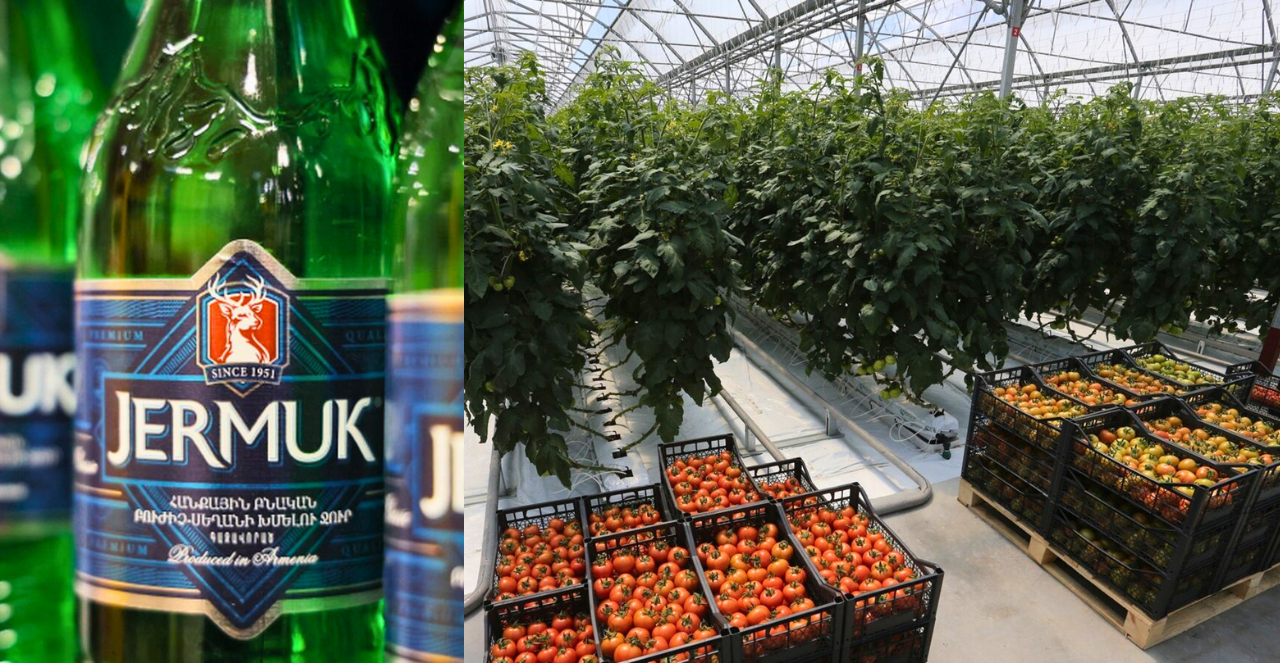

As Armenia heads into parliamentary elections on June 7, Russia has significantly expanded economic restrictions on Armenian exports, from a ban on the sale of 64.5 million bottles of Jermuk mineral water to fresh curbs on vegetables, strawberries, cut flowers, wine, and brandy, alongside a warning over discounted natural gas. Russian agencies attribute the wave of measures to sanitary and safety violations, while Armenian officials describe them as politically motivated pressure over Yerevan’s deepening engagement with the European Union.
New Agricultural Restrictions
On Thursday, Russia announced a new round of temporary restrictions on Armenian agricultural imports, tightening measures already introduced earlier in the week. The restrictions, which come into force on Saturday, apply to Armenian vegetables and strawberries exported in large quantities to the Russian market.
Russia’s agricultural watchdog, Rosselkhoznadzor, said inspections of Armenian greenhouse facilities conducted this week detected “quarantined objects” it classified as dangerous, and accused Armenian regulatory authorities of failing to address similar violations identified earlier in the year. From May 30, 2026, Russia will restrict imports of fresh tomatoes, cucumbers, peppers, greens, and strawberries from Armenia until an “appropriate algorithm” is developed to ensure product safety.
According to Rosselkhoznadzor, inspections carried out between May 21 and 27 identified multiple violations, including the presence of quarantine organisms in greenhouse complexes across Armenia. The agency said there had been 181 such cases recorded in 2026 and raised concerns about weak traceability in Armenian exports, including shipments from operators with unclear ownership.
A Widening Wave of Trade Barriers
The latest measures add to a widening list of trade barriers imposed in recent days. Russia’s consumer safety watchdog, Rospotrebnadzor, has ordered the suspension of sales of 64.5 million bottles of Jermuk mineral water nationwide, citing violations of technical regulations, according to a statement reported by TASS.
The regulator also instructed the operator of Russia’s product labeling system, Chestny Znak, to halt sales of natural carbonated medicinal table water produced by Armenia’s Jermuk Group CJSC. The ban on new shipments took effect on May 28, 2026, and will remain in place until further notice.
Rospotrebnadzor said laboratory tests found elevated levels of bicarbonates, chlorides, and sulfates exceeding permitted technical standards, arguing that the discrepancies could mislead consumers about the water’s therapeutic qualities and pose potential health risks. Additional restrictions have been imposed on cut flowers, ornamental plants, wine, and brandy produced by several Armenian companies.
Two Readings Of The Same Measures
Russian agencies have justified each of these measures on sanitary and phytosanitary grounds. Armenian officials, however, view them as politically motivated responses to Yerevan’s shifting geopolitical orientation and growing engagement with the European Union. Armenia’s Food Safety Inspectorate called the abrupt ban on Jermuk “very strange,” noting that the water has moved through international transit for 23 years without a safety problem.
The clustering of the measures coincides with intensified political rhetoric from Moscow. Russian officials have linked the restrictions to Armenia’s deepening EU engagement and to what they describe as anti-Russian policy trends in Yerevan, and Moscow has repeatedly warned that Armenia cannot simultaneously pursue EU integration while remaining in the Russian-led Eurasian Economic Union. President Vladimir Putin said on May 9 that Armenia must “choose as soon as possible” between EU integration and continued participation in the EAEU, a bloc that provides Armenian exporters with tariff-free access to the Russian market.
Energy Leverage
The pressure has extended to energy. The Russian government reportedly warned that it could suspend discounted natural gas supplies to Armenia if Yerevan continues moving closer to the European Union, a threat that underscores Armenia’s continued reliance on Russian energy and trade channels.
Russia currently supplies natural gas to Armenia at $177.50 per thousand cubic meters, while prices in Europe can reach up to $633 per thousand cubic meters.
At the same time, Russian officials have downplayed the economic impact of the restrictions on their own side. Economic Development Minister Maxim Reshetnikov said Russian markets would not be affected, citing diversified supply chains and domestic production, while stressing that Armenia remains a valued trading partner.
Yerevan’s Response
Armenian Prime Minister Nikol Pashinyan has likewise downplayed the impact, saying Armenia can resolve the issues through “constructive dialogue” and that he does not see a threat to the country’s economic development. He said he maintains a relationship of trust with both the Russian president and the Russian prime minister, noting that issues occasionally arise that require clarification, and described the current phase of Armenia-Russia relations as a transformation he views as positive.
He reaffirmed that Armenia will not leave the EAEU despite pursuing closer cooperation with the European Union, and argued that the Armenian economy is entering a phase of expansion built on diversification, new investment, and regional connectivity projects.
The Astana Summit
Armenia’s position in the bloc was addressed during a two-day sequence of events in Astana on May 28 and 29. The Eurasian Economic Forum brought together officials, business representatives, and experts from member states to discuss economic cooperation, followed on May 29 by a meeting of the Supreme Eurasian Economic Council, the EAEU’s main decision-making body.
Armenian Deputy Prime Minister Mher Grigoryan participated in the Council meeting and reaffirmed Yerevan’s commitment to continued cooperation within the EAEU framework. He said Armenia remains ready to engage in EAEU processes “on the basis of mutual respect, equal partnership, and taking into account the national interests of all member states,” adding that Armenia has repeatedly confirmed its commitment to cooperation aimed at regional economic stability.
Following the meeting, Russian presidential aide Yuri Ushakov said Armenia’s position within the union had been discussed, and that the four member states adopted a joint statement that was conveyed to the Armenian delegation led by Grigoryan.
Trade Dependence
Russia remains Armenia’s largest trading partner, accounting for more than 36 percent of its foreign trade. Armenian agricultural producers, agribusinesses, and alcohol exporters are particularly dependent on the Russian market.
According to Russian Foreign Ministry spokesperson Maria Zakharova, up to 98 percent of Armenian agricultural exports and around 80 percent of strong alcoholic beverages are directed to Russia. She dismissed Armenian assurances that relations would not deteriorate further, accusing Yerevan of aligning with Western states engaged in what Moscow describes as a “hybrid war” against Russia.
Analysts note that Armenia’s recent economic growth has also been driven in part by re-export activity linked to Western sanctions on Russia, which has increased trade flows through Armenian territory since 2022.