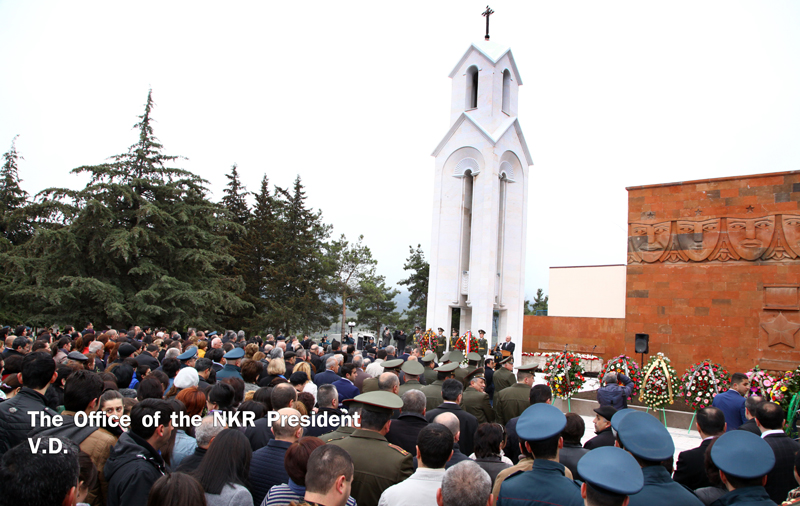

Azerbaijan has completed the destruction of the Armenian Genocide Centennial Memorial in occupied Stepanakert, including the white marble bell tower and the surrounding memorial complex, according to satellite documentation released by Caucasus Heritage Watch (CHW). The destruction was carried out in a phased operation between July 14, 2025, and April 25, 2026, in the months and days leading up to the inaugural EU-Armenia Summit and the 8th European Political Community Summit in Yerevan, where nearly 50 heads of state and government gathered this week. While the destruction has drawn condemnation from Armenian church and civil society leaders, the Armenian government has so far declined to raise the issue at the level of international discussion.
The bell tower had been erected to mark the 100th anniversary of the Armenian Genocide of 1915. It housed a reliquary containing human remains brought from Deir ez-Zor, the Syrian desert town where hundreds of thousands of Armenians perished during the death marches that defined the final stage of the genocide. For Armenians worldwide, Deir ez-Zor is not a place name. It is a wound. The bell tower was a place of remembrance, prayer, and pilgrimage for the descendants of those who survived.
Armenia’s Response
Responses within Armenia have reflected a cautious official line. On May 5, as European leaders gathered in Yerevan, Hasmik Hakobyan, a member of Prime Minister Nikol Pashinyan’s Civil Contract party, said that relations with Azerbaijan remain among Armenia’s most important priorities and should focus on a shared agenda, including delimitation, unblocking of communications, and advancing the peace process.
Commenting on the destruction of Armenian Christian heritage sites in Artsakh, Hakobyan stated that there is both historical-cultural heritage and newer structures in Artsakh, which represent different values. Responding to concerns that even 18th-century churches have been destroyed, she said the issue has been raised on various platforms, including international organizations.
Hakobyan’s framing closely tracks the position of Azerbaijan’s government-affiliated Caucasus Muslims Board, which argued in a communiqué dated April 27, 2026, that the demolition of the Holy Mother of God Cathedral and Saint Jacob church “cannot be distorted in any way as the destruction of religious or cultural heritage” because the structures had been built in recent decades. The Board described the churches as illegally constructed during what it called the period of Armenian occupation. Armenian Prime Minister Nikol Pashinyan, speaking to reporters in late April, said that “taking into account our previous experience,” he did not consider it appropriate to bring the issue to the level of international discussion. “We need to be careful about these topics, especially now, because such topics are a double-edged sword,” he said.
The Ombudsman’s Warning
Hovik Avanesov, Cultural Heritage Ombudsman of Artsakh and Vice President of the Azgayin (National) Cultural-Historical NGO, has offered a sharply different reading. Avanesov said the destruction of the memorial cannot be treated as an isolated incident. “The complete eradication of the memorial dedicated to the Centennial of the Armenian Genocide, located within the Stepanakert Memorial Complex, cannot be interpreted as an isolated incident,” Avanesov said in an urgent statement. “It clearly aligns with a broader process of systematic destruction of cultural heritage and the erasure of historical memory.”
Avanesov emphasized that the satellite chronology itself is evidence of intent. “This chronological data attests not to accidental damage, but to a deliberate and phased operation aimed at the total cleansing of the area of any traces of Armenian presence.” He further described the destruction as carrying clear political and ideological purpose: “It aims to reshape the historical narrative of the territory by erasing evidence of Armenian presence and creating a blank historical space. This is a classic example of cultural genocide, where not only are people destroyed, but also their memory, culture, and the material evidence of their existence.”
The destruction of the Centennial Memorial follows a wider pattern of heritage erasure documented across occupied Stepanakert in early 2026. Caucasus Heritage Watch has confirmed the destruction of the 2019 Holy Mother of God Cathedral between March 3 and April 2, 2026, using Sentinel imagery, with subsequent high-resolution imagery published by RFE/RL. CHW also documented the destruction of the 2007 Saint Jacob church in the same period. Taken together, the demolitions form what CHW described as “a concentrated destruction of Armenian religious sites and cultural monuments across Stepanakert” that suggests “a coordinated program of heritage erasure that must stop, as per the International Court of Justice provisional measure of December 2021.”
The Diplomatic Backdrop
The timeline of the Centennial Memorial’s destruction is particularly stark in light of the diplomatic events unfolding simultaneously in Yerevan. As Azerbaijan completed the final phase of the demolition by April 25, 2026, European leaders were preparing to travel to Armenia for the European Political Community Summit on May 4 and the inaugural EU-Armenia Summit on May 5. Among the leaders who attended in person were European Commission President Ursula von der Leyen, European Council President António Costa, French President Emmanuel Macron, UK Prime Minister Keir Starmer, and Ukrainian President Volodymyr Zelenskyy. Azerbaijani President Ilham Aliyev addressed the EPC Summit on May 4 via video link from Baku rather than attending in person in Yerevan, using the platform to justify the September 2023 ethnic cleansing of Artsakh and to attack European institutions for what he called their “lies and defamation” regarding Azerbaijan’s record on Armenian heritage.
According to Aliyev’s own remarks, the video format had been agreed during European Council President António Costa’s visit to Baku on March 11, 2026, where Costa and Aliyev signed a joint 15-point statement reaffirming EU-Azerbaijan strategic partnership. That visit, which made no public mention of Armenian heritage destruction or human rights concerns, took place during the same window in which Caucasus Heritage Watch was documenting the demolition of the Holy Mother of God Cathedral.
The European Parliament’s most recent resolution, adopted on April 30, 2026, four days before the EPC Summit and five days after CHW’s documentation cutoff, had explicitly called for those responsible for the destruction of Armenian cultural and religious heritage to be held accountable, and demanded renewed international pressure for a UNESCO mission to assess the affected sites. The reaction from Baku was swift. On May 1, Azerbaijan’s parliament voted to sever ties with the European Parliament entirely, while the European Union’s ambassador in Baku was summoned and handed a diplomatic note condemning the resolution as distorting facts. The destruction of the Centennial Memorial, completed within that same window, makes the Parliament’s call newly concrete.
The Calls for Action
Avanesov noted that the destruction violates several international conventions, including those adopted under the auspices of UNESCO, and that the persistent lack of accountability has emboldened the pattern. “This case demonstrates that such actions persist, often in an environment of impunity, which encourages their repetition,” he said. He called for “a clear and practical response from the international community,” addressing his statement to UNESCO, Blue Shield Armenia, and Blue Shield International.
Armenian Apostolic Church Archbishop Pargev Martirosyan has sent official appeals to the President of the United States, members of the U.S. Senate and Congress, the Pope, and international and church organizations, raising concerns over the destruction of Armenian spiritual and cultural heritage in Artsakh.
The destruction of the Centennial Memorial, the Holy Mother of God Cathedral, and Saint Jacob church, all completed in the months immediately preceding the European summits in Yerevan, marks one of the most concentrated periods of heritage destruction in occupied Artsakh since the September 2023 ethnic cleansing of the territory’s indigenous Armenian population. The demolitions were carried out as European leaders gathered in Yerevan, as Baku formally severed ties with the European Parliament over its accountability resolution, and as the Armenian government continued to decline to bring the issue to the level of international discussion. Azerbaijan’s official religious body characterized the destruction as the lawful removal of structures built during occupation. Armenia’s ruling party characterized it as a matter of competing values. Caucasus Heritage Watch characterized it as evidence of intent.