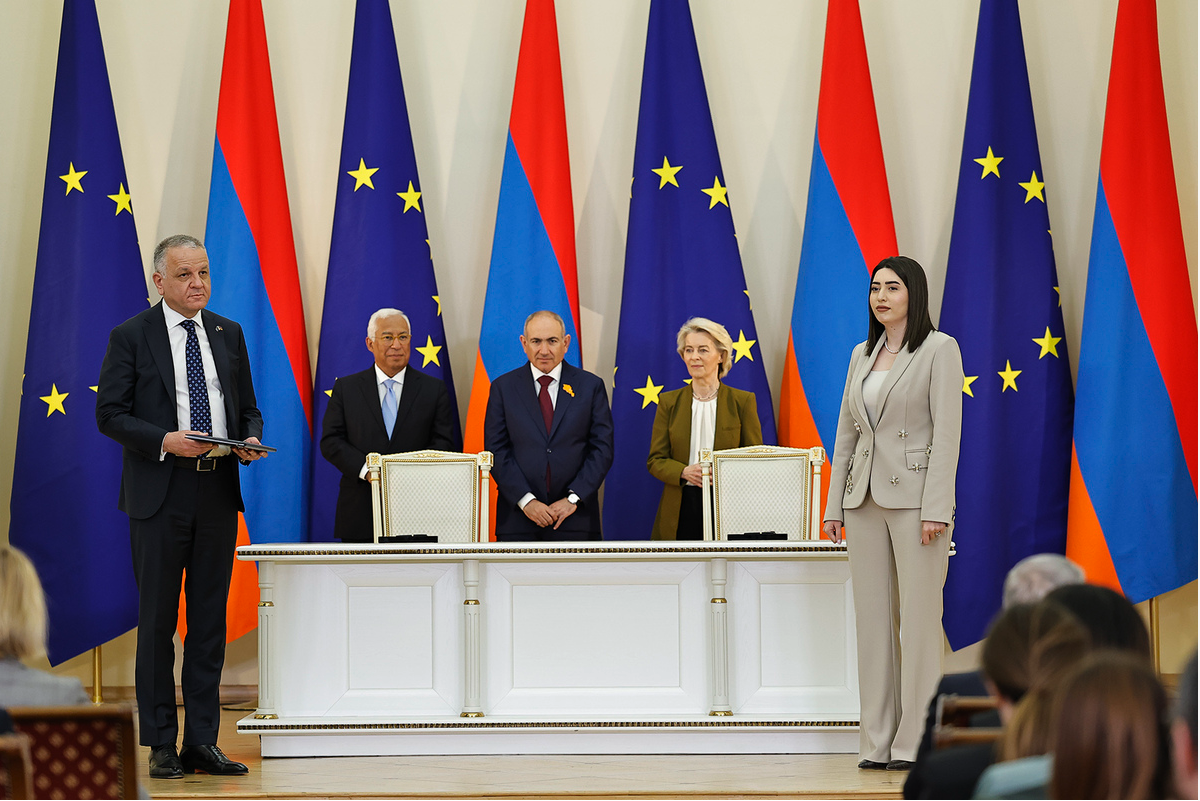
The European Union and Armenia held their first-ever bilateral summit on May 4–5 in Yerevan, marking a major step in strengthening political, economic, and security ties between the two sides.
The summit brought together Armenian Prime Minister Nikol Pashinyan, European Commission President Ursula von der Leyen, European Council President António Costa, and EU High Representative for Foreign Affairs and Security Policy Kaja Kallas.
Pashinyan hosted Costa and von der Leyen at the presidential residence, where the visit opened with an official welcoming ceremony featuring the anthems of Armenia and the European Union and a military march, followed by a private meeting and an expanded-format discussion. “It is a great honor for me to welcome you to Yerevan within the framework of the inaugural Armenia-EU summit,” Pashinyan told the delegation. “Today, with another step, we are raising the relations between Armenia and the European Union to a qualitatively new level, and for the first time in history, the Republic of Armenia and the European Union are holding a bilateral summit.”
The two sides adopted a Joint Declaration following the summit. The document explicitly recognized “the European aspirations of the Armenian people,” rooted in the March 2025 law launching the process of Armenia’s accession to the European Union, and reaffirmed that “Armenia’s future should be determined freely and democratically by its citizens.” The declaration also reiterated the EU’s commitment to deepening relations with Armenia and supporting the country’s sovereignty, resilience, and comprehensive reform agenda.
At a press conference following the summit, von der Leyen said the meeting was “more timely than ever,” calling it a chance to elevate EU-Armenia relations to a new level amid a rapidly changing global context. She said Armenia has long been part of the broader European family, pointing to the 2018 Velvet Revolution as a demonstration of the country’s commitment to “European values — democracy, rule of law, and fundamental rights.”
European Council President António Costa, speaking alongside von der Leyen, described the summit as a “historic milestone” in the deepening of EU-Armenia relations and credited Pashinyan personally with reshaping the country’s trajectory. “You didn’t change the place of Armenia, but you changed radically the conditions of your country,” Costa said, commending Pashinyan’s vision for a “democratic, resilient and prosperous Armenia.” He pointed to Azerbaijani President Ilham Aliyev’s video participation in the EPC Summit a day earlier as evidence of “the new atmosphere” between Armenia and Azerbaijan, and emphasized that “a stable and prosperous South Caucasus is the bedrock of Armenia’s future.” Costa also positioned Armenia as “a key pillar” in the EU’s relationship with the South Caucasus and the broader corridor connecting Europe to the Caspian Sea and Central Asia.
Both leaders framed the summit within a broader geopolitical shift. Von der Leyen noted that the shortest route from Europe to the Caspian Sea and Central Asia passes through Armenia, a corridor long closed by war but now reopening thanks to what she called Armenia’s “courageous choice in favor of peace.” She placed Armenia’s trajectory within the wider regional picture: “From Ukraine to Iran, the entire region is being shaken by wars, while here in the South Caucasus there is a different story,” she said. “In an era of new conflicts, you are healing old wounds, and we want to support you by showing that peace leads to prosperity.” Pashinyan echoed the framing from the Armenian side, calling the shift in how Armenia’s geographical position is described “a truly historic change.” He recalled that Armenia had long been viewed as a country in a difficult region, surrounded by hostile neighbors, but said that perception has now flipped: “the description of Armenia’s geographical position is no longer that we are in a problematic environment, but that the shortest route connecting the East and the West passes through the Republic of Armenia.” Pashinyan also described the EU’s call for European businesses to invest in Armenia as “of historical significance,” noting that Armenia had long been considered a risk zone for investment and that “we have never before heard such a call or message from many of our international partners.”
Connectivity As The Central Pillar
Von der Leyen identified connectivity as the first and central area of cooperation, highlighting the newly signed EU-Armenia Connectivity Partnership. The partnership document was signed by Deputy Minister of Foreign Affairs Vahan Kostanyan and Adrienn Kiraly, Director for Eastern Neighbourhood and Turkey at the European Commission’s Directorate-General for Enlargement and Neighbourhood Policy.
She said Armenia’s “Crossroads of Peace” initiative could transform the country into a regional transport hub linking Europe, the South Caucasus, and Central Asia. The EU, she added, is ready to support the upgrading of border crossing points once regional borders are opened and to help Armenia integrate into key transport corridors such as the Trans-Caspian Transport Corridor.
To institutionalize the partnership, two new high-level dialogues were launched at the summit: a High-Level Dialogue on Connectivity and a High-Level Dialogue on Transport, both aimed at improving mobility, competitiveness, and regional integration.
Energy Cooperation And Green Transition
The second pillar of cooperation focuses on energy. Von der Leyen highlighted Armenia’s growing solar energy sector, calling it an important step in diversifying the country’s energy mix amid global energy challenges.
She announced that the EU will support Armenia’s energy security, including a €25 million investment in the Caucasus electricity network for energy storage infrastructure to strengthen supply stability.
Pashinyan said the partnership could fundamentally reshape Armenia’s energy position, noting that the country has historically been considered energy-dependent but possesses what he called “virtually unlimited” solar potential, with regions experiencing more than 300 sunny days a year. “What we lack are storage facilities, and I thank our EU partners for their willingness to support us in developing energy storage systems in Armenia,” he said. He added that the cooperation also extends to green hydrogen production technologies and water-based storage systems, and expressed confidence that with the right architecture, Armenia could shift from being an energy-dependent country to an energy exporter.
Digital Innovation And Artificial Intelligence
The third priority area is information technology and innovation. Von der Leyen praised Armenia’s “impressive ecosystem in artificial intelligence and engineering,” and announced that the EU has signed letters of intent with six key Armenian companies and foundations: Amber Capital, an investment management firm; Firebird AI, an artificial intelligence and high-performance computing infrastructure company; Synopsys Armenia, an electronics and semiconductor developer; TUMO, the educational center for creative technologies; Creative Armenia, a foundation supporting artists and creative projects; and AGBU, the Armenian General Benevolent Union.
The EU also launched a Call for Expressions of Interest, inviting companies registered in the EU, the European Economic Area, and Armenia to develop strategic investment projects in Armenia. Von der Leyen encouraged European companies to invest in Armenia, citing strong human capital and growing opportunities in the sector.
Firebird AI To Build Major AI Computing Center And Gigawatt-Scale Energy Storage
Among the most significant private-sector commitments announced at the summit was a strategic cooperation declaration signed between the European Commission and Firebird AI, formalizing a partnership in Armenia’s digital and energy infrastructure. The document was signed in Yerevan by Adrienn Kiraly, Director General of the European Commission’s Directorate-General for Enlargement and the Eastern Neighbourhood, and Aleksandr Yesayan, co-founder of Firebird AI.
Under the agreement, Firebird AI announced plans to establish one of the world’s largest artificial intelligence computing centers in Armenia, built on Nvidia high-performance graphics processing units. The project is designed to position Armenia as a global leader in AI data center capacity, building on the country’s existing engineering and technology ecosystem.
In parallel, the company will deploy a battery energy storage system (BESS) with a capacity of up to 1 gigawatt, which is intended to strengthen the stability of Armenia’s electrical infrastructure and accelerate the integration of renewable energy sources. The dual investment links Armenia’s emerging AI sector directly to its energy transition, with the storage system supporting both the data center’s power demands and the broader grid.
The European Commission welcomed the initiative as a significant contribution to Armenia’s energy system and to the EU-Armenia partnership, and said it would examine how to mobilize its financial instruments, particularly within the European Fund for Sustainable Development Plus (EFSD+) framework, to support the project’s implementation and alignment with EU policy.
Security, Resilience, And Hybrid Threats
On security cooperation, von der Leyen confirmed continued EU support for Armenia under the European Peace Facility, while emphasizing the need to address hybrid threats, disinformation, and foreign interference.
“Our partnership will help you withstand these threats,” she said, adding that “the only legitimate source of power in this country is the will of the Armenian people.”
The EU also announced plans to launch a new mission focused on countering foreign interference and strengthening resilience in Armenia.
Pashinyan welcomed the EU’s support on hybrid threats, thanking the bloc for its assistance in helping Armenia counter the spread of disinformation and hate speech across social networks and traditional media. He noted that all reforms achievable through political will alone have already been implemented in Armenia, and that further progress will require deeper institutional, legislative, and expert cooperation, particularly in strengthening the independence of the judiciary and addressing hybrid challenges as part of the broader reform agenda.
Visa Liberalization And Border Cooperation
Visa liberalization was described as a key priority. Von der Leyen welcomed Armenia’s progress, noting that the first implementation report was “very positive,” and she confirmed continued EU confidence in achieving full liberalization. The European Commission’s progress report on the implementation of the Visa Liberalization Action Plan was formally handed by EU Ambassador to Armenia Vassilis Maragos to Interior Minister Arpine Sargsyan, who serves as Armenia’s Chief Negotiator for Visa Liberalization with the EU. The report includes recommendations aimed at achieving full visa liberalization between Armenia and the EU once all conditions are met.
In parallel, a working arrangement on operational cooperation in border management was initialed between Armenia’s Ministry of Internal Affairs and the European Border and Coast Guard Agency (Frontex). The document was signed by Sargsyan and Frontex Executive Director Hans Leijtens.
Economic Support And Social Resilience
Von der Leyen also highlighted the EU’s long-term economic support through the €270 million Resilience and Growth Plan for Armenia, launched in 2024. She said the program is expected to mobilize an additional €2.5 billion in investments.
The EU is supporting Armenian businesses in accessing new markets, investing in skills and employment, strengthening demining efforts, and providing assistance to people displaced from Artsakh, including housing support.
Defense Cooperation And EU Presence In Armenia
On defense cooperation, Armenia’s Armed Forces have begun receiving support under the European Peace Facility, with initial assistance worth €30 million.
The Armenia-EU Summit followed the 8th European Political Community Summit, held in Yerevan a day earlier, which brought together nearly 50 heads of state and government.
Together, the two events underscored Armenia’s growing role in European political and security architecture and signaled a new phase in EU-Armenia relations focused on connectivity, resilience, and long-term regional stability.