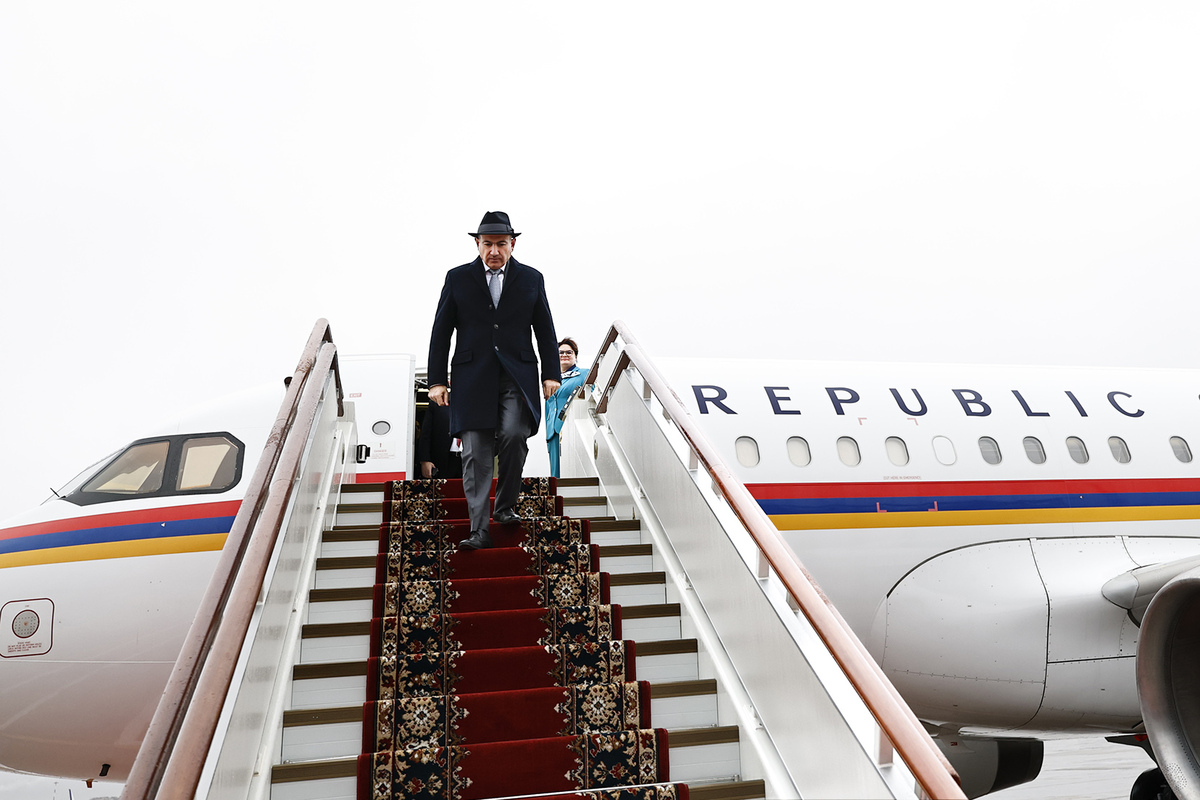

Prime Minister Nikol Pashinyan said Armenia has proposed a joint roadmap with Azerbaijan to simultaneously remove competing “return” narratives from the negotiating agenda, warning that continued debate over Artsakh and so-called “Western Azerbaijan” risks renewed war. Speaking to Armenian journalists in Hamburg, Germany, Pashinyan said he has made an “open and public proposal” to Baku to put aside both Azerbaijan’s claims and the issue of Armenians returning to Artsakh (Nagorno-Karabakh), arguing that reopening the issue would revive the Artsakh movement, undermine peace efforts, and lead to new conflict, even as Artsakh’s exiled leadership continues to insist on refugees’ right of return.
Prime Minister Nikol Pashinyan said Armenia and Azerbaijan should jointly agree to “put aside” the issue of refugee return, including Azerbaijan’s demands regarding so-called “Western Azerbaijan” and the question of Armenians returning to Artsakh. He said the proposed roadmap is intended to remove both topics from the agenda simultaneously.
“Removing this issue means, from a long-term strategic perspective, eliminating any potential conflict situation,” Pashinyan said. He argued that reopening debates about return would only revive the “Karabakh movement,” which he insists has come to an end. He also said that he had conveyed this position publicly and directly, including to displaced Artsakh Armenians, stating that a return under current conditions is “not realistic.”
“If we continue to maintain the agenda of return, the Karabakh question will remain,” he said. “Continuing the Karabakh question means new war, new casualties, and new suffering with unpredictable consequences.”
He stressed that Armenia has no preconditions for signing a normalization treaty and said constitutional amendments demanded by Baku are unnecessary. Once a peace treaty is signed, he noted, it would supersede domestic law and eliminate any possibility of territorial claims.
“Constitutional changes are Armenia’s internal matter and should not concern Baku,” he added.
Pashinyan also directly rejected the “Western Azerbaijan” terminology, stating: “There can be no Western Azerbaijan in Armenia.”
Diplomatic Context: Armenia–EU Agenda and Azerbaijan’s Reaction
Pashinyan’s remarks came amid criticism from Azerbaijan’s Foreign Ministry, which accused the Armenia–EU strategic agenda signed in Brussels on December 2 of “distorting realities” and undermining the peace process.
Baku objected in particular to language describing Armenians displaced after the 2023 Azerbaijani offensive in Artsakh as “refugees,” instead claiming they had “voluntarily migrated” and rejected reintegration. Azerbaijan also demanded the removal of what it called “harmful provisions,” including a section it said incorrectly referred to Armenian detainees held in Baku as “prisoners of war.”
On Wednesday, Armenia’s Foreign Ministry rejected all Azerbaijani allegations. Armenian Foreign Ministry spokesperson Ani Badalyan stated that the agenda reflects a deepening partnership between Armenia and the European Union based on shared values and mutual interests.
“It is evident that this, in itself, contributes to efforts aimed at further consolidating peace in the region,” Badalyan said, stressing that the document strengthens, rather than contradicts, the peace process.
Pashinyan criticized Baku for simultaneously promoting its state-backed “Western Azerbaijan” narrative, a claim that Azerbaijanis should “return” to the territory of the Republic of Armenia, while objecting to any mention of displaced Artsakh Armenians in the EU–Armenia agenda.
Pashinyan Says Claims That “Karabakh Issue Is Not Resolved” Are Saying New War Is Needed
During the same press briefing in Hamburg, Prime Minister Nikol Pashinyan addressed domestic and regional discourse suggesting that the Artsakh issue remains unresolved, noting that such rhetoric is being closely observed not only within Armenia but also by Azerbaijan. “I see headlines saying the Karabakh issue is not resolved, some discussion is taking place somewhere in Armenia, now Azerbaijanis are also seeing this,” he said, warning that framing the issue in this way risks pushing Armenia toward renewed conflict and undermining efforts to secure lasting peace.
“This issue must be resolved bilaterally, and we must give our peoples a chance to live in peace. What does it mean to say that ‘the Karabakh issue is not resolved?’” Pashinyan said. He added that critics often accuse him by saying, “You sent 7,000 young people to their deaths,” but questioned what continuing to frame the issue as unresolved would actually entail. “Well, if the Karabakh issue is not resolved, what are you proposing? Continuing the Karabakh issue means a new war, new casualties, new hardships, a new blockade, and so on, with all its unpredictable consequences,” he said.
Pashinyan stressed that those insisting the issue remains unresolved are, in effect, calling for renewed war and warned that such rhetoric is used by Azerbaijan to justify its own actions. “Those who say the Karabakh issue is not resolved are saying that Armenia must wage a new war,” he stated. “When they say there are forces in Armenia who say Armenia must wage a new war, Azerbaijan says: ‘Then we must increase the military budget, then we must adopt the ‘Western Azerbaijan’ narrative.’”
He said he had previously avoided addressing these arguments in detail but now believes clearer explanations are necessary so the public understands the consequences of such discourse. “That is, is there a need to explain in such detail? I used to avoid such explanations, even though there is a need to speak clearly, transparently about everything so that people understand what the matter is about,” he said.
He reiterated that claims suggesting the issue remains unresolved go beyond prediction and amount to advocacy for renewed conflict. “Those who say the Karabakh issue is not resolved are saying that a new war is needed. Moreover, they are not predicting it, they are saying a new war is needed,” Pashinyan said. He also addressed accusations that he had “given Karabakh” and that there were casualties, saying this reflected how Armenians had long been devoted to the idea of Artsakh, even as their understanding evolved. “That we were so devoted to that idea that we went to all lengths for Karabakh, but along the way our eyes were opened, we realized many things we did not understand before,” he said.
Reflecting more broadly, Pashinyan said Armenians must reassess the repeated cycles of tragedy the nation has endured and emphasized the need to preserve what he described as an opportunity for lasting peace. “In the end, we must realize: well, what is it that we are not doing right, that we keep going through tragedies, struggles, massacres, genocides?” he said. “Now, we, yes, we have gained the chance to change our destiny at the cost of the lives of our martyrs.” He concluded by asserting that key political issues related to peace have already been resolved, urging restraint in public discourse. “Peace is established, the Karabakh issue is resolved also, all issues are resolved also,” he said, adding that what remains is “to stay within these solutions, to avoid giving in to those provocations, and not to adopt provocative discourse.”
Baku’s Narrative Gains Institutional Support
Azerbaijan’s “Western Azerbaijan” concept has expanded significantly in recent years. State-backed structures, including the so-called Western Azerbaijan Community, promote claims that Azerbaijanis were expelled from Armenia and should be granted a “right of return.” The initiative includes conferences, a dedicated media ecosystem, and the promotion of Azerbaijani toponyms for locations inside Armenia.
Speaking last week at the 3rd international conference on “Cultural Heritage and the Right of Return: Restoring the Cultural Heritage of Azerbaijanis Displaced from Armenia as a Path to Justice, Reconciliation, and Peace,” Azerbaijani President Ilham Aliyev reiterated calls for the “right of return” of Azerbaijanis “forcibly displaced from Western Azerbaijan,” which he defined as mountainous regions within modern-day Armenia.
Aliyev accused Armenia of destroying “the rich material and intangible cultural heritage of the Azerbaijanis who lived in Western Azerbaijan, including their shrines and cemeteries,” claiming Yerevan aimed to erase “the traces of the Azerbaijani people” from its territory.
He asserted that this right of return is guaranteed under international legal instruments, including the Universal Declaration of Human Rights, the International Covenant on Civil and Political Rights, and the Convention on the Status of Refugees.
According to Soviet-era census data, around 160,000 Azerbaijanis lived in Soviet Armenia in 1979, while Armenian communities in Soviet Azerbaijan numbered nearly half a million before the outbreak of the First Artsakh War. Both populations were displaced in the late 1980s as tensions escalated around Artsakh.
Artsakh Leadership Vows to Continue Fight for Refugees’ Right to Return
Following Pashinyan’s announcement in Germany, Artsakh’s exiled leadership vowed during a Wednesday hearing to continue fighting for the displaced Artsakh Armenians’ right to return to their homeland, despite the Armenian government’s refusal to raise the issue on the international stage.
“Our main goal is to realize the rights of the people of Artsakh to return to their homeland, live there safely, and determine their political status based on self-determination,” said Ashot Danielyan, the acting Artsakh President, during hearings held in Yerevan.
The following day, Armenian authorities raided the building housing the Artsakh representation in Armenia as part of a criminal investigation. The case remains unspecified, and officials did not comment publicly, prompting immediate criticism from opposition figures and former Artsakh officials.
Artak Beglaryan, former Artsakh state minister and ombudsman, suggested that the searches were prompted by the recent parliamentary hearings.
“I believe the hearings triggered the raids,” Beglaryan told reporters. “Artsakh state institutions, including the representative office, have long faced scrutiny and pressure. The hearings provided an additional pretext for new searches,” he added.