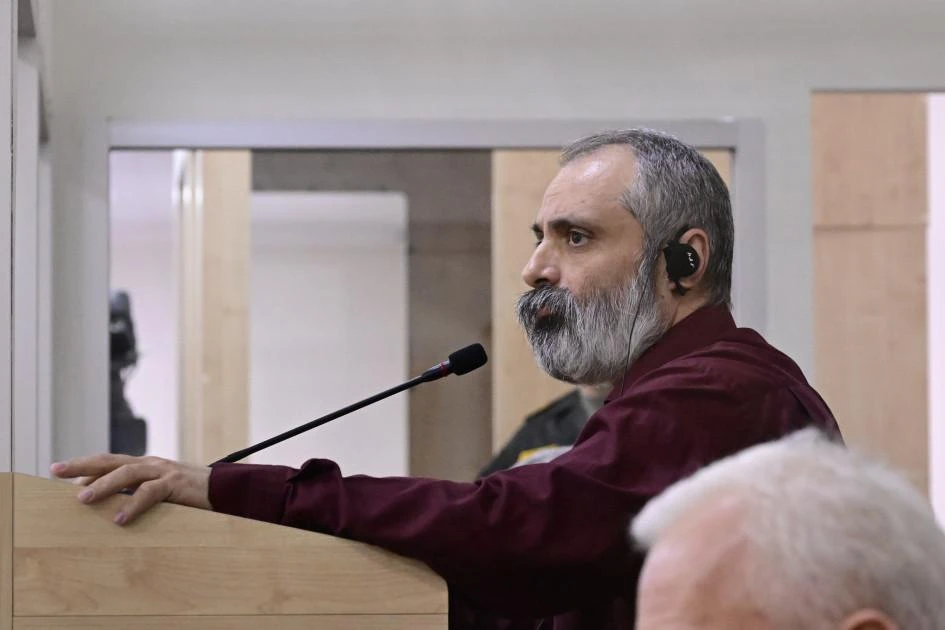

Former Foreign Minister of Artsakh (Nagorno-Karabakh) David Babayan, unjustly imprisoned in Baku and serving a life sentence, has issued an audio message through his family exposing what he called a rigged appeals process, as reports emerge that all seven of the former Artsakh leaders sentenced by Baku are planning to petition the European Court of Human Rights. Babayan revealed that the Azerbaijani court added two life-sentence articles to his verdict that were never mentioned during the entire trial, and that 99.4 percent of rulings in the first-instance court favored the prosecution.
Babayan addressed his appeal to all human rights defenders, compatriots, and people of good will around the world. The audio message was transmitted to media outlets through his family.
Babayan was sentenced to life imprisonment on February 5, 2026 by the Baku Military Court, alongside four other former Artsakh leaders. The Baku appeals court upheld the sentences approximately two weeks ago, ending the appeals stage of his case, which he described as a purely formal phase the defense participated in only to preserve the ability to petition the European Court of Human Rights.
Babayan called the appeals process “a theater, the script of which was written in advance,” pointing to a proceeding so predetermined that the court listed his old defense attorneys in the final session and refused to correct the error. He revealed that the Azerbaijani court added two life-sentence articles from the Criminal Code to his final verdict that were never raised during the trial, which he discovered only when he received the verdict summary a week after proceedings ended. In the first-instance court, 99.4 percent of rulings favored the prosecution. In the appeals court, that figure reached 100 percent. Babayan called the record-keeping “legal apartheid,” saying his statements were omitted, reduced, or distorted, and that 200 to 300 people were bused in and paid to attend the first-instance trial, while no citizens attended the appeals at all.
Babayan said his defense team changed five to six times during the trial, and that when one attorney was suddenly replaced at the start of the appeals stage, the court told him the reason was “health,” then refused his request to verify the attorney’s well-being via video call. He warned that Azerbaijan may use the health conditions of Armenian hostages held in Baku as a pretext to block their petitions to the European Court of Human Rights. “I doubt, it is understandable that they will not want me to go to international court,” he said. His message closed with defiance: “It is one thing to fight for justice, it is another thing to sit in prison for it. But know that although we are sitting in an Azerbaijani prison, we are not kneeling.”
Below is the full statement by David Babayan, conveyed through his family:
“Dear compatriots, dear friends, sisters and brothers, Armenians around the world, all our sisters and brothers of other nationalities, people of good will: You know that the ‘appeal’ phase of our so-called trial has also ended. What trial? This was a theater, the script of which was written in advance. They did not even dare to correct elementary mistakes. For example, when presenting those in attendance to the last court session, when they left those verdicts in force, they presented my defenders in the old composition, in the case when they had changed during this trial. That is, not only did they not consider it necessary to check, but they also did not dare to change the script written in advance, even to correct the mistakes that are there.
This was a purely formal phase that we had to go through in order to use it later to petition to international court.
In the court of appeal of Azerbaijan, citizens did not participate in the process, in the case when in the court of first instance, about 200-300 people were in attendance each time. Of course, they were all being brought selectively, in special buses. In addition, according to some information, they were also being well paid, but this time there was no one. One of the reasons is that these people were seeing what kind of abuses are being committed there, they were seeing the weak positions of their side, our self-defense, our persistence, the quality of that self-defense, and it is natural that all this, willingly or unwillingly, also penetrates their society.
It is very interesting that such ideas are being put into circulation that it is simply impossible to imagine it. For example, a crime committed by one person is automatically attributed to everyone. Or ideas that are completely impossible to imagine in the history of the international community. For example, they added two life [sentence] [criminal code] articles to me, which did not exist, were never mentioned during the entire trial. I saw this when a week after the trial ended, they gave us a summary of all of it. I asked them to watch our remarks, whether it was the closing statement to the court of first instance, or the main remarks of this trial, and to transmit them to their human rights defender in a video version, but they refused. They say that it is an ‘open trial,’ but they refuse to provide all of that even to their human rights defender.
One of the interesting phenomena is that the defense attorneys have also changed. 5 to 6 defense attorneys have changed during this period. One changed right at the start of the trial in the Court of Appeals. I tried to find out what the reason was; they said it was health. In court, during the trial, I said, ‘Contact them via video call; I want to find out personally how they are.’ Of course, they got perplexed, they didn’t connect to the defense attorney, they said that there was no risk to their lives.
Of course, they wouldn’t let us continue the remark at every moment, they would interrupt us, they would disrupt us. We need all this to submit in international court.
One of the interesting developments is that one of the defense attorneys here has stated that they don’t want the case to reach international court, because more than 95 percent of the accusations are fabricated and there is no evidence. That’s really the case. Let me bring a specific example. In particular, I was sentenced to life imprisonment under an article [of the Azerbaijani criminal code] according to which I was trying to overthrow the power in Azerbaijan, overthrow the Azerbaijani constitution, etc. I posed a question: ‘Is there any evidence that, while I was here, I participated in the struggle for your power? If so, then I must have had supporters, cells of some organization throughout your country.’ Of course, there is no answer.
In addition, all our appeals in court were 100 percent granted in favor of the prosecution. In the court of first instance, 99.4 percent were granted in favor of the prosecution. I expressed my gratitude for such quality and quantity of errors, because this is very important for us, it will also contribute to the restoration of justice, because we will submit all this in international court.
It is quite noteworthy that instead of evidence, they also use substitutes: lies, forgeries, toasts, their different political approaches, slogans, etc. Sometimes we have tried to see the notes, how all this is recorded in their documents, we have seen that what we said is not included at all, or at best they include it in a severely reduced or distorted form. This is nothing more than legal apartheid.
What can be said when it is officially announced that it is necessary to expand the scope of unintentional killings so that everyone can be accused of murders?
Of course, I doubt, it is understandable that they will not want me to go to international court. I am not the only one with health problems. A number of our friends really have serious health problems. Of course, it is to be expected to some extent, because we are fighting for justice and freedom, for human rights in this evil world, and it does not just happen.
It is one thing to fight for justice, it is another thing to sit in prison for it. But know that although we are sitting in an Azerbaijani prison, we are not kneeling, and let everyone know this. Everything else is normal, be strong, dear compatriots, people of good will. Difficult events still await our homeland.”
Babayan’s message is the latest in a series of statements from Armenian hostages held in Baku publicly exposing what they have described as a rigged Azerbaijani judicial process. In July, former Artsakh State Minister Ruben Vardanyan’s lawyer Siranush Sahakyan filed an application with the European Court of Human Rights on his behalf, revealing that the Baku Military Court had convicted Vardanyan on findings that included his supposed membership in an Artsakh “criminal community” in December 2020, when he was in fact residing in Moscow. In May, both Vardanyan and former parliament speaker Davit Ishkhanyan issued separate statements accusing the Armenian government of doing nothing in any organized way for the 19 Armenian hostages Azerbaijan continues to hold. Reports indicate that all seven of the other former Artsakh leaders sentenced by Baku are also preparing ECHR petitions, which would bring the total to eight Armenian hostages seeking international judicial review of their cases.
Babayan is one of five former Artsakh leaders serving life sentences from the February 5 verdict, alongside former President Arayik Harutyunyan, former National Assembly Speaker Davit Ishkhanyan, former Defense Army commander Levon Mnatsakanyan, and former deputy commander Davit Manukyan. Former presidents Arkadi Ghukasyan and Bako Sahakyan received 20-year terms, as did former State Minister Ruben Vardanyan, whose case was tried separately and concluded with his sentencing on February 17. Other officials and civilians received prison terms ranging from 15 to 19 years. Amnesty International condemned the verdicts as a travesty and a mockery of justice. The International Committee of the Red Cross, the last independent body with access to the prisoners, was expelled from Azerbaijan in September 2025.