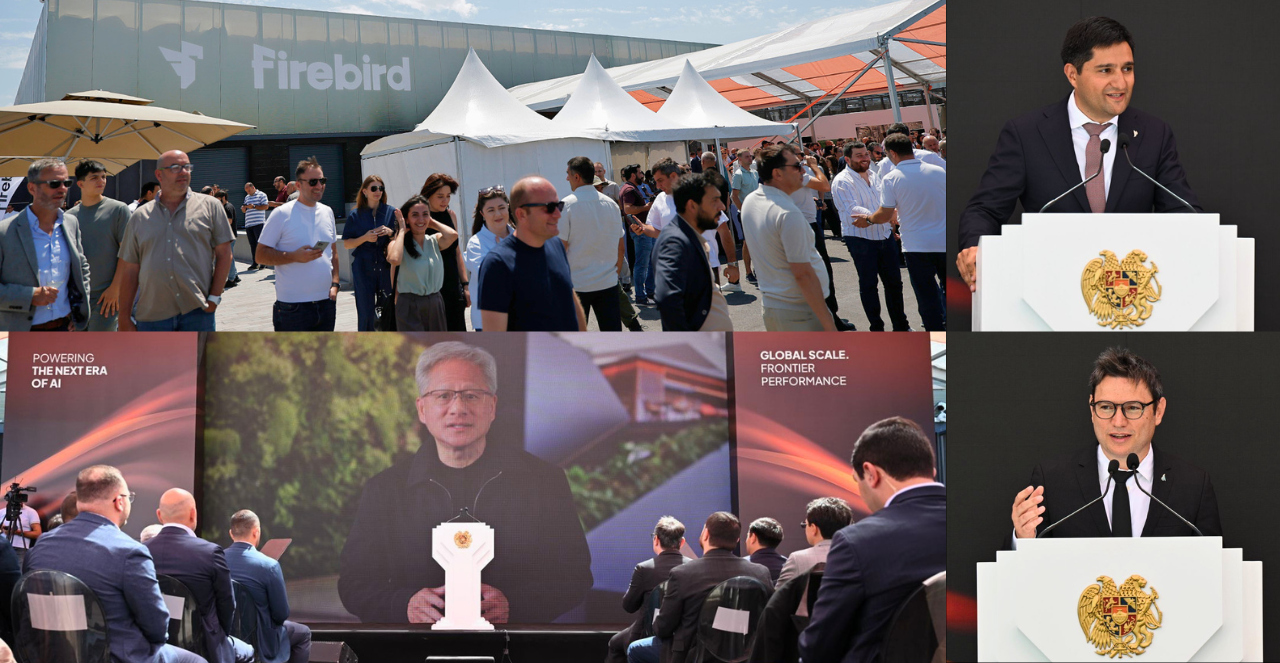

Firebird officially opened the first phase of its flagship AI Factory in Armenia’s Hrazdan on August 8, the largest artificial intelligence computing factory in the CIS region. The part that opened is worth more than $500 million, and total investment will grow to roughly $5 billion as the project builds out. It is the anchor of a megaproject that already reaches into Kazakhstan and beyond. For the first time, Armenia can build and run artificial intelligence on its own soil.
The factory starts with 6,144 NVIDIA GPUs and will grow to more than 70,000 NVIDIA Blackwell and Vera Rubin GPUs by the end of 2027, reaching 300 megawatts of computing power. It is the first site running in a wider plan to build about 2 gigawatts of AI capacity across Armenia, Kazakhstan, and other markets, with two Armenian co-founders leading it.
It went from ground to deployment readiness in just over six months, among the fastest AI infrastructure builds anywhere. The factory gives Armenian developers, startups, universities, and public institutions the computing power to build AI at home rather than rent it from abroad.
Prime Minister Nikol Pashinyan attended the ceremony alongside Kazakhstan’s Deputy Prime Minister Zhaslan Madiyev, U.S. Chargé d’Affaires David Allen, Armenian High-Tech Industry Minister Davit Tadevosyan, foreign ambassadors, and representatives of the world’s leading technology companies.
“Six months ago this was simply a construction site, and today the region’s largest AI factory operates here,” said Firebird Co-Founder Alexander Yesayan.
The factory sits on roughly 200,000 square meters near Hrazdan and runs on NVIDIA accelerated computing and Dell Technologies high-performance servers. It is built on the NVIDIA DSX platform and connected through NVIDIA Spectrum-X Ethernet networking, integrating computing, networking, power, and cooling as a single system that allows up to 40 percent more GPUs in the same footprint. Its cooling runs on a closed-loop architecture, meaning water is not consumed during operation and does not discharge into the surrounding environment.
The build drew on several global suppliers. Schneider Electric provided the power systems, including medium- and low-voltage switchgear, uninterruptible power supplies, and rack enclosures. Vertiv supplied the cooling architecture, combining chilled-water technology with advanced controls for efficient heat rejection. The servers are Dell PowerEdge units built on NVIDIA’s AI factory platform.
“The future of artificial intelligence will be shaped by the organizations and countries that can turn vision into real capability,” said Dell Technologies Chairman and CEO Michael Dell, who said the project gives Armenia a foundation to develop AI locally while expanding research and economic opportunity.
Part of the factory’s purpose is to keep AI capacity inside the country. A portion of the computing power is reserved for Armenia’s own ecosystem, and under an agreement signed on April 17, 2026, the Armenian state is acquiring $25 million in computing resources from Firebird to provide to local startups, universities, research centers, and government-funded scientific and educational programs. In the first phase the factory employs roughly 100 specialists, with more than 300 high-skill jobs expected once the project is fully built out.
Firebird also named Perplexity among its first customers. The AI-native company is working with Firebird to access high-performance infrastructure for its answer engine and AI agent platform.
In a video message, NVIDIA Founder and CEO Jensen Huang said AI factories are the infrastructure nations need to create knowledge, drive economic growth, and compete in the AI era. “With Firebird, we’re building infrastructure in Armenia and Kazakhstan that gives researchers, startups and industries the computing foundation to develop AI locally, attract innovators from around the world, and take part in the global AI economy,” Huang said.
NVIDIA Vice President Rev Lebaredian traced the project’s origins back nearly a decade, to Pashinyan’s first visit to NVIDIA in 2019. “When Prime Minister Nikol Pashinyan first visited NVIDIA in 2019, the seed for the idea of Firebird was planted. For Armenia, that seed has grown and become a reality,” Lebaredian said. He said each industrial and technological revolution gives smaller states a chance to connect with the wider world, and that Armenia now finds itself ahead of many countries in claiming that opening.
Firebird’s ambitions reach well past this one site. With NVIDIA’s support, the company is pursuing an approximately 2-gigawatt AI infrastructure roadmap spanning Armenia, Kazakhstan, and additional markets, targeting that capacity by the end of 2028. Co-Founder and CEO Razmig Hovaghimian said that as AI becomes the foundational infrastructure of every modern economy, countries need trusted partners who can deliver secure, scalable AI platforms quickly. Kazakhstan became the company’s second market in June, when Firebird secured 125 megawatts of capacity at the Data Center Valley project in Ekibastuz, along with the corresponding government approvals and a U.S. export license from the Commerce Department’s Bureau of Industry and Security.
The company also confirmed that NVIDIA intends to invest in Firebird, following an earlier investment this year from CoreWeave. Firebird said the capital will help it expand its global infrastructure and build the largest and most advanced compute clusters across frontier markets.
Firebird appeared for the first time among Armenia’s largest taxpayers in the first half of 2026, paying 823 million drams, about $2.2 million, into the state budget.
Prime Minister Pashinyan tied the opening to the August 8, 2025 Armenia-Azerbaijan peace summit in Washington, held on the same date a year earlier. He recalled that when Firebird and NVIDIA first described building the project in a year or less, the timeline sounded improbable. “And here we are today, at the exact agreed location and at the right time,” he said. He said that a year ago the government had to defend returning from Washington with what critics dismissed as only a memorandum of understanding on technology and artificial intelligence. “And here is the result,” Pashinyan said.
Pashinyan also framed the factory as a model of Armenia-Diaspora cooperation, pointing to Lebaredian and Hovaghimian as figures focused on building the country rather than sympathizing with it. “The Republic of Armenia does not need sympathy, and I say this officially. The Republic of Armenia needs partnership and cooperation. The Republic of Armenia is a reliable partner,” he said. He closed on the day’s theme. “The future is now, it is here, it is today, and you can see that future with your own eyes today.”
Firebird has said more markets are in discussion beyond Armenia and Kazakhstan, each to follow the same U.S.-standard model built in Hrazdan.