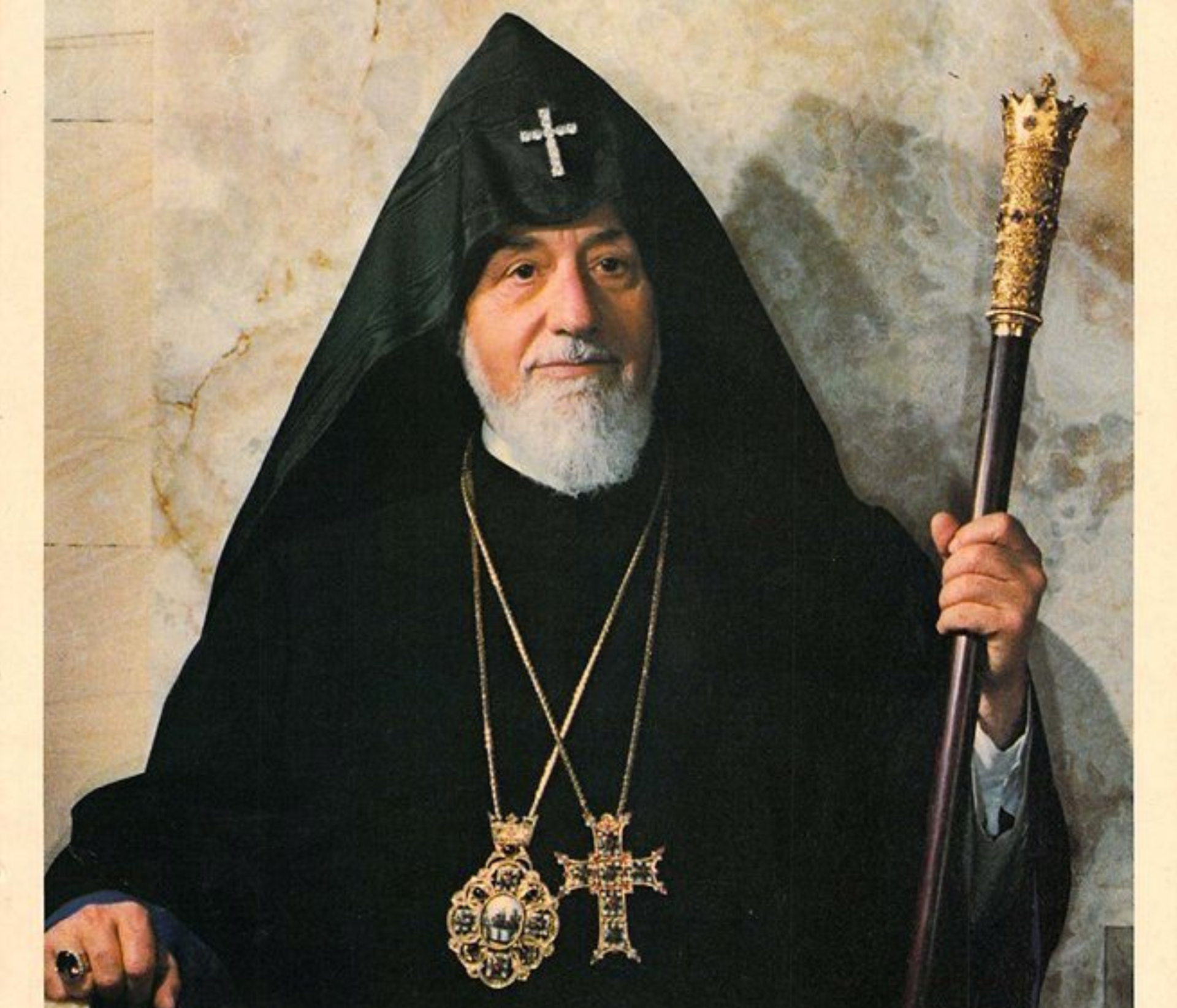

Today marks the 32nd anniversary of the passing of His Holiness Vazgen I. Born Levon Garabed Baljian on September 20, 1908, in Bucharest, Romania, to a family belonging to the Armenian-Romanian community. His father was a shoemaker and his mother was a schoolteacher.
He would go on to become the 130th Catholicos of All Armenians, serving for 39 years in one of the longest reigns in the history of the Armenian Apostolic Church.
He led the Church through Soviet repression, the 1988 Spitak earthquake, the Karabakh movement, and the restoration of Armenian independence in 1991.
He passed away on August 18, 1994, in Yerevan, at the age of 85, after suffering from a long-term illness. He had lived long enough to see an independent Armenia.
From Bucharest to Etchmiadzin
The young Levon Baljian did not initially pursue the Church as a profession, instead graduating from the University of Bucharest’s Faculty of Philosophy and Letters. After graduation, he became a philosopher and published a series of scholarly articles.
As his interests began to shift from philosophy to theology, Baljian studied Armenian Apostolic Theology and Divinity in Athens, Greece, eventually gaining the title of vardapet, an ecclesiastical rank for learned preachers and teachers in the Armenian Apostolic Church roughly equivalent to receiving a doctorate in theology.
His rise through the hierarchy of the Church culminated in 1955 when he was elected Catholicos, becoming one of the youngest Catholicoi in the history of the Armenian Apostolic Church. He left Bucharest and moved to Etchmiadzin, in Soviet Armenia, to take up the most consequential position in Armenian religious life. He would not leave it for 39 years.
Leading the Church Under Soviet Rule
Appointed under KGB oversight, Vazgen outwardly endorsed Soviet policies while quietly expanding the Church’s reach at home and abroad. Seminaries were revived, ties to diaspora parishes cautiously restored, and the Church became a symbol of unity during the crises of the late 1980s.
He adopted a strategy of public cooperation with Soviet authorities while quietly working to reopen seminaries, restore churches, and preserve Etchmiadzin. It was a careful and deliberate balancing act, one that required him to publicly align with a regime that was ideologically hostile to religion while ensuring that the institution he led did not simply disappear. He succeeded.
The Armenian Apostolic Church under His Holiness Vazgen I did not collapse under Soviet pressure. It endured, quietly and stubbornly, until the pressure itself collapsed.
The Diaspora and the Armenian Genocide
His Holiness Vazgen I strengthened ties with the Armenian diaspora, notably through his 1964 kondak (pontifical encyclical) marking the 50th anniversary of the Armenian Genocide, which called for unity and remembrance.
In an era when the Soviet government actively discouraged public commemoration of the Armenian Genocide, His Holiness Vazgen I used the authority of the Church to keep the memory alive both inside Soviet Armenia and across the diaspora. He understood that the Church was not simply a religious institution. It was the one Armenian institution that had survived everything, the one structure that connected Armenians in Yerevan to Armenians in Beirut, Paris, Los Angeles, and Buenos Aires.
With the support of philanthropist Alex Manoogian, he founded the Alex Manoogian Museum in 1982 to safeguard Armenian religious and cultural treasures. The museum still stands at Etchmiadzin today.
The Earthquake and Artsakh
On February 25, 1988, as the Karabakh movement was intensifying, His Holiness Vazgen I wrote directly to Soviet leader Mikhail Gorbachev, urging a constitutional resolution for the unification of Nagorno-Karabakh with Armenia, citing the concerns of over 2 million Armenians of the diaspora who had reached out to him directly.
Later that same year, the Spitak earthquake struck northern Armenia, killing 25,000 people. The Church’s clerical networks mobilized aid and reinforced communal solidarity, further embedding religious authority in national resilience.
In two of the most defining moments of late Soviet Armenian history, His Holiness Vazgen I was present, visible, and active. He did not stand back. He wrote to Gorbachev, mobilized the Church, and made clear that the spiritual leader of the Armenian people was also the servant of their national survival.
The First Catholicos of Independent Armenia
On August 23, 1990, during the Supreme Soviet session adopting the Declaration of Independence, His Holiness Vazgen I formally blessed the document, signaling divine sanction for statehood and bridging ecclesiastical tradition with modern republicanism. In 1991, Armenia declared full independence from the Soviet Union.
His Holiness Vazgen I, who had become Catholicos in 1955 under a Soviet regime that viewed religion with suspicion and hostility, lived to become the first Catholicos of a sovereign Armenian republic in modern times.
He became the first Armenian National Hero and had a great contribution to the consolidation of the new homeland. He had served under the Soviet system for 36 years and lived to serve the free republic for 3. He passed away on August 18, 1994, knowing that the Church he had preserved through the worst of times was now free.
A Legacy That Did Not End With Vazgen I
His Holiness Vazgen I is buried at the Mother Cathedral of Holy Etchmiadzin, the same ground he had devoted 39 years of his life to preserving and protecting. He was succeeded by Karekin I and the Church he handed over was stronger, more connected to the diaspora, and more deeply embedded in the identity of the Armenian nation than it had been when he inherited it. The seminaries he quietly reopened are still training priests.
The museum he founded with Alex Manoogian still preserves the treasures of the Armenian Church. The independence he lived to bless is still the foundation of the Republic of Armenia today.
Vazgen I served through decades when the Armenian Church was not permitted to be what it was. He made it survive anyway. For a people whose Church has been the single most continuous institution in their national life across 15 centuries, that survival was not a small thing. It was everything they had left.