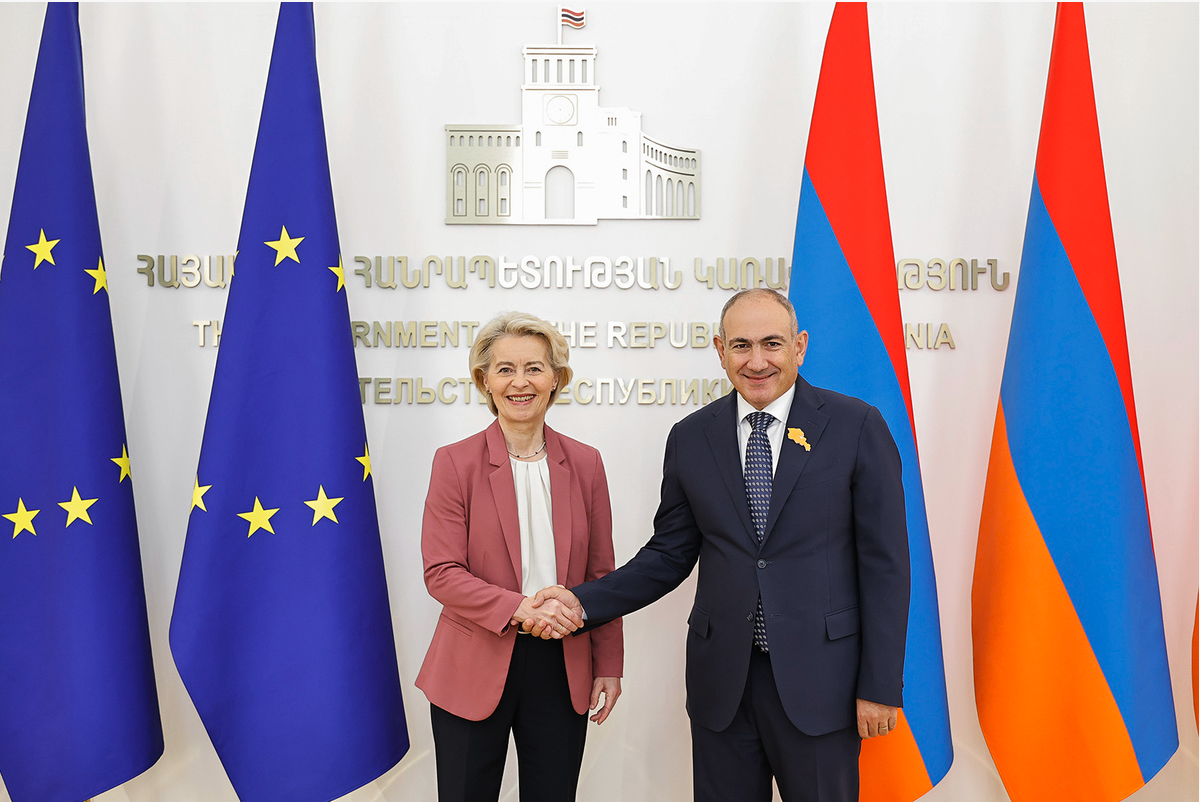
European Commission President Ursula von der Leyen visited Yerevan on Thursday, her second trip to Armenia in two months, and pledged that the European Union will open its single market of 450 million consumers to the bulk of Armenia’s exports if Russia closes its own. “You can count on us,” she told Prime Minister Nikol Pashinyan.
Von der Leyen announced the final tranche of a €52 million support package, a proposal to make roughly 80 percent of Armenian exports to the EU tariff-free, EU investment in regional connectivity across the South Caucasus, and expertise to help Armenia diversify its energy supplies away from Russia.
The visit came weeks after Armenia’s June 7 parliamentary elections, with Von der Leyen congratulating the Armenian people for choosing “democracy, peace and closer ties with Europe.”
Armenia-EU Cooperation
Pashinyan opened by noting that this was von der Leyen’s second visit to Armenia in two months, following the inaugural Armenia-EU Summit and the 8th European Political Community Summit held in Yerevan in May. The jointly adopted statements of recent years, he said, are “not just words, but concrete actions” that Armenia and the EU are now implementing together.
Von der Leyen described the relationship in personal terms. “It is good to be back in Yerevan again, this is the second time in less than two months, and this proves the strength of our partnership and personal friendship,” she said. Both leaders anchored the cooperation in the Comprehensive and Enhanced Partnership Agreement and the Strategic Agenda for the Armenia-EU Partnership, built on shared commitments to democracy, the rule of law, and human rights.
Pressure From Russia
Russia was the backdrop to the visit. Von der Leyen described the pressure Armenia faces from Moscow as “nothing short of economic coercion.” She acknowledged that “not everyone likes” the Armenia-EU rapprochement and that Russia is working to keep Armenia from drawing closer to Europe, before delivering the visit’s central guarantee: if Russia closes its market to Armenian products, the European Union will open its own.
In a written statement accompanying the visit, she said no country should be pressured for a sovereign choice. The pressure escalated after Yerevan hosted two European summits in early May, when Moscow, citing sanitary grounds, blocked imports of Armenian flowers, fruit, vegetables, fish, and other agricultural goods.
Pashinyan Rules Out a 2013 Reversal
Asked directly whether Armenia could see a repeat of 2013, when the country abruptly abandoned an Association Agreement with the EU under Russian pressure and pivoted toward the Customs Union, Pashinyan’s answer was unequivocal: no. He called such a reversal impossible, “especially now, when the people of the Republic of Armenia have clearly expressed support” for the government’s balanced foreign policy.
At the same time, he framed Armenia’s European course as a matter of national interest rather than confrontation with Moscow. Armenia “has never set a goal, does not have one and will not set a goal to create a crisis” in relations with Russia, he said, adding that while Armenia respects the interests of all its partners, it cannot place any partner’s interests above its own. He confirmed that his telephone conversation with Russian Prime Minister Mikhail Mishustin the previous day had taken place at his own initiative, and that the two had agreed to hold more detailed discussions in the near future.
Opening the European Market: 80% of Exports Go Tariff-Free
The economic centerpiece of the visit was the European Commission’s proposal for Autonomous Trade Measures, which would liberalize approximately 80 percent of Armenia’s exports to the EU. “Eighty percent of your trade with us will now be tariff-free,” von der Leyen said, explaining that the measures would let Armenia redirect goods currently dependent on the Russian market toward Europe’s single market.
The measures would open the European market to almost 99 percent of Armenia’s fresh fruits, vegetables, and plants previously exported to Russia, and to more than 90 percent of its beverages and spirits. Von der Leyen pointed to the growing volume of Armenian flowers already arriving in Europe as “a beautiful symbol of a new chapter” in the economic partnership, and said this was only the beginning.
Pashinyan welcomed the proposal and noted its historic character: once the measures enter into force, Armenia will become the first country that is neither an EU candidate state nor a holder of a free trade agreement with the bloc to benefit from the instrument. He urged swift adoption by the European Parliament and the Council, noting that Armenia’s harvest season has already begun.
The €52 Million Package
Von der Leyen confirmed that Armenia will soon receive an additional €18 million to strengthen and diversify its trade, potentially to establish an export promotion agency. The sum is the final installment of the €52 million support package the two leaders discussed by phone in early June, the first €34 million of which the EU had already disbursed within two weeks of that call.
To ensure the new market access translates into real trade, the Commission will deploy experts to Armenia by mid-July to work directly with producers, businesses, and exporters. At a separate cabinet meeting, Pashinyan said the EU’s market of 450 million is a high-standard one, and that Armenian exporters would need to meet its documentation and food-safety requirements to benefit. “We cannot take apricots to the European Union in buckets,” he said, adding that the work now falls to Armenia’s private sector. “At the political level, we can state that the export problem has been solved. Now it remains for us to solve it at the practical level. This is our work, not the work of foreign institutions.”
Energy
Pressed on what the EU would do if Russia raised gas prices or cut supplies to Armenia, von der Leyen called for a “strategic, multi-layered and comprehensive approach” to energy and pledged to help Armenia diversify its supplies. A team of EU experts will arrive next week for that purpose, drawing on experience the bloc gained in Ukraine, Moldova, and within Europe itself.
She announced €25 million for the Caucasus Transmission Network to strengthen regional energy security through new electricity interconnectors, alongside EU support for expanding Armenia’s renewable energy generation, which she described as “home-grown energy” that gives the country independence and resilience. The context is a warning delivered in late May, when Russian Energy Minister Sergei Tsivilev signaled Moscow could suspend or terminate the 2013 agreement that governs the price of Russian gas supplied to Armenia if Yerevan continued pursuing EU membership. Von der Leyen did not commit to compensating Armenia for a possible gas price surge or to sourcing an alternative supplier.
Connectivity
Von der Leyen carried into Yerevan the connectivity commitments she had announced a day earlier in Baku: a €200 million Global Gateway package for “peace through connectivity” that could mobilize up to €2 billion in public and private investment for transport, energy, and digital projects across the South Caucasus. According to a Commission source, the €200 million is to be split evenly between Armenia and Azerbaijan by 2027. In Armenia, von der Leyen said, the funding could support border crossing points and road infrastructure already under preparation. She also confirmed a separate €20 million program of “Peace Dividends” for communities along the borders, funding local businesses, new farming and water-management equipment, refrigeration facilities, healthcare, and demining.
The spending is part of a broader European push to develop the Middle Corridor, the trade route linking Europe to China through the Caucasus and Central Asia that bypasses Russia. Days before the visit, EU Enlargement Commissioner Marta Kos, who accompanied von der Leyen on both legs of the trip, launched a new Connectivity Agenda Platform tied to those projects, with a stated goal of mobilizing more than €2 billion in transport, energy, and digital investment.
Pashinyan tied the EU support to his government’s Crossroads of Peace initiative, pointing to recent progress including the joint statement on the EU-Armenia Connectivity Partnership and last week’s agreements in Brussels on feasibility studies for three Armenian border crossing points and two northern highways, signed with the European Commission, the European Investment Bank, and the European Bank for Reconstruction and Development. He stressed the importance of expanding energy connectivity, including power lines and interconnectors with Turkey and Azerbaijan. In a separate briefing, he distinguished this EU track from the US-led Trump Route for International Peace and Prosperity, the freight-route project through Armenia’s Tavush, Lori, and Shirak provinces that Yerevan is advancing with Washington, noting the EU’s position on it is positive but that it carries no direct EU involvement.
The Yerevan stop was the second leg of a two-capital trip. A day earlier in Baku, von der Leyen had offered Azerbaijan its own connectivity partnership, called the country a “reliable and trusted energy partner” for Europe, and welcomed Baku’s proposal to build an electricity cable to Armenia, alongside potential projects including a rail link through Nakhchivan and development of the Port of Baku.
Digital Cooperation and AI
Beyond trade, energy, and connectivity, Pashinyan flagged Armenia’s interest in deepening cooperation with the EU in digital technologies, artificial intelligence, high tech, and innovation, while building an environment to attract European private investment. He also underscored the importance of Armenia’s participation in the Black Sea submarine power and digital cable projects as a means of strengthening the country’s links with Europe.
Visa Liberalization and EU Standards
Von der Leyen confirmed that Armenia is the only partner country currently engaged in an active visa liberalization dialogue with the EU, praised the progress documented in the Commission’s April report, and said new assessment missions would visit in the autumn to evaluate the remaining benchmarks. She described a merit-based process: once all required elements are met, the Commission can move to propose a visa-free regime. “Once it is fulfilled, you pass the finish line,” she said.
Pashinyan set the target at 2029, acknowledging that the timeline depends largely on Armenia’s own reform efforts. “In many cases, we should ask the questions not to the European Union, but to ourselves,” he said. He described the moment as an opportunity to restart a democratic reform agenda repeatedly interrupted over the past years by the pandemic, war, and its aftermath. Full and sincere compliance with EU standards is the first strategic task, he said; membership, a political question, could follow. Even if the EU ultimately chooses not to enlarge, he said, Armenia would still gain by becoming a country that meets European standards. “This is not being done for the European Union,” he said. “It is being done for the citizens of the Republic of Armenia.”
In a post on X, von der Leyen reaffirmed that Armenia is “staying the course on reform and moving closer to Europe,” and signed off in Armenian: “???? ??? ??? ???.” We are with you.