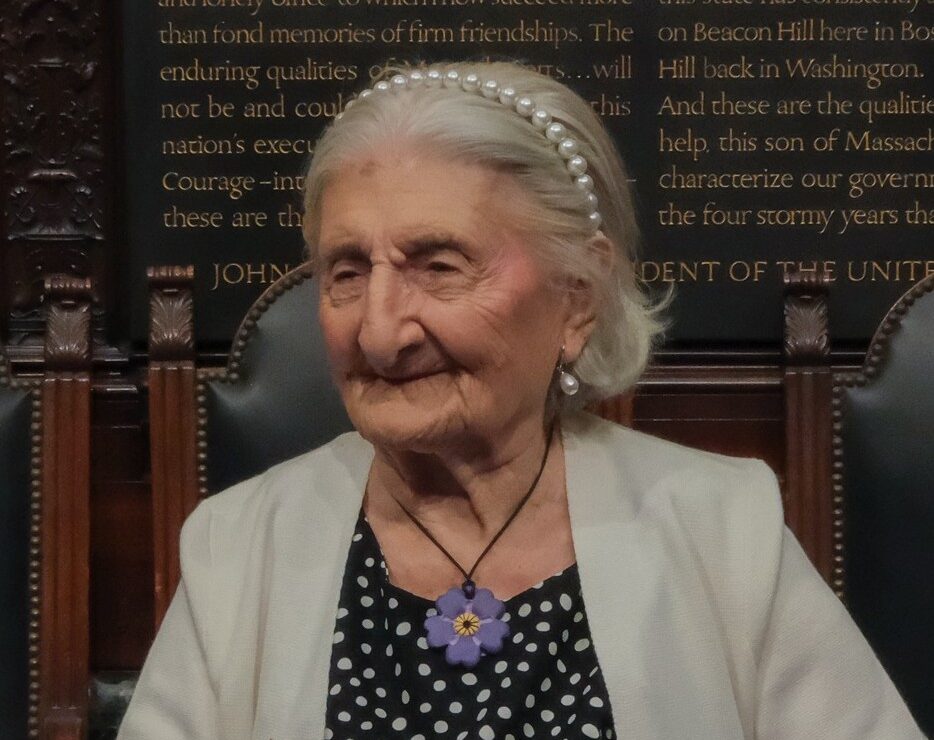

Mary Vartanian, one of the last living survivors of the Armenian Genocide, has passed away at the age of 112, according to her granddaughter, Natalie Vartanian, who shared the news of her passing over the weekend on Facebook.
Born Mary Ouzkoushian in Aintab, in historic Cilicia, on August 17, 1914, she came into the world just before the 1915 Armenian Genocide, the Ottoman Empire’s campaign against its Armenian population that killed an estimated 1.5 million people. She survived its opening years as a small child and carried the memory of that survival across a life that stretched more than a century and four generations.
Her family was spared deportation in part through the protection of a paternal cousin, Dr. Garabed Yesayan, whose family helped the Ouzkoushians escape to Aleppo in the early 1920s, leaving behind their home and nearly all they owned. Her father had been a miller who produced cracked wheat. Too young to remember much of Aintab, she nonetheless recalled her years at the Grtasirats Armenian School there as the happiest of her life. She grew up speaking Armenian, Turkish, and later Arabic, and learned to crochet, sew, and weave Aintab-style rugs, a craft that would later help her earn a living in Aleppo. Decades on, samples of her handiwork were displayed at the museum of the Catholicosate of Cilicia in Antelias, Lebanon.
In 1935 she married Hovhannes Vartanian, a fellow Aintab native, a violinist and composer who performed for the Armenian Radio of Aleppo and was awarded the Syrian National Medal of Recognition for his musical talent. Together they raised four sons and two daughters. In 1965 the family moved to Beirut to spare their sons compulsory service in the Syrian army, and four years later, in 1969, Hovhannes died, leaving Mary widowed at 55. She never remarried. One of her sons, Zaven, emigrated to the United States and settled in Watertown, Massachusetts, and Mary followed with another son in 1972. She would call Watertown home for 45 years.
In the United States she built a quiet life grounded in faith, family, and work. She worked briefly assembling parts at an electrical company, became an active member of the Ladies Guild at St. James Armenian Church in Watertown, and cooked for its luncheons and annual bazaar, honored in 1997 as the guild’s Mother of the Year. She crocheted pieces bearing a cross and the words urging Armenians never to forget April 24, and donated them to churches. Remarkably active well into her later years, she traveled through Europe on a group tour in her 90s, journeyed to Beirut at the age of 100, and lived independently until she was 101, moving into the Armenian Nursing and Rehabilitation Center in Jamaica Plain only after a fall.
For generations of Armenians, Vartanian stood as a direct and living link to a history that too many have sought to deny. She attended genocide commemorations year after year, and in April 2024 she was honored at the Massachusetts State House, where lawmakers and visitors rose in a standing ovation to recognize her contributions to the Armenian-American community and her lifelong work to keep its memory alive. Speaking in Armenian, she told those gathered that her joy and her pride were with the Armenian people. She often said the one thing she never wanted forgotten was April 24, and she credited her long life to two simple constants: hard work and daily prayer.
In her message, Natalie Vartanian described a grandmother whose own survival made possible the lives of everyone who came after her, and a woman who taught those around her to treasure life in equal measure through its joys and its sorrows. She asked that her grandmother rest in peace and watch over the family from beyond.
She is survived by a large family spread across the diaspora, including children, more than a dozen grandchildren, and numerous great-grandchildren, a living continuation of the family line that the genocide had once tried to erase.
Her passing marks the loss of one of the dwindling few who remembered, however faintly, the world before the catastrophe, and who lived long enough to become a witness for those who did not survive it. May her soul find rest, and may the memory of her life endure among those who knew her and those who will only ever know her story.