
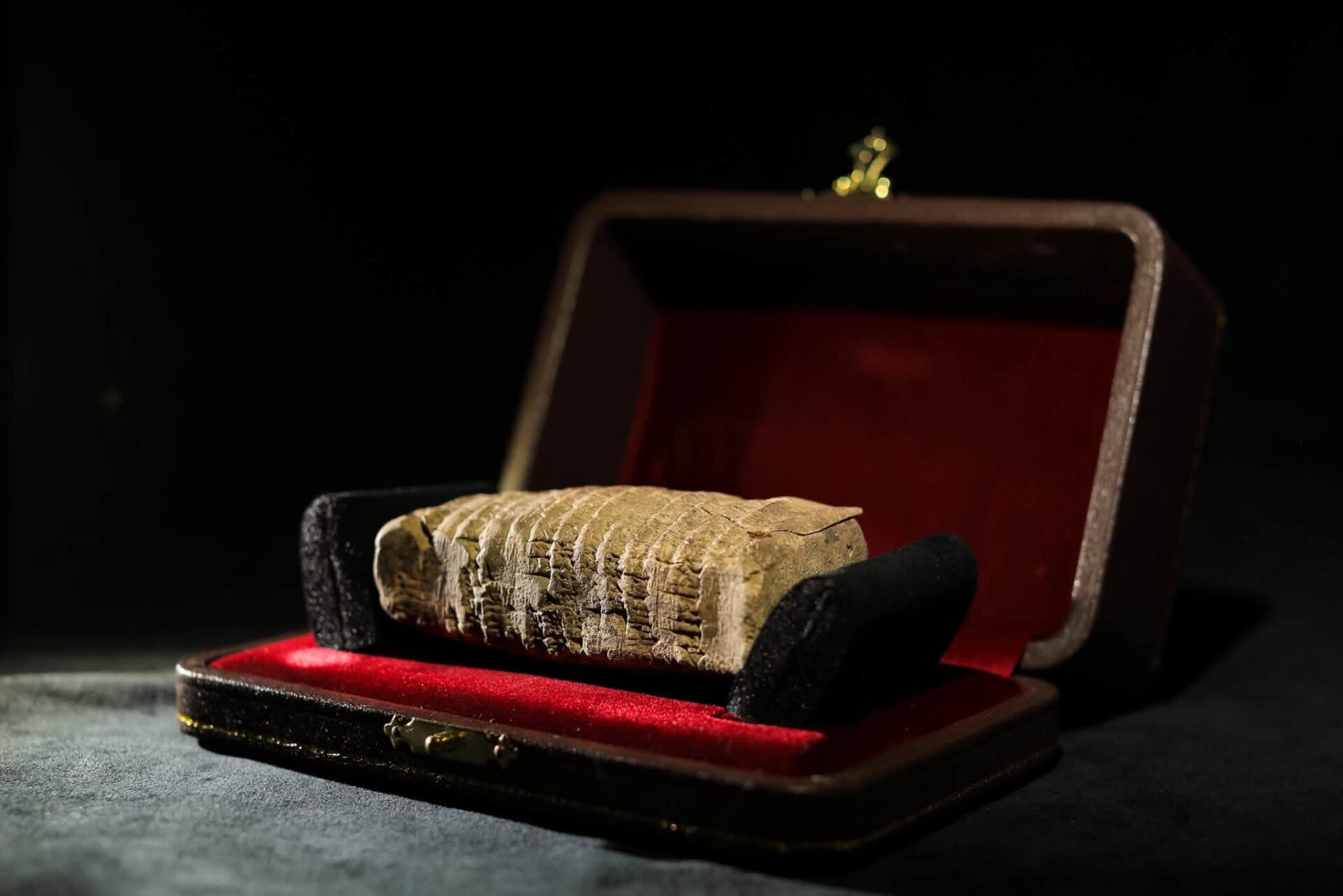

A nearly 4,000-year-old Akkadian contract inscribed on a clay tablet has entered the collection of the Matenadaran, Armenia’s national repository of ancient manuscripts, following a donation by Prince Dani Badawi, a representative of the Badawi royal dynasty. The Matenadaran announced the donation on June 11.
The tablet, dating to 1750-1712 BC, was produced during the Old Babylonian period, an era when Akkadian served as the administrative and commercial language of Mesopotamia. Contracts of this kind, recording agreements in cuneiform script pressed into wet clay, are among the oldest surviving legal documents in human history. The artifact dates to the years immediately following the reign of Hammurabi, the Babylonian king whose famous law code stands among the most influential legal documents of the ancient world.
Prince Badawi visited the institute accompanied by Narek Mkrtchyan, Armenia’s Ambassador to the United States, and Grammy Award-winning singer Mohombi. During their visit, they toured the Matenadaran Museum and the Restoration Department.
Prince Dani Badawi serves as Special Envoy for Cultural Diplomacy at the Garibay Institute for Systems Diplomacy and traces his lineage to the Royal House of Badawi, which originates from the Tkhuma Assyrian tribe. The donation carries a layer of historical resonance, placing an artifact connected to the ancient Near East’s shared civilizational heritage into the care of an Armenian institution, a gesture between two of the region’s oldest peoples.
The Matenadaran, officially the Mesrop Mashtots Institute of Ancient Manuscripts, is the largest center in the world for the storage, study, and popularization of Armenian manuscripts, holding a collection of roughly 23,000 manuscripts and scrolls. Its collection is inscribed in UNESCO’s Memory of the World register, and the institution has grown steadily since its establishment in 1959, largely through individual donations such as this one.
The gift adds to a long tradition of diaspora figures, foreign dignitaries, and private collectors entrusting rare manuscripts and artifacts to the Yerevan institute, reinforcing its role not only as the guardian of Armenian written culture but as a custodian of the broader heritage of the ancient world.


