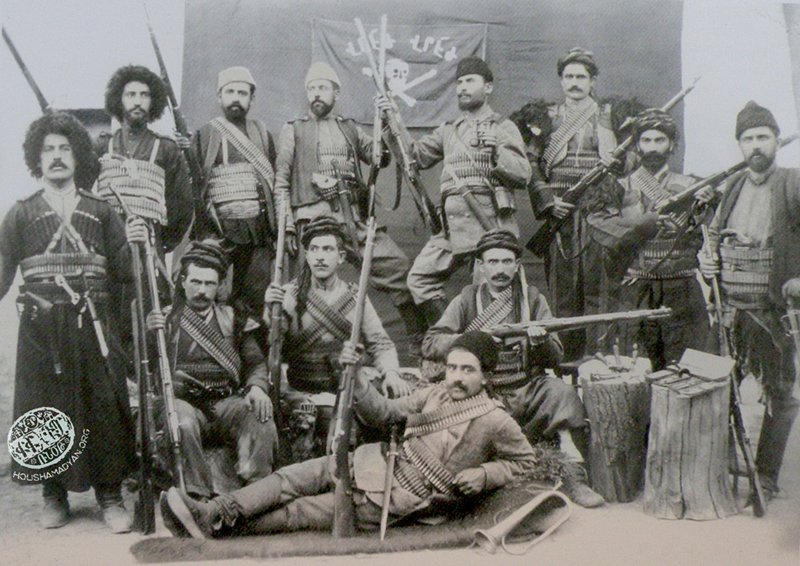

Inside The 12 Hours That Made The Fedayee A Force. Swipe
129 years ago today, on July 25, 1897, at dawn, roughly 250 Armenian fedayees crossed the Persian-Ottoman border, climbed the Araul mountains, and descended on the encampment of the Kurdish Mazrik tribe on the Khanasor plain, near the historic battlefield of Avarayr, where Vartan Mamikonian had been martyred 1,446 years earlier in the battle that kept Armenia Christian.
The Mazriks, led by Sharaf Beg and backed by Ottoman Sultan Abdul Hamid II, remembered across the Armenian world as the Bloody Sultan, had ambushed and killed more than 300 Armenian defenders of Van a year earlier as they retreated into Persia. The Khanasor Expedition was the answer.
It ended in 12 hours of combat. The Mazrik tribe was destroyed, and its chief, Sharaf Beg, escaped only by wearing women’s clothing.
25 Armenian fedayees were martyred. Khanasor became one of the defining victories of the Armenian national liberation movement.
From The Ashes Of Van
In the spring and summer of 1896, the Armenians of Van rose in self-defense against the massacres that had been sweeping across Ottoman Armenia since 1894. The Hamidian Massacres, ordered by Sultan Abdul Hamid II and carried out by Kurdish irregular units under the Ottoman state, had killed tens of thousands of Armenians in Sasun, Erzurum, Trabzon, Kharput, and Bitlis.
Van rose and briefly defended itself. When the fedayees of Van attempted to retreat across the border into Persia at the end of the fighting, the Mazriks were waiting for them.
More than 300 Armenians, fighters of the Armenian Revolutionary Federation, the Hunchakian Party, and the Armenagan Party, were ambushed and killed as they moved through the mountains.
Sharaf Beg had eliminated the fedayee groups of Avetisyan, Peto, and Martik in 1895, blocked weapons crossing from Persia into Western Armenia, and become one of the most notorious perpetrators of the Hamidian Massacres. He acted with the Sultan’s backing.
The Plan
In the autumn of 1896, at a regional assembly of the ARF held in Tiflis, Nikol Duman, one of the ARF’s most respected military commanders, proposed a punitive expedition. The Mazriks would answer for what they had done.
There were debates. Some Armenian leaders believed the operation was too risky and too far outside the party’s political focus. The resolution passed, and Duman traveled to Baku to raise the necessary funds.
The ARF acted with the support of the Hunchakian Party and the Armenagan Party. Sargis Mehrabyan, an experienced fedayee already active across Vaspurakan, was named overall field commander, with Nikol Duman and Ishkhan Arghoutian as fellow commanders.
Disagreements broke out among the fedayees themselves as the operation approached. The party sent Harutiun Shahrigian to Tabriz to resolve them. The men agreed, and the operation went forward.
Dawn On The Khanasor Plain
By the night of July 24, 1897, roughly 253 Armenian fedayees, with most on foot and the rest on horseback, had gathered near Salmast on the Persian side of the border.
They took an oath, crossed the frontier under cover of darkness, and climbed the Araul mountains. They positioned themselves on all sides of the Mazrik camp on the plain below, and at dawn on July 25 they attacked.
Their orders spared women and children. The strike was to be an act of political justice for the more than 300 Armenians martyred the year before.
Sharaf Beg had learned in advance that the Armenians were coming. When the assault began, he disguised himself in women’s clothing and escaped through the confusion, leaving the women and children of his camp behind.
His guest, a captain of the Ottoman army who had been staying with the tribe, was killed in the fighting. The Mazriks reorganized and fought back. The battle lasted 12 hours, and by its end the encampment was destroyed.
The Martyred
25 Armenian fedayees were martyred during the expedition.
Among them was Garo, whose given name was Aristakes Zorian, the younger brother of Stepan Zorian, better known to Armenian history as Rosdom, one of the three founders of the ARF. His name would be spoken at ARF ceremonies for the next century.
By nightfall, Kurdish reinforcements and Ottoman regular forces were arriving. Rather than remain on the plain to be surrounded, the surviving fedayees withdrew to the mountains and crossed the Persian border again under cover of night.
The operation formally ended on July 27, 1897.
The Khanasorian Generation
Before the operation, Sargis Mehrabyan had spoken to his men. His words were remembered for more than a century:
“Let us show the doubters in our own society that we are capable of pursuing the revolutionary struggle, however unequal, to victory. Let us show the whole world that Armenians, too, know how to fight for freedom.”
Earlier fedayee actions had been improvised or defensive. Khanasor was the first strategically planned and successfully executed strike against the specific perpetrators of a specific massacre.
The men who fought at Khanasor became known as the Khanasorian Generation. Their names would echo through the next 20 years of Armenian revolutionary history. After that day, Sargis Mehrabyan would be known across the Armenian world as Vartan of Khanasor, and would rise to become one of the most senior military leaders of the ARF.
With the Mazrik tribe destroyed, the arms-smuggling routes from Salmast through Vaspurakan to Taron reopened, and the Armenian fedayee movement entered its most active period.
After Khanasor, the men who killed Armenians could not assume they would go home. The Armenian fedayee had arrived.