
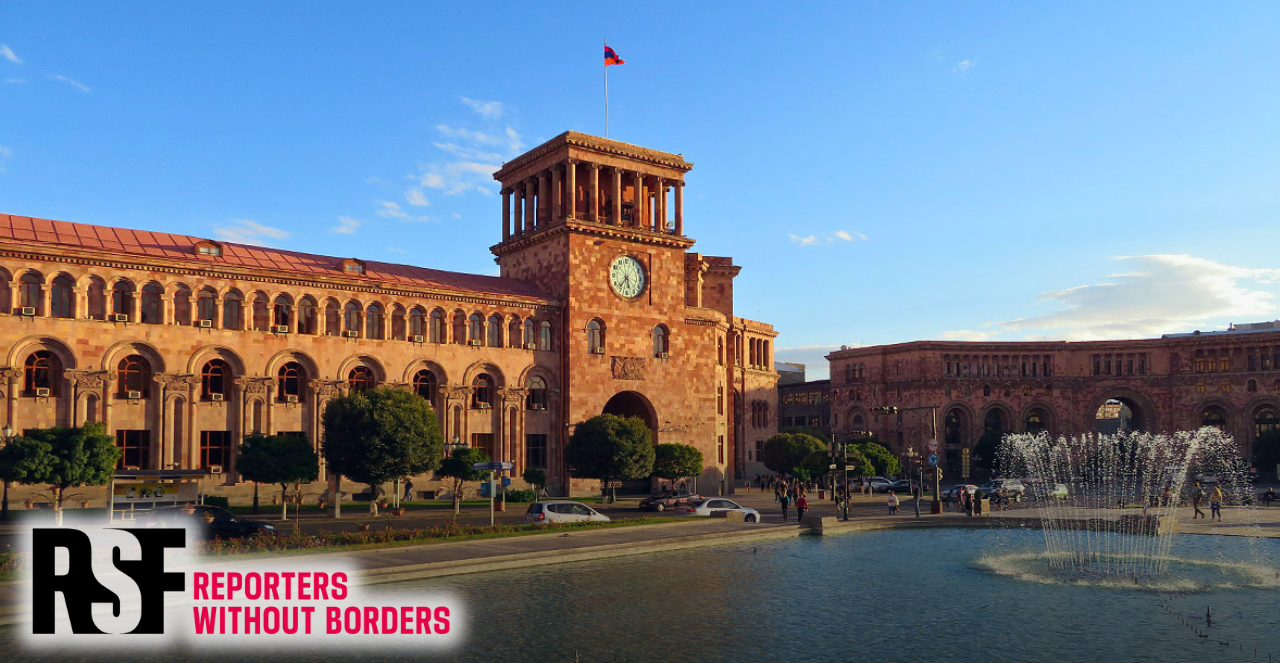

Armenia ranked 50th out of 180 countries in the latest World Press Freedom Index published by Reporters Without Borders (RSF), down from 34th place last year — a drop of 16 positions reflecting growing pressure on the country’s media environment. RSF noted that Armenia’s score declined across all five indicators it evaluates: economic, legal, security, political, and sociocultural.
It scored 67.02 points out of 100 in this year’s index, down from 73.96 last year, with its media environment classified as “problematic” — the third tier out of five. Despite the decline, Armenia still ranks higher than it did in 2022 or in any earlier year, a trend RSF attributes to a broader global deterioration in press freedom, where many countries are seeing even sharper declines.
The index comes amid a global worsening of conditions for journalism, with RSF noting that press freedom has declined in 100 out of 180 countries and territories. “In 25 years, the average score of all 180 countries included in the ranking has never been so low,” the organization said.
In Armenia, RSF reports that no journalists were killed or are currently detained this year, but structural problems continue to weigh on the media environment.
The country’s media landscape remains deeply polarized, with social media — used daily by two-thirds of the population — serving as the main source of information. Most broadcast and print media remain tied to political or commercial interests and continue to face pressure over editorial independence.
RSF says this polarization mirrors the political landscape, with media outlets often aligned with competing political camps, leaving only a limited number of genuinely independent actors. Sensitive issues such as negotiations with Azerbaijan and relations with Russia are especially vulnerable to disinformation and hybrid influence operations, further distorting the information space.
“Armenia is facing an unprecedented level of disinformation and hate speech fed by internal political tension, security problems at the country’s borders, and the country’s complicated position between Russia and the European Union,” RSF said.
The legal environment also remains a concern. Although defamation has been decriminalized and media ownership transparency laws exist, RSF argues that the framework still does not fully protect press freedom or meet European standards. Access to state-held information is often restricted, while recent reforms have failed to address challenges linked to gag orders and disinformation.
Economically, the sector remains fragile. Many outlets are owned by politically connected figures, advertising markets are weak, and few media have sustainable subscription models, limiting independence. State media, meanwhile, largely avoids criticism of the government.
Beyond institutional factors, journalism also faces sociocultural pressure. RSF highlights widespread stigmatization of journalists, with political elites often portraying them as biased or corrupt. This contributes to harassment, insults, and abusive defamation cases, reinforcing self-censorship. In practice, journalists are regularly subjected to pressure and violence from both government and opposition figures, as well as their supporters, in public spaces, parliament, and online — with most incidents going unpunished.
Despite these challenges, Armenia still performs better than many of its regional neighbors. Azerbaijan ranked 171st, Russia fell one spot to 172nd, and Iran ranked 177th, while Turkey came in at 163rd. Georgia fell to 135th after a 21-place drop, amid what RSF describes as a year of democratic crisis and crackdowns on protests and their coverage.
At the top of the ranking, Norway once again led the index with 92.72 points, followed by the Netherlands, Estonia, Denmark, Sweden, and Finland. At the very bottom, Eritrea ranked 180th, with indicators even lower than those of North Korea.


