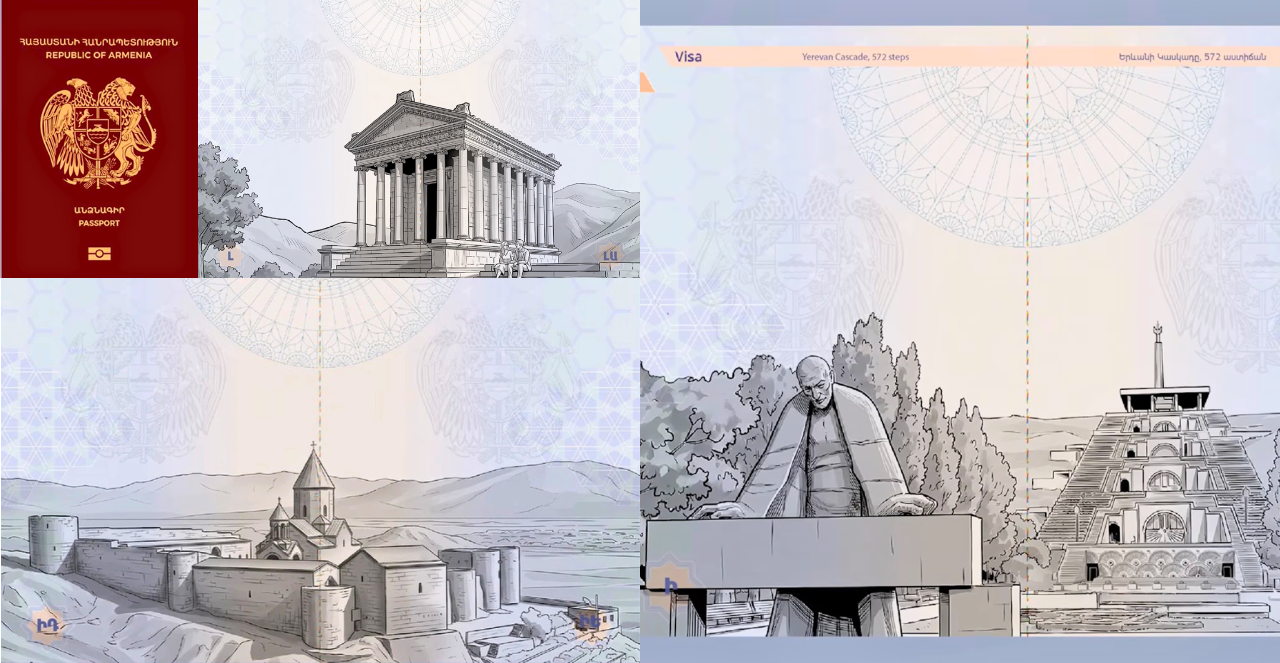

Armenia has unveiled the design of its new biometric passport, set to roll out in the autumn of 2026 with a shift from dark blue to red and a complete visual overhaul of its interior pages. Interior Minister Arpine Sargsyan presented the redesign on Tuesday to Prime Minister Nikol Pashinyan, framing it as both a technical upgrade aligned with international standards and a visual narrative of Armenian identity. But one absence has already drawn debate: Mount Ararat, omitted from the passport’s depiction of Khor Virap monastery, the site most famous for its view of the mountain across the border in Turkey.
Move Toward International Standards
Sargsyan said the new system is designed to bring Armenia’s identity documents in line with International Civil Aviation Organization (ICAO) standard 9303, which governs globally recognized travel documents. She noted that the country’s previous infrastructure no longer met international requirements.
“The infrastructure that existed in 2022 has no connection to international standards,” she said, adding that the goal is to issue biometric documents compatible with modern technologies and recognizable at border checkpoints around the world.
The reform traces back to an August 2024 government decision to issue new biometric passports and ID cards. The tender was awarded to a French consortium of IDEMIA Identity Security France and A.C.I. Technology, which created HAYPASS, the entity now implementing the system in Armenia. The agreement with HAYPASS was signed in April 2025. The choice of a French infrastructure partner places a tangible European pillar beneath Armenia’s broader pivot toward the European Union, moving the relationship from rhetoric to physical infrastructure embedded in one of the most sensitive systems a state operates.
A central component of the project is the construction of a new data center to handle biometric records, alongside an ongoing memorandum with ICAO that will make Armenian documents readable and verifiable in partner countries. The new passports will incorporate advanced security mechanisms, including ultraviolet protection layers and a range of physical safeguards designed to meet contemporary anti-fraud standards.
Pashinyan said the introduction of biometric passports is also tied to Armenia’s broader goal of visa liberalization with the European Union, supporting negotiations that would eventually allow Armenian citizens to travel to EU countries without visas.
The New Passport Design
The interior of the new passport has been completely reworked, moving away from the previous uniform pages bearing only the coat of arms. The cover, in deep red with the Armenian coat of arms in gold, opens onto an inside spread featuring the outline map of Armenia on the left and the coat of arms alongside the document’s official text on the right. The coat of arms, with Mount Ararat and Noah’s Ark at its center, is also watermarked across every interior spread, anchoring the document in the state symbol that has carried Ararat since Armenia’s independence.
From there, the document unfolds as a visual narrative beginning with the origins of the Armenian nation and continuing through key moments of its history. Running through the design is the Armenian alphabet created by Mesrop Mashtots, alongside the first sentence ever written in Armenian: “To know wisdom and instruction, to perceive the words of understanding.” Several letters are emphasized with symbolic weight, including ? for freedom and independence, ? for happiness, ? as a reference to God in Classical Armenian, ? for the people, ? for sovereignty, ? for peace, ? for life, ? for Armenia, ? for human, ? for water as a symbol of life, ? for law and legality, ? for the state, ? for love, and ? for Christ, reflecting Armenia as the first nation to adopt Christianity as a state religion.
The first illustrated spread depicts Hayk Nahapet, the legendary founder of the Armenian nation, drawing his bow atop a rock formation, with ancient petroglyphs from the Geghama Mountains and Ukhtasar carved into the stones beside him. The narrative continues with the cuneiform inscription marking the founding of Erebuni in 782 BC, the Artaxiad Boundary Stone of the 2nd century BC depicted alongside farmers plowing the land, and the Mother Cathedral of Holy Etchmiadzin commemorating Armenia’s adoption of Christianity in 301 AD. The Temple of Garni, dating to 77 AD, anchors the country’s pre-Christian heritage. Modern symbols of statehood follow, including the Residence of the President, and Yerevan is further represented through the Cascade Complex, with a tribute to Alexander Tamanyan, the architect recognized as the founder of modern Armenian urban planning.
Ararat, Absent
The depiction of Khor Virap monastery has drawn the most attention. The monastery is internationally known for offering one of the most striking views of Mount Ararat, and is among the most photographed sites in Armenia precisely because of that backdrop. In the new passport, Khor Virap is rendered from an elevated, aerial angle, looking outward across the Ararat plain, with distant foothills traced into the horizon but Mount Ararat itself absent from the frame. The omission has prompted criticism on social media, with some defending it as a deliberate aesthetic choice and others reading it as the latest move in a broader policy.
The decision reflects a wider shift in official symbolism under the current government. In recent years, Pashinyan has stated that Mount Ararat should not serve as a symbol of Armenia, a position that has generated sustained public criticism. The stance is closely tied to his “Real Armenia” narrative, which emphasizes state symbolism grounded in internationally recognized territory and elevates Mount Aragats, Armenia’s highest peak within its current borders, as the alternative national reference point.
The shift has also taken concrete administrative form. In 2025, Mount Ararat was removed from Armenia’s passport border stamps, a decision that triggered public backlash. Pashinyan defended the change as part of a sovereignty-driven approach, while critics described it as a departure from longstanding national imagery.
The tension is sharpened by what the new passport does still carry. While the discretionary illustrations omit Ararat, the official coat of arms placing the mountain and Noah’s Ark at the center of Armenia’s national identity remains on the cover and on every interior page, an inherited state symbol the design could not edit out.
Contactless Border Crossings
Alongside the passport reform, Armenia will introduce automated, contactless border-crossing systems at major checkpoints, including airports. Citizens holding biometric passports will be able to scan their documents and pass through without direct interaction with border officers, significantly speeding up travel.
“With the introduction of biometric passports, we will implement a model of border crossing without human contact,” Pashinyan said, adding that the system will be deployed at all major entry points.
The autumn 2026 rollout is positioned as a foundational step in Armenia’s visa liberalization process with the European Union, a process that will be measured not only by what the new passport allows Armenian citizens to do at foreign borders, but also by how the country chooses to represent itself on the page they hand across the counter.