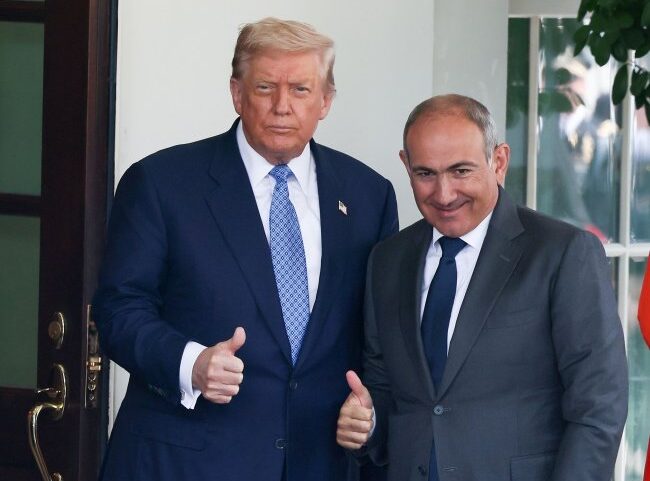

The Armenian government on Thursday approved a draft law to ratify the Board of Peace Charter, with Prime Minister Nikol Pashinyan pledging that Armenia will make a financial contribution to the U.S.-led initiative while declining to disclose how much the country intends to pay.
Under the government’s proposal, the charter will first be submitted to the Constitutional Court to assess its compliance with Armenia’s Constitution. If the court rules the document constitutional, the government will then formally introduce a ratification bill to the National Assembly (Parliament).
Armenia is among the founding member states of the Board of Peace, an international initiative established under the leadership of U.S. President Donald Trump, who serves as the body’s Chair. The charter was signed in Davos on January 22 by Pashinyan alongside other world leaders, following a personal invitation from Trump.
Speaking at a press briefing after the Cabinet meeting, Pashinyan said Armenia’s participation does not involve mandatory financial obligations and is based on a voluntary principle, while affirming the country’s intention to contribute.
“There are no mandatory financial commitments. We should contribute to the extent we can. Armenia has no obligations, but I believe we should participate, and we will participate,” he said, adding that any contributions would depend on the country’s financial capacity.
He went further in framing Armenia’s posture, telling reporters, “I believe that the Republic of Armenia must move beyond the status of a poor relative.” He declined to specify the amount Armenia might contribute.
The pledge sits alongside an earlier statement from Armenia’s Finance Ministry, which said ahead of the Cabinet meeting that Yerevan will have to finance its participation in the Board of Peace, noting that the agreement entails financial commitments for the country, including potential increases in state budget expenditures.
The Board of Peace is described as an international organization aimed at promoting stability and ensuring peace in conflict-affected regions, while also developing and disseminating best practices for peacebuilding within the framework of international law. The charter enters into force once at least three signatory states formally recognize it as binding.
Armenia’s Ministry of Justice stated that the charter does not contradict existing legislation and is subject to ratification under constitutional procedures. The Foreign Ministry has also endorsed the bill.
The initiative has faced criticism from some observers for lacking United Nations institutional backing, with detractors describing it as a more personalized, transaction-based project of U.S. leadership. None of the other four permanent members of the UN Security Council have joined the initiative, and major Western nations including Germany and Italy have also declined to participate.
Reportedly, countries seeking permanent membership would be required to contribute around $1 billion to a fund linked to the Board, while others would serve on a rotating three-year basis, subject to renewal at Trump’s discretion. Armenian officials have clarified that the $1 billion fee is voluntary and applies only if a country requests permanent membership within one year of the charter entering into force, meaning Armenia’s three-year founding-member participation does not trigger it.
The ratification bill will now be debated in the Armenian Parliament, which will decide whether to formally approve the country’s participation framework in the Board of Peace.