
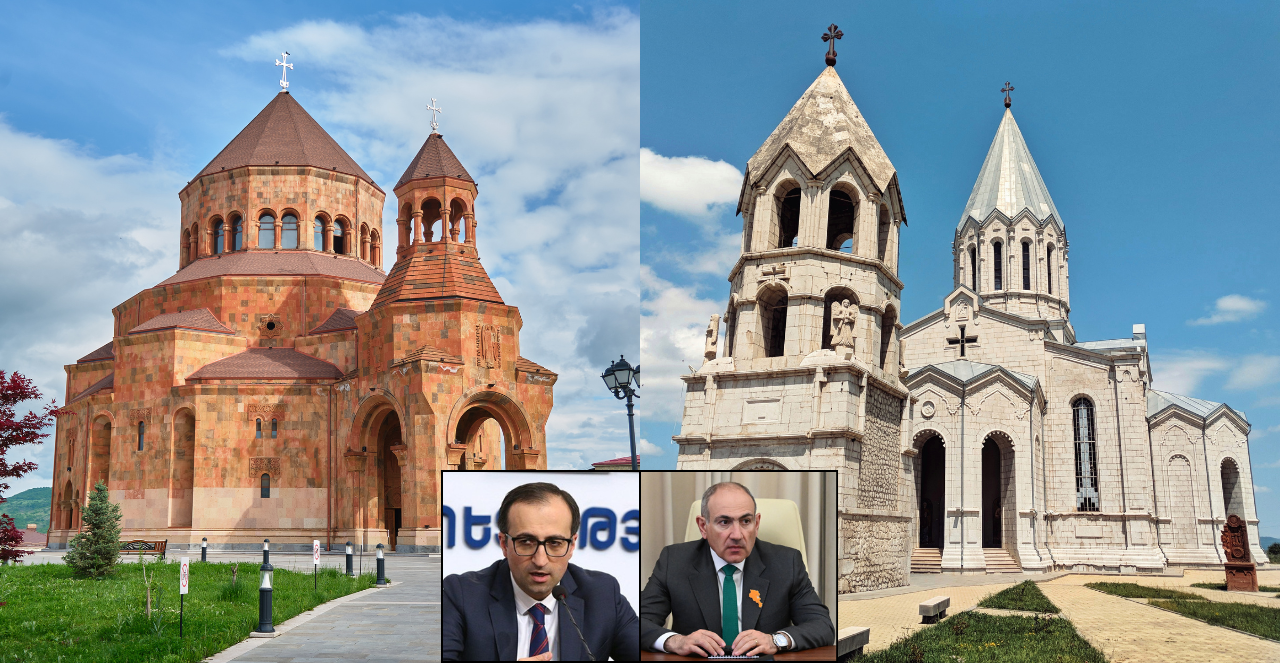

Azerbaijan’s state-controlled Islamic religious body has confirmed and defended the demolition of two of Stepanakert’s Armenian churches, the Holy Mother of God Cathedral and the Church of St. Jacob, claiming “both legal and moral grounds” for razing what it described as illegal structures built during the era of Armenian “occupation.” The Mother See of Holy Etchmiadzin has condemned the destruction as “state-sponsored vandalism” aimed at erasing the Armenian presence from Artsakh.
In a statement issued Monday, the Caucasus Muslims Office (CMO) said the demolition could not be considered an attack on religious or cultural heritage. “The demolition of two illegal buildings cannot be considered a destruction of religious or cultural heritage,” the statement read, adding that formerly displaced Azerbaijanis had repeatedly appealed to state bodies and courts for the structures’ dismantling.
Signs of the cathedral’s recent demolition surfaced last week through satellite imagery, while earlier in the month Armenian media circulated photos indicating that the smaller Church of St. Jacob had likely been completely destroyed.
The CMO’s response came days after the Armenian Apostolic Church issued a strongly worded statement on April 23, condemning what it described as the destruction of Armenian religious and cultural heritage in Artsakh. The Mother See said it had learned “with profound indignation” that Azerbaijani authorities had razed the Church of Saint Hakob (Jacob) in Stepanakert along with nearby khachkars and monuments, which it said were “baselessly declared to be illegal structures.” It also raised alarm over the Holy Mother of God Cathedral, condemning what it called the “systematic destruction of the spiritual and cultural heritage of Artsakh” and accusing Azerbaijan of deliberately targeting Armenian Christian sites.
Etchmiadzin warned that such actions cast serious doubt on Azerbaijan’s stated commitment to achieving a just and lasting peace with Armenia. It called on Armenian authorities to take “urgent and effective steps” to prevent further destruction, and appealed to the international community and cultural organizations to intervene and safeguard Artsakh’s heritage.
Expanding on its position, the CMO framed the backlash as an attempt to politicize the issue at a sensitive moment in Armenia-Azerbaijan normalization efforts. It accused the Mother See of remaining silent for decades over the destruction of Azerbaijani cultural and religious sites, while now making “baseless accusations” against Baku. The CMO also reiterated that Azerbaijan had initially preserved the structures after regaining full control over Artsakh in 2023, and only recent appeals from returning internally displaced persons led to their demolition. It portrayed Azerbaijan as a country with a tradition of religious tolerance, pointing to the coexistence of mosques, churches, and synagogues, and highlighting restoration efforts such as the repair of the Armenian Ghazanchetsots Cathedral in Shushi and the preservation of an Armenian church in Baku.
Armenian Prime Minister Nikol Pashinyan has refrained from directly condemning the demolitions. Three days after reports emerged about the cathedral’s demolition, Pashinyan said he did not believe the issue would become a subject of international discussion at the state level. “We need to be especially cautious with such issues right now, because they are a double-edged sword. As the New Testament says, you will be judged by the same judgment you pass, and measured by the same measure you use. We will look into it and analyze it. Considering our previous experience, I don’t think we will raise this as a topic for international discussion at the state level. This is a situation we must fully understand,” he said during a briefing with journalists.
The Armenian government has largely avoided accusing Azerbaijan of systematically destroying Armenian cultural heritage in Artsakh even as evidence continues to grow. Commenting on the issue, Armenia’s Minister of Labor and Social Affairs Arsen Torosyan said on Public Television that the demolition of churches in Stepanakert could be raised by organizations like UNESCO, but not by Armenia itself. “Let’s say we did that—what would it give Armenia and its citizens? Azerbaijan is doing something within its sovereign territory,” he said.
The cathedral, consecrated in 2019 after nearly 13 years of construction, had served not only as a place of worship but also as a shelter during the 2020 war, when its underground halls were used by residents during bombardments. Reports indicate that the destruction of Armenian religious sites in Artsakh has continued since the 2020 war and intensified after Azerbaijan’s full capture of the region in 2023.


