
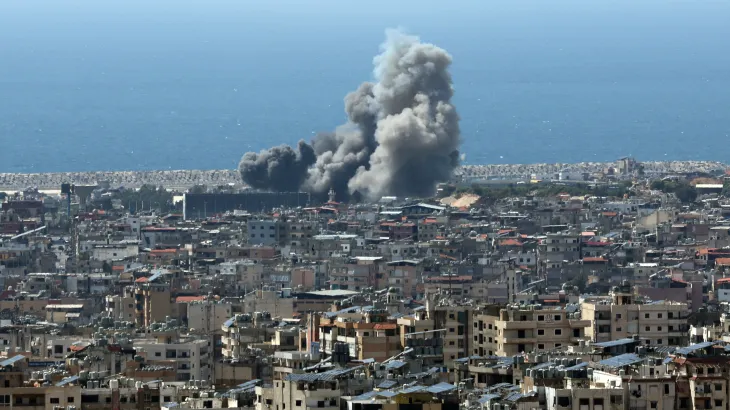

Lebanon’s Armenian communities remain safe so far, with no Armenian casualties reported, despite one of the deadliest waves of Israeli bombardments since the start of the war, Armenian officials in the country told Zartonk Media, as strikes across Beirut, the Bekaa Valley, Mount Lebanon, Sidon, and several southern villages killed hundreds, wounded around 1,000, and deepened fear, uncertainty, and displacement across the country.
Lebanon’s Ministry of Health reported at least 203 people killed and 1,000 wounded in the airstrikes. Earlier, the Civil Defense had put the death toll at over 250.
The attacks came just hours after a two-week ceasefire deal was announced between the United States and Iran, brokered by Pakistan. However, both Israel and the United States said the truce did not include Lebanon, even as Pakistani Prime Minister Shehbaz Sharif insisted the agreement covered “everywhere including Lebanon.” Hezbollah said it had halted its attacks on Israel after the ceasefire took effect.
The Israeli military said 50 fighter jets dropped approximately 160 munitions on more than 100 Hezbollah targets within 10 minutes, describing the assault as its largest coordinated attack on Lebanon since March 2.
Armenian neighborhoods have so far not been directly affected, though the sound of planes, drones, and occasional rockets remains constant, said Aram Somoundji, a member of the ARF Lebanon Central Committee, to Zartonk Media.
“There is fear and uncertainty, of course,” said Somoundji. “But no panic. Life continues, schools are open, Easter masses were held last week, and we’re preparing to commemorate the 111th anniversary of the Armenian Genocide.” He added that displaced people from southern Lebanon and Beirut’s southern suburbs have arrived in Bourj Hammoud and Anjar.
“This isn’t the first time our community has faced challenges like this,” Somoundji said. “We’re organizing ourselves to respond quickly if the situation worsens.”
Shahan Kandaharian, editor of the Lebanese Armenian daily Aztag, told Zartonk Media that while the situation felt more peaceful on Thursday, that did not necessarily mean the ceasefire was holding in Lebanon, even if it appeared to be in place in Iran. He added that the Armenian community in Beirut is not in chaos, but that the situation remains uncertain.
“The Armenians of Beirut do not know what the future will bring,” Kandaharian said.
Somoundji also said that the three Armenian political parties, the Armenian Revolutionary Federation, the Social Democrat Hunchakian Party, and the Armenian Democratic Liberal Party, are holding regular meetings to assess the situation and coordinate their actions.
“A meeting with His Holiness Catholicos Aram I emphasized the importance of unity and cooperation within the community,” he said. “Armenian social and benevolent associations have also mobilized to provide support to those in need.”
Armenia’s Foreign Ministry expressed its condolences in a statement on X. “Gravely saddened by hundreds of victims and more than thousand injuries resulted by airstrikes across Lebanon on April 8. We extend our condolences for families of deceased and wish speedy recovery to all injured, expressing hope for de-escalation and cessation of all hostilities,” the ministry said.
UN Secretary General António Guterres also condemned the strikes, urging all parties to immediately cease hostilities.
The Lebanese government declared April 9 a national day of mourning in memory of those killed in the Israeli airstrikes.
Since the resumption of hostilities on March 2, Israeli attacks on Lebanon have killed more than 1,500 people, including at least 130 children, wounded nearly 5,000, and displaced more than 1.2 million, according to Lebanese authorities.


