
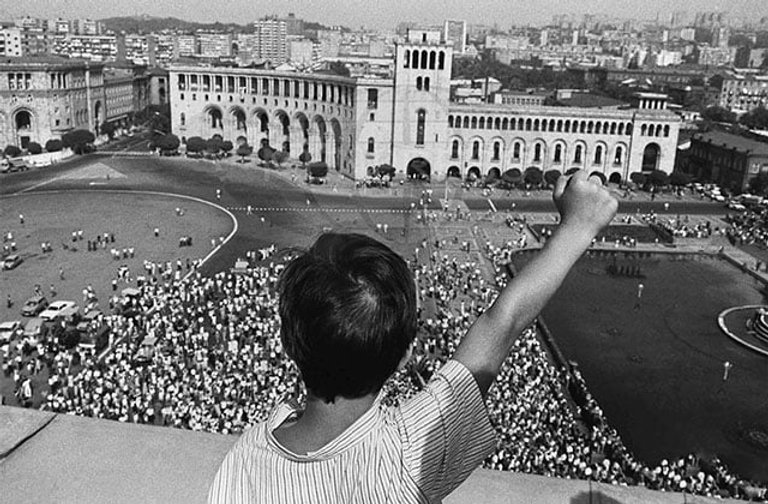

A Yerevan court has banned the screening and distribution of “Our Road to Independence,” a documentary by director Tigran Paskevichyan about Armenia’s Declaration of Independence, after ruling that Public TV holds the film’s exclusive property rights.
The March 27 decision, issued in a case launched in June 2025, prohibits Paskevichyan from using the film in any form, including public screenings. The court also ordered him to pay ?40,000 ($100) to reimburse the state fee paid by the broadcaster, which has held the rights to the documentary since its production in 2020 but has never aired or published it.
The lawsuit concerned the screening of the documentary by Paskevichyan in May 2025 without Public TV’s permission.
The two-episode documentary was produced for the 30th anniversary of Armenia’s Declaration of Independence, adopted on August 23, 1990.
According to the case materials, Paskevichyan’s company signed a contract with Public TV in July 2020 and delivered the finished film in November of the same year. Under the agreement, the filmmaker transferred the film’s property rights to Public TV and received ?4,240,000 ($11,000) in return.
During the court proceedings, Paskevichyan argued that he had previously attempted to discuss the film’s status with the director of Public TV. He said that a letter he sent to the broadcaster’s director on March 3, 2023, requesting to “discuss issues related to the film” remained unanswered.
In court, Paskevichyan also said that when he delivered the documentary in November 2020, as Armenia was reeling from defeat in the Second Artsakh (Nagorno-Karabakh) War, he had himself proposed postponing its debut screening “considering the moral and psychological state of society.”
Paskevichyan said that after Armenia held snap parliamentary elections in June 2021, Public TV never aired the documentary or uploaded it to its YouTube channel, despite “dozens of opportunities to broadcast the film.”
In a separate Facebook post, Paskevichyan accused the channel of “locking away” the documentary for the past five and a half years.
“The public television channel has kept my film ‘Our Road to Independence’ locked away for five and a half years and, through the court, has now banned its screening in any format. I am used to waiting, being patient, and enduring. My previous film, ‘Armenia’s Lost Spring’, faced similar obstacles but was eventually broadcast. This film will also soon go on air, very soon, once we have sent the petty and hypocritical authorities to their appointed place, together with you,” he wrote.
“They consider it inappropriate to show what happened from the 1988 movement up to the Declaration of Independence,” Paskevichyan told CivilNet.
Despite the court ruling, Paskevichyan vowed to continue screening the film in other formats.
Public TV, however, rejected the characterization of the dispute as a film ban. “This is not about censorship, but about failing to fulfill contractual obligations,” Public TV Director Hovhannes Movsisyan said regarding the controversy over the screening of Paskevichyan’s film.
Movsisyan explained that “the film was commissioned, clear deadlines were set, and a broadcast date was scheduled, but the author did not deliver the film within the contractual timeframe.”
“Despite this, some time later, the author began screening the film without the permission of the rights holder, Public TV. Only when the author publicly accused Public TV during one of these screenings did the need for a legal response arise. That is why Public TV turned to the court to defend its rights. It is also noteworthy that during the legal process, the author himself attempted to reach a settlement.
“It is unfortunate when this simple legal issue is presented as a ‘banned film’ story while unnecessary insults are made in parallel,” Movsisyan wrote on his Facebook page.
He also noted that the broadcaster is discussing ways to make the film accessible so that everyone can assess the situation for themselves.
Public TV filed the lawsuit, and the court approved its claim to prohibit the use and distribution of the film. The plaintiff requested “to prohibit the distribution of the film, rental of the originals, alteration of the original or copies, translation, adaptation, rearrangement, illustration, modification, public performance, broadcast, and rebroadcast in any form.”
The dispute over the documentary comes amid ongoing debates in Armenia about references made to the Declaration of Independence in the country’s constitution. The document states it is “based” on a joint decision made by Soviet Armenia’s Supreme Council and the Nagorno-Karabakh National Council on the “reunification” of the two territories.
Azerbaijani officials, including President Ilham Aliyev, have repeatedly stated in past years that Armenia’s constitution contains territorial claims against Azerbaijan, demanding that Yerevan change it.
While Armenian authorities have confirmed plans to hold a referendum on changes to the constitution, and have also hinted that references to the Declaration of Independence would be removed, they have continuously denied that they were doing so under Azerbaijani pressure.


