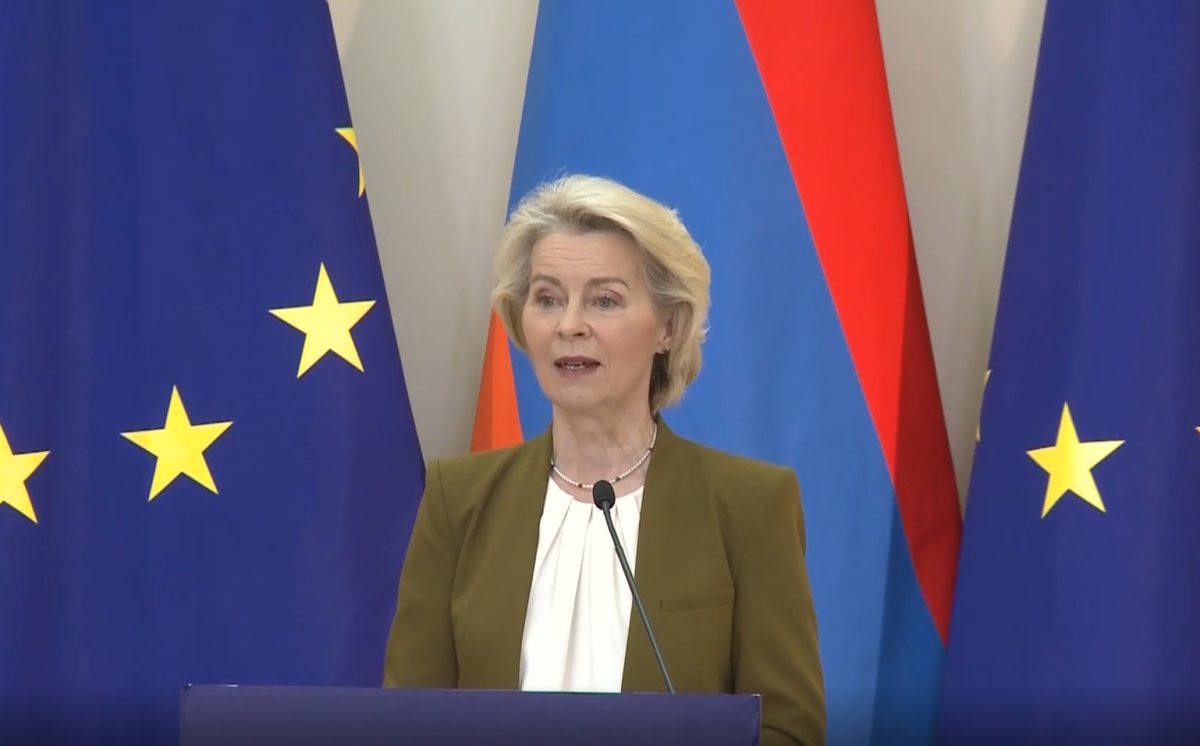

The European Union is preparing an immediate support package worth more than €50 million for Armenia as the country faces growing trade restrictions imposed by Russia on a range of Armenian exports.
The announcement came following a phone call between Prime Minister Nikol Pashinyan and European Commission President Ursula von der Leyen, who described Moscow’s actions as economic coercion and pledged support for affected Armenian businesses and exporters.
She described Moscow’s recent measures in blunt terms. “This is nothing short of economic coercion, and it is unacceptable,” von der Leyen said in a statement released by the European Commission. She accused Moscow of weaponizing economic relations for political pressure by expanding restrictions on Armenian products, and said Europe would stand firmly with Armenia.
“By extending export restrictions on Armenian products, Moscow is weaponizing economic relations for political pressure. We know this playbook all too well. This is why Europe stands firmly with Armenia,” she said.
According to von der Leyen, the support package will include immediate financial assistance exceeding €50 million, measures to facilitate trade for Armenian products entering European markets, and practical support for sectors directly affected by the Russian restrictions. She announced additional measures to ease trade for Armenian products, particularly agri-food goods, and direct support for affected sectors, including Armenia’s flower industry.
A shipment of 10,000 Armenian flowers is expected to arrive in Latvia, with additional deliveries planned in the coming weeks. The initiative follows efforts already announced by the European Union Delegation to Armenia to help Armenian flower producers access European markets after Russia imposed restrictions on flower imports.
Speaking at a meeting with Armenian exporters organized by the International Trade Centre, EU Ambassador to Armenia Vassilis Maragos said the European Union is actively working to open new markets for Armenian producers. “Today, we will present a measure on how we will help export Armenia’s excellent flowers to the European market, particularly to Latvia. In addition, discussions are underway regarding exports to the Netherlands,” Maragos said.
According to the ambassador, the EU Delegation and member states are coordinating efforts to support Armenian exporters, expand existing assistance mechanisms, and help businesses diversify away from traditional markets. “We already have a certain support framework in place, which we are seeking to expand and complement with new measures in order to create new opportunities for producers and exporters,” he said. He stressed that discussions were taking place at the level of the European Commission president and described the initiative as part of the EU’s broader strategy to support the diversification of Armenia’s economy. “This is not a new support measure. It is a continuation of what we are already doing, as we seek to support the diversification of Armenia’s economy,” he added.
Beyond immediate assistance, von der Leyen highlighted Armenia’s growing strategic importance and said the country has the potential to become a key hub connecting Europe, the South Caucasus, and Central Asia. She welcomed the recent reopening of regional trade routes, including railway connections through Georgia and Türkiye, and said the EU is prepared to support infrastructure projects and border-crossing facilities as regional connectivity expands.
“We will continue advancing these priorities together at the Connectivity Platform Ministerial on 23 June,” she said. To coordinate implementation of the new initiatives, the European Union and Armenia agreed to establish a joint EU-Armenia Task Force. The European Commission also noted that support provided under the EU’s Resilience and Growth Plan since 2024 has already assisted approximately 7,000 businesses and contributed to the creation of more than 20,000 jobs in Armenia.
Moscow Defends Restrictions, Signals Shift to Azerbaijani Imports
The EU announcement comes as Russia continues to tighten restrictions on Armenian imports. In recent weeks, Russia’s Federal Service for Veterinary and Phytosanitary Surveillance (Rosselkhoznadzor) imposed restrictions on imports of Armenian flowers, tomatoes, cucumbers, peppers, greens, strawberries, stone fruits, grapes, apples, eggplants, potatoes, dried fruits, fish, mineral water, and alcoholic beverages.
On May 30, Rosselkhoznadzor introduced temporary restrictions on imports of Armenian tomatoes, cucumbers, peppers, greens, and strawberries, citing repeated phytosanitary violations. Additional restrictions on stone fruits and grapes followed, along with measures affecting other agricultural products.
Russia has rejected suggestions that the measures are politically motivated and insists they are based on phytosanitary concerns. At the end of May, Rosselkhoznadzor said Armenian agricultural products had recently failed to comply with Russian and Eurasian Economic Union requirements, and argued that Armenia’s Ministry of Economy had not been properly exercising oversight responsibilities since the dissolution of the Ministry of Agriculture in 2019.
Russian officials have also warned of broader consequences if economic ties between the two countries continue to deteriorate. Boris Titov, the Russian president’s special representative for relations with international organizations, said a complete rupture in economic relations would primarily affect Armenia’s economy. Speaking to RBC, Titov argued that energy prices in Armenia could move closer to European levels while food prices on the domestic market could increase. He also suggested that Armenian products currently sold in Russia could be replaced by imports from Azerbaijan. “And what we lose in Armenia, we will, of course, replace, including with products supplied from Azerbaijan,” Titov said.
Armenia’s Economy Minister Gevorg Papoyan has disputed concerns over product quality, noting that Armenian export-oriented fruits and vegetables possess GlobalG.A.P. certification, one of the highest internationally recognized agricultural standards.
Armenian Government Launches Compensation Program for Exporters
In response to the restrictions, Armenia’s government approved a compensation program during Thursday’s Cabinet meeting aimed at supporting exporters and helping them access alternative markets. Under the program, exporters of fresh greenhouse-grown fruits, vegetables, and flowers shipped abroad during June will receive state compensation. The government set compensation rates at 770 drams per kilogram of strawberries, 275 drams per kilogram of tomatoes, 400 drams per kilogram of peppers, and 37 drams per flower exported.
According to the government’s explanation, the measure is intended to alleviate export-related difficulties, encourage market diversification, and ensure the continued operation of affected businesses. The Ministry of Economy reported that Armenia exported approximately 72.9 billion drams worth of fruits, vegetables, and flowers in 2025, with 93.3 percent of those exports destined for Russia. Government estimates suggest that around 4,250 tons of agricultural products and approximately 10 million flowers could qualify for support under the new compensation scheme during June.
In a separate decision, the government also approved customs duty compensation measures designed to encourage exports of Armenian-made products to the European Union, the United Kingdom, and Canada. Agricultural products classified under crop cultivation activities have been added to the list of goods eligible for support.