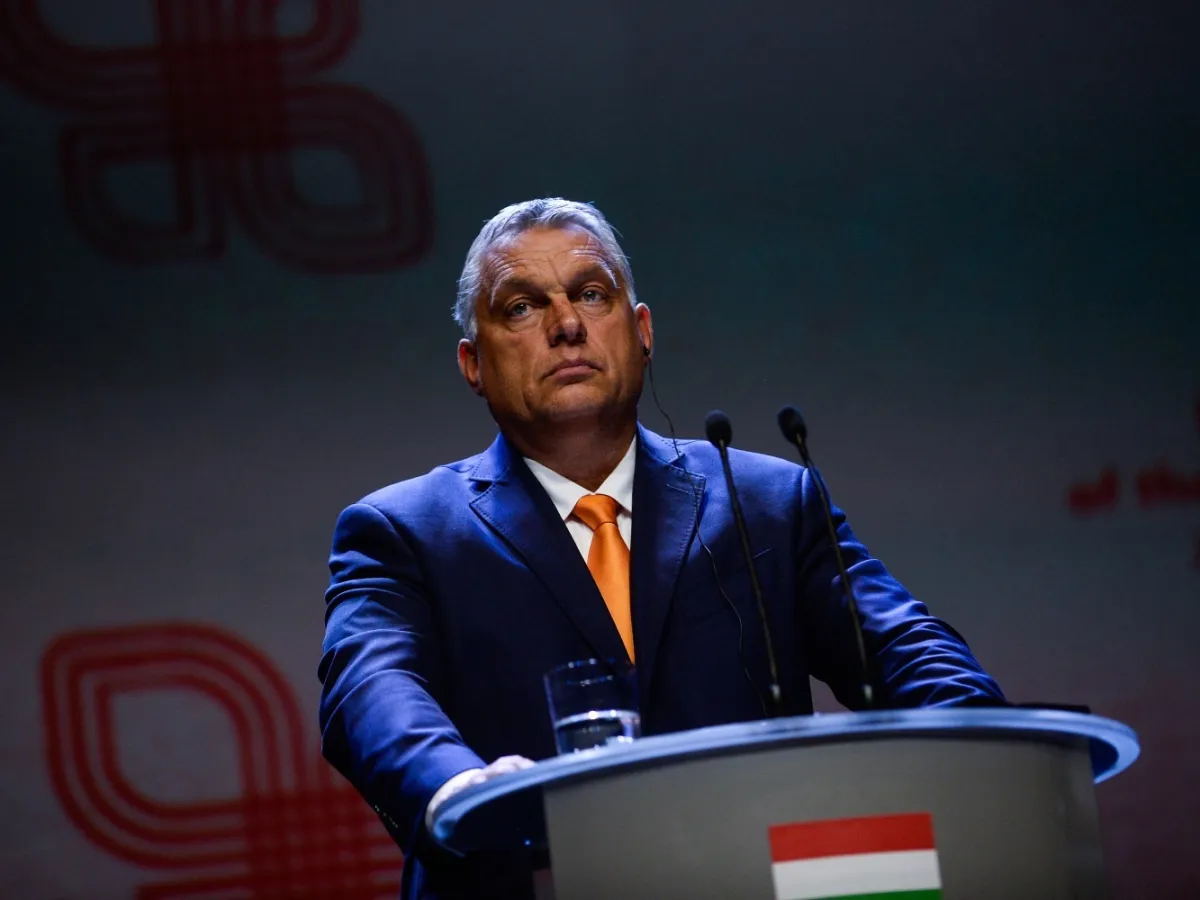

Hungary’s Prime Minister Viktor Orbán, widely known among the Armenian public for the 2012 extradition of Azerbaijani officer Ramil Safarov, the convicted murderer of Armenian officer Gurgen Margaryan, has been defeated in Hungary’s parliamentary elections after 16 years in power. Opposition leader Péter Magyar, a former Orbán ally turned fierce critic, led his Tisza Party to a commanding parliamentary majority, marking a major political shift in Hungary and reviving attention to one of the darkest and most painful episodes in Armenian-Hungarian relations.
Magyar’s Tisza Party won 138 seats in Hungary’s 199-seat parliament with 53.6% of the vote, while Orbán’s Fidesz party, which had dominated Hungarian politics for more than a decade and a half, was reduced to just 55 seats and 37.8% of the vote in an election that saw nearly 80% turnout.
Armenian Prime Minister Nikol Pashinyan congratulated Magyar on his victory, signaling expectations of a potential reset and new chapter in relations with Hungary following Orbán’s defeat. In a post on X, Pashinyan said, “Extend my cordial congratulations to Magyar Péter and the Hungarian people on the occasion of the victory in the Hungarian elections. These democratic elections reflect the will of the Hungarian people and the future vision of the country.”
For many Armenians, however, Orbán’s political legacy extends far beyond Hungary’s domestic politics. His time in office remains stained by the decision to extradite Safarov, whose brutal killing of Gurgen Margaryan shocked Armenians around the world and triggered a diplomatic rupture between Armenia and Hungary that lasted for a decade.
Gurgen Margaryan was in Hungary’s capital, Budapest, to participate in a NATO Partnership for Peace program on January 11, 2004. At around 5 a.m. on February 19, he was killed in his sleep with an axe by fellow participant, Azerbaijani Lieutenant Ramil Safarov.
According to testimony from Margaryan’s Hungarian roommate, Balázs Kuti, he woke up to muffled sounds and saw Safarov standing by Margaryan’s bed holding an axe. Safarov continued the attack despite being confronted, stating he had no issue with the witness, and proceeded to stab Margaryan multiple more times before leaving the room.
A post-mortem examination concluded that Safarov delivered 16 axe blows to Margaryan’s face, nearly severing his head, and that he was also stabbed multiple times in the chest, with Hungarian police briefings later confirming the extreme brutality of the attack.
After killing Margaryan, Safarov reportedly attempted to target another Armenian officer participating in the program, but was unable to access the room.
During interrogation and trial, Safarov stated that he killed Margaryan solely because he was Armenian. In April 2006, the court sentenced him to life imprisonment without the possibility of parole until 2036, citing the premeditated nature of the crime, its brutality, and his lack of remorse.
However, in August 2012, Hungarian authorities approved Safarov’s extradition to Azerbaijan to serve the remainder of his sentence there, a move that sparked outrage in Armenia and across the Armenian world.
Orbán later defended the decision by insisting it had been made in accordance with Hungarian and international law, saying: “We would have done the same if an Armenian had killed an Azerbaijani. Hungary should follow its own interests rather than those of Armenia or Azerbaijan.”
For Armenians, that justification only deepened the sense of betrayal. What Hungary presented as a legal transfer was seen by many as a grave moral failure, one that ignored the racist and premeditated nature of the murder and the obvious likelihood that Safarov would not remain behind bars in Azerbaijan.
Following the extradition, Armenia suspended diplomatic relations with Hungary in 2012, while Safarov received a hero’s welcome upon arriving in Baku.
He was not only pardoned by Azerbaijani President Ilham Aliyev, but also promoted to major, granted an apartment, and paid eight years of back wages. Azerbaijan’s Human Rights Commissioner later stated that Safarov “must become an example of patriotism for Azerbaijani youth.”
The episode became one of the clearest and most disturbing examples of how anti-Armenian violence was not only excused in Azerbaijan, but openly glorified, leaving Orbán’s name permanently tied in Armenian memory to the decision that helped turn a convicted murderer into a celebrated figure.
In 2017, media investigations raised allegations of financial links tied to the extradition. According to the Organized Crime and Corruption Reporting Project (OCCRP), more than $9 million was transferred in 2012 to 2013 to Hungarian bank accounts linked to Velasco, an offshore company owned by a son of Azerbaijan’s Deputy Prime Minister Yaqub Eyyubov. The report stated the company was dissolved in 2015, and it remains unclear where the funds ultimately ended up.
Notably, on the website of the Armenian Foreign Ministry, the reason for suspending diplomatic relations with Hungary is no longer explicitly detailed, stating only that relations were suspended before noting that on December 1, 2022, Armenian Foreign Minister Ararat Mirzoyan and Hungarian Foreign Minister Péter Szijjártó met on the margins of the OSCE Ministerial Council in ?ód?, where an agreement was reached to restore full diplomatic relations.