
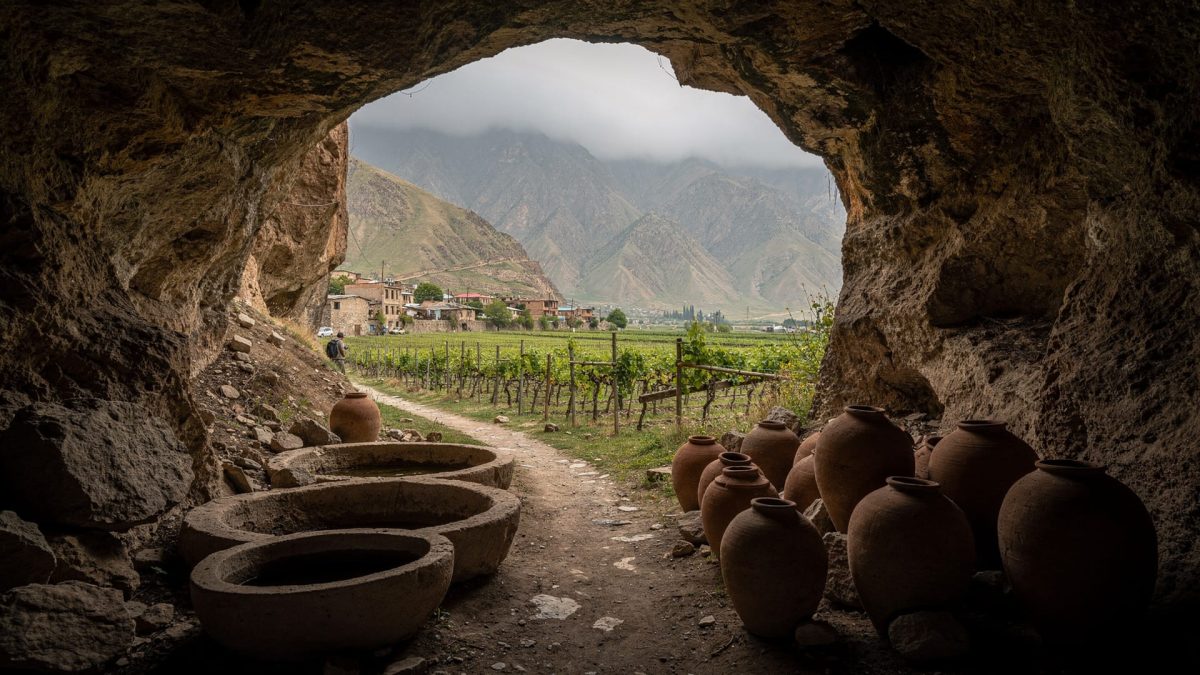

Armenia’s Areni-1 Cave, home to the world’s oldest known winery, has been added to UNESCO’s World Heritage Tentative List. The cave in Vayots Dzor Province holds a 6,000-year-old winemaking installation dating to around 4000 BC, along with the world’s oldest preserved leather shoe.
The Ministry of Education, Science, Culture and Sports announced the listing. The nomination, titled “Areni-1 (Birds’) Cave: Prehistoric Life and Winemaking in the Arpa River Gorge,” was approved during the 48th session of the World Heritage Committee, taking place in Busan, South Korea, from July 19 to 29. Armenia’s Permanent Delegation to UNESCO submitted it under criteria three, four, and five.
Armenia is participating in the session as a member of the World Heritage Committee for the first time. The country was elected to the body on November 24, 2025, at UNESCO headquarters in Paris, receiving 105 of 161 votes, the highest result among all candidates for the open seats, and holds the seat for the 2025 to 2029 term.
The Armenian delegation is headed by the country’s Permanent Representative to UNESCO, Aram Hakobyan, and includes Harutyun Vanyan, head of the Department for the Protection of Historical and Cultural Monuments at the ministry, along with five national experts.
The nomination was prepared through a memorandum of cooperation signed between the Ministry of Education, Science, Culture and Sports, the Areni-1 Cave Research Foundation, and the Armenian Enotourism Council. The Enotourism Council financed the project.
With the addition of Areni-1, Armenia now has eight sites on UNESCO’s World Heritage Tentative List, having added four entries over the past three years to the four originally registered in 1995. The other recent additions are the Vishaps and the Cultural Landscape of Tirinkatar, the Archaeological Complex of Garni and the “Basalt Organ” Columnar Joint, and the Urartian Heritage of Yerevan.
Archaeologist Boris Gasparyan first recognized the cave’s significance in 1997, and systematic excavations began in 2007 as a joint project of the Institute of Archaeology and Ethnography of Armenia’s National Academy of Sciences, the Cotsen Institute of Archaeology at UCLA, and University College Cork in Ireland. Excavators uncovered a packed-clay pressing platform sloping into a buried storage jar, surrounded by larger vessels filled with grape pips, skins, and stems. Chemical analysis identified tartaric acid and malvidin, conclusive markers of grape wine, and radiocarbon dating placed the installation at around 4000 BC.
The same cave produced the world’s oldest preserved leather shoe, found in a plastered pit beneath a ceramic vessel. Measuring 24.5 centimeters and stitched from a single piece of cowhide, it was stuffed with grass to hold its shape and dates to roughly 3600 to 3400 BC, several centuries older than the footwear of the Alpine iceman known as Ötzi.
Excavators also documented ritual and mortuary deposits, including ceramic vessels holding the skulls of children and adolescents, accompanied by offerings such as goat horns, a deer scapula with dried meat, and fish vertebrae.
The cave, known locally as the Birds’ Cave, sits in the limestone cliffs of the Arpa River gorge in southern Armenia. Positioned at the natural crossroads between the Ararat Depression and the Syunik Uplands, the site overlooks fertile alluvial lands cultivated for thousands of years with orchards and vineyards.
The cave is a multi-chamber karst system with three main galleries extending more than 40 meters into the cliff. The eastern gallery rises to over 10 meters at its entrance, while the central gallery reaches deep into the bedrock, forming dark, stable microclimates. A steep talus slope leads down to the Arpa River, and an external rockshelter was once reinforced by cyclopean dry masonry. The total interior area is approximately 850 square meters, while the wider cave system and adjacent terrace together exceed 7,800 square meters.
Those conditions gave the cave natural protection and preserved organic materials rarely found in world prehistory. Wood, rope, textiles, leather, plant remains, and even food residues have survived there for six millennia. Human use of the cave spans from the Neolithic through the medieval period, with the most intensive occupation during the Late Chalcolithic, roughly 4500 to 3500 BC. Late Chalcolithic painted pottery in the cave lies directly beneath the earliest Kura-Araxes wares, which marks the start of the Early Bronze Age in the region.
Areni-1 forms part of a wider landscape of caves in the Arpa gorge, where surveys have documented nearly forty caves showing traces of prehistoric use, though Areni-1 is among the largest, richest, and most intensively occupied. Areni village still grows grapes and makes wine on the land below the cave.


