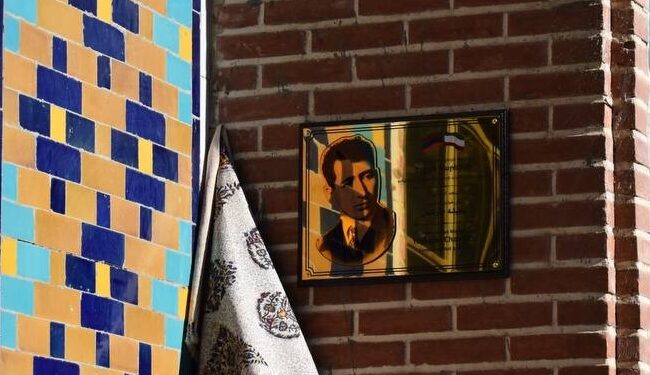

Azerbaijan’s state-linked religious authority condemned the naming of a hall in Yerevan’s Blue Mosque after Armenian poet Yeghishe Charents, calling it “an obvious manifestation of vandalism and a provocation,” reports Zartonk Media.
The Caucasus Muslims Office said on November 11 that it “strongly condemns and firmly protests” the event, and called the naming of a hall after an Armenian poet and plans to install his bust an act of blasphemy. It demanded that the Armenian government prevent such events and said the naming undermines the peace process. Azerbaijan’s State Committee for Work with Religious Organizations separately called the developments “disrespectful to universal values.”
The statement accused Armenia of attempting to “falsify the history of the mosque built in the 18th century by Huseynali Khan,” and said efforts to present the building as Iranian were doomed to fail.
The building Azerbaijan is claiming was commissioned by Hoseyn Ali Khan, ruler of the Erivan Khanate, and completed in 1765 and 1766. The khanate was a Persian administrative unit, Persian was the language of its court, and the mosque’s inscriptions are in Persian. There was no Azerbaijani state at the time, and none would exist for another 152 years.
The hall was named after Charents on November 9 at an event organized by the cultural center of the Iranian Embassy in Armenia. Iranian Vice President Seyyed Hamid Pourmohammadi unveiled the nameplate and attended the launch of the first Armenian prose translation of Ferdowsi’s Shahnameh, translated by Georg Asatryan. The embassy called Charents “a friend of Iranian culture and literature” and said a bust of the poet would be installed in the hall.
Iran has managed the Blue Mosque for 3 decades. Yerevan transferred the right of use to Iran in October 1995, Iran funded the restoration between 1994 and 1998, and in December 2015 the complex was leased to the Iranian Embassy for 99 years as a cultural center. It is the only working mosque in Armenia and houses a Persian library opened in 2014.
Iran has rejected Azerbaijan’s claim to the building repeatedly and in public. Iranian Ambassador to Armenia Khalil Shirgholami said on November 4 that “Yerevan’s Blue Mosque has been and will remain Armenian-Iranian,” and that its design and tilework clearly reflect Iranian architectural style.
In 2022, after 2 Azerbaijani lawmakers called the mosque the only Azerbaijani monument preserved in the Armenian capital and said its “real masters” would soon pray there, the Iranian Embassy responded by calling the building a symbol of Iranian art and publishing photographs of its inscriptions with the question, “Who can read them?”
Charents was born Yeghishe Soghomonyan in Kars in 1897 and is among the most widely read Armenian poets of the 20th century. He was arrested in July 1937 during the Great Purge on charges of Trotskyite and nationalist activity, died in NKVD custody in Yerevan on November 27, 1937, and his books were banned. He was rehabilitated in 1955 and his burial place remains unknown.
Iranian officials have said Charents helped save the mosque from demolition under Soviet rule, an account that comes from Iranian sources and is not documented in standard records of his life. What is established is that the mosque courtyard and its teahouse became a gathering place for Yerevan’s writers and artists in the Soviet period, and that Charents was among its regulars.
The mosque stands because Armenians kept it standing, the only one of Yerevan’s 8 mosques to survive the Soviet period, and it survived by being converted rather than demolished, first into the Anti-Religious Museum, then into the Museum of Natural Sciences with a planetarium, and from 1936 into the Yerevan History Museum. It reopened for worship in 1996 and has functioned as a mosque ever since.
Azerbaijan issued its statement about vandalism 7 months after it razed the main Armenian cathedral of Stepanakert in Occupied Artsakh (Nagorno-Karabakh).
The Cathedral of the Protection of the Holy Mother of God was founded in 2006 by Catholicos Garegin II and consecrated on April 7, 2019. It was 35 meters long, 30 meters wide and 35 meters tall, seated about 1,500 people, and Monument Watch describes it as one of the most important spiritual and architectural symbols of Artsakh. Its last liturgy was held on October 1, 2023, after Azerbaijan’s September 2023 assault and during the forced displacement of more than 120,000 Armenians.
Hetq reported the cathedral still standing on March 3, 2026. Sentinel-2 satellite imagery from April 2 showed its white paving stones with no building on them. Caucasus Heritage Watch confirmed the destruction, Planet Labs imagery published by Simon Maghakyan confirmed the loss of both the cathedral and Surb Hakob Church, and on April 28 Monument Watch issued an alert stating that the cathedral had been razed to the ground by Azerbaijan.
Azerbaijan’s Foreign Ministry declined to comment on the destruction to RFE/RL, and the pro-government agency APA responded by pointing to Armenia’s “responsibility for acts of vandalism against Azerbaijan’s religious monuments.” The November 11 statement likewise accused Armenians of decades of vandalism against mosques “including in Shusha.” Ghazanchetsots Cathedral in Shushi was shelled during the 2020 war and has been under Azerbaijani control since November 2020.
Armenia’s government did not raise the cathedral’s destruction internationally. Asked about it on April 23, Prime Minister Nikol Pashinyan told reporters after the government session, “I don’t think we will make that a subject of international discussion at the state level,” and said “such topics are a double-edged sword.”
The Artsakh Union called the destruction the direct result of what it described as the encouraging statements and inaction of Armenia’s authorities. It demanded an urgent application to the International Court of Justice for new provisional measures, sanctions against Azerbaijan at the UN Security Council and UNESCO, and the protection of Artsakh’s heritage as a precondition in negotiations with Baku.