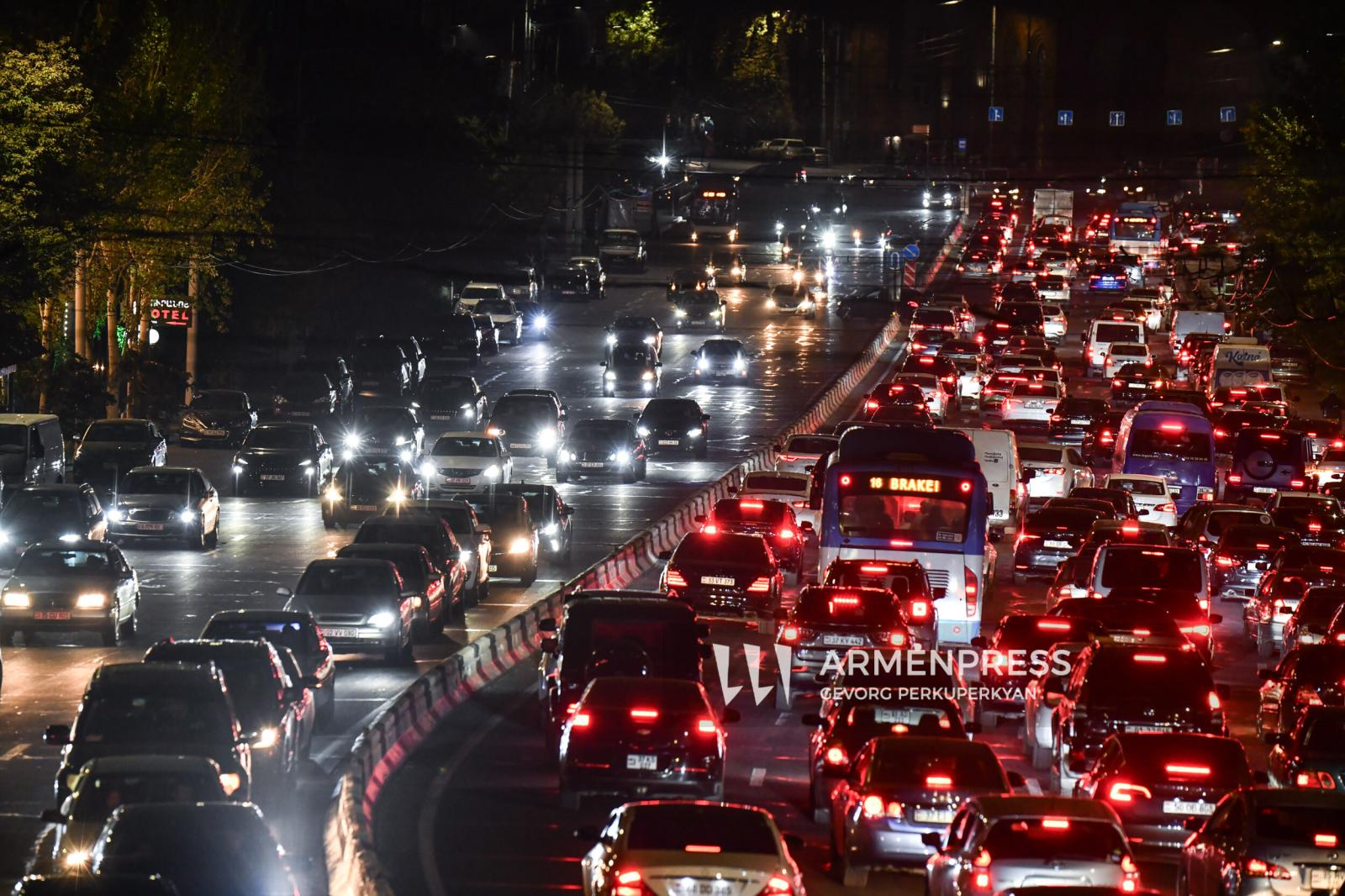

Yerevan Mayor Tigran Avinyan said on November 9 that the capital’s traffic cannot be solved without restrictions on cars, and that getting around Yerevan by car has to become more of a luxury, reports Zartonk Media.
He said the answer is to give public transport priority through dedicated bus lanes while limiting the movement of passenger cars in parts of the city. He spoke at the National Assembly during the preliminary discussion of Armenia’s 2027 draft state budget, calling congestion one of the capital’s most fundamental problems.
“Without restrictions we cannot have any solution,” Avinyan said.
“Getting around by car here, so to speak, must become somewhat more of a luxury,” he said.
He said the number of cars in Yerevan will keep growing as the economy improves and people have more money, and that nearly every developed city has taken the same approach.
Avinyan did not present that as painless. “But to be honest, we must clearly state that this will create a bigger problem for passenger cars,” he said. He said the city needs to build proper parking infrastructure alongside the restrictions and make public transport a reliable way to move around.
One concrete measure is already identified. The municipality plans to reduce “red line” parking in parts of Yerevan’s small center to keep traffic flowing continuously.
Avinyan rejected building more roads as an answer, saying new roads will fill up as the number of cars grows. “Our streets are not made of rubber, they cannot be widened further,” he said, noting that American cities with wide roads built for cars still have congestion.
He said the heavy flow of cars contributes to emissions of nitrogen dioxide, which is dangerous to health and particularly to people with respiratory problems.
Avinyan presented the results of a municipal study of 100 Yerevan intersections. He said that in about 85 percent of the cases observed, congestion begins when a driver enters an intersection at the last moment of a green light and stops, blocking traffic.
He acknowledged that Yerevan’s own public transport drivers do the same, and said the municipality has already worked with the bus and electric transport services to prevent it. A repeat study is planned.
Avinyan also raised the congestion caused by minor collisions. He said the patrol service’s functions should be revised so that in light accidents without serious injuries, officers prioritize clearing the road quickly over recording minor damage. He said legislative discussions on this are under way with Deputy Prime Minister Tigran Khachatryan.
On the lanes themselves, Avinyan said the municipality’s analysis indicates dedicated bus lanes could speed public transport by up to 30 percent, and that 15 buses running on dedicated lanes can move faster than 25 buses without them. On October 12 he said travel times on some routes rise by as much as 70 to 80 percent at peak hours. The city’s target is to cut average public transport travel time by 30 percent by 2030.
The draft budget sets aside 765 million drams, about $2.1 million, for road markings, traffic signs and traffic lights in Yerevan.
In a press briefing afterward, Avinyan rejected reports that the municipality intends to bar cars from Armenia’s regions from entering the capital.
“There is no issue of restricting residents of the regions from entering Yerevan on our agenda. The uproar surrounding this issue is the result of misleading headlines,” he said. “In this situation, there is no other solution than to give priority to public transport by expanding bus lanes. At the same time, the movement of passenger cars through various parts of the capital must be restricted. First and foremost, it is very important for public transport in Yerevan to begin operating regularly. People should know that buses will arrive at stops according to the posted schedule.”
The denial followed an interview Deputy Mayor Suren Grigoryan gave to Factor TV, in which he said one of the city government’s strategic aims is to build parking at the entrances to Yerevan so that people arriving from the regions can leave their cars and travel inside the city by public transport.
Grigoryan is also the official Avinyan tasked with the bus lanes. At City Hall’s executive session on October 26, Avinyan asked him to present a phased plan for the lanes this year and said implementation begins in the same period. The first lane is to be separated on the right side of the road with cameras installed, followed by a second and a third.
It is the second time this year Avinyan has told lawmakers the city will need restrictions on private cars. He made the same argument in June, saying the main cause of the congestion is economic growth and the rise in car ownership that came with it.
On the fleet, Avinyan said a tender package has been prepared for 170 electric buses to replace the diesel Higer buses now in service. That purchase is not yet funded in the draft budget, and he said he expects state financing to change during the discussions.
A separate program for 250 electric buses, under negotiation with the Asian Development Bank, is waiting on the consultants’ final report, which is to include the solutions for dedicated bus lanes. The purchases follow Avinyan’s October decision that Yerevan will buy only electric buses from its next tender onward.
On the metro, the draft budget allocates 2 billion drams, about $5.5 million, for construction of the Ajapnyak station, specifically for the purchase of land. Avinyan said that is not enough. It would be the system’s 11th station and the first new one since Charbakh opened in 1996.
Finance Minister Vahe Hovhannisyan told the same session that “allocating more than 2 billion drams for next year would not be realistic,” and that the government has an agreement with the municipality to add funds if the scope of work grows or construction moves faster than planned. Mayoral adviser Anetta Babayan said in April that the project as a whole is valued at 107.3 billion drams, about $298 million at the current exchange rate.
Ajapnyak has slipped repeatedly. Construction was first set for 2024, then moved to the end of 2025, then to 2026, and in February a city official said the tender could be announced in 2026 or 2027. The city allocated 9.6 billion drams to the program in its 2025 budget and later cut that to 1.4 billion, with part of the difference going to buy 45 new trolleybuses. Armenia’s Investigative Committee opened a criminal case in February 2026 on signs of official negligence over the ordering and procurement of equipment for the project.
Avinyan said in October that construction “must begin next year, regardless of which partner is involved in the project.” Prime Minister Nikol Pashinyan told a government meeting in June that it is “very important that we finally begin construction of the Ajapnyak station,” adding that “contrary to popular belief, there are no delays in this matter.”
The draft budget provides 2.5 billion drams, about $6.9 million, for renovating metro infrastructure, and 1 billion drams, about $2.8 million, to subsidize metro operations. Avinyan said that subsidy is not enough.
“In terms of the metro subsidy, 1 billion drams is allocated, which does not cover the full cost of the metro even taking the new tariffs into account, and the Yerevan Municipality again allocates budget so that it can carry out the current servicing of the metro,” he said. He added that the municipality has final government approval for the metro modernization program, and that trains are overcrowded in the early morning and at the end of the working day, so the city regularly increases the number of train cars.
Yerevan’s congestion has been a stated government priority for more than a year. Pashinyan told a Cabinet meeting in October 2025 that the capital’s traffic had reached a crisis point, saying the center had been so congested the previous evening that “you couldn’t even get through on a bicycle,” and ordered the Ministry of Internal Affairs, the Ministry of Territorial Administration and Infrastructure and City Hall to form a crisis team.
An interdepartmental commission on traffic chaired by Khachatryan met in December 2025, with an action plan due in early 2026. City Hall’s own pilot study of vehicle flows into the city was due to report between September and October. Neither had been presented publicly as of Monday.