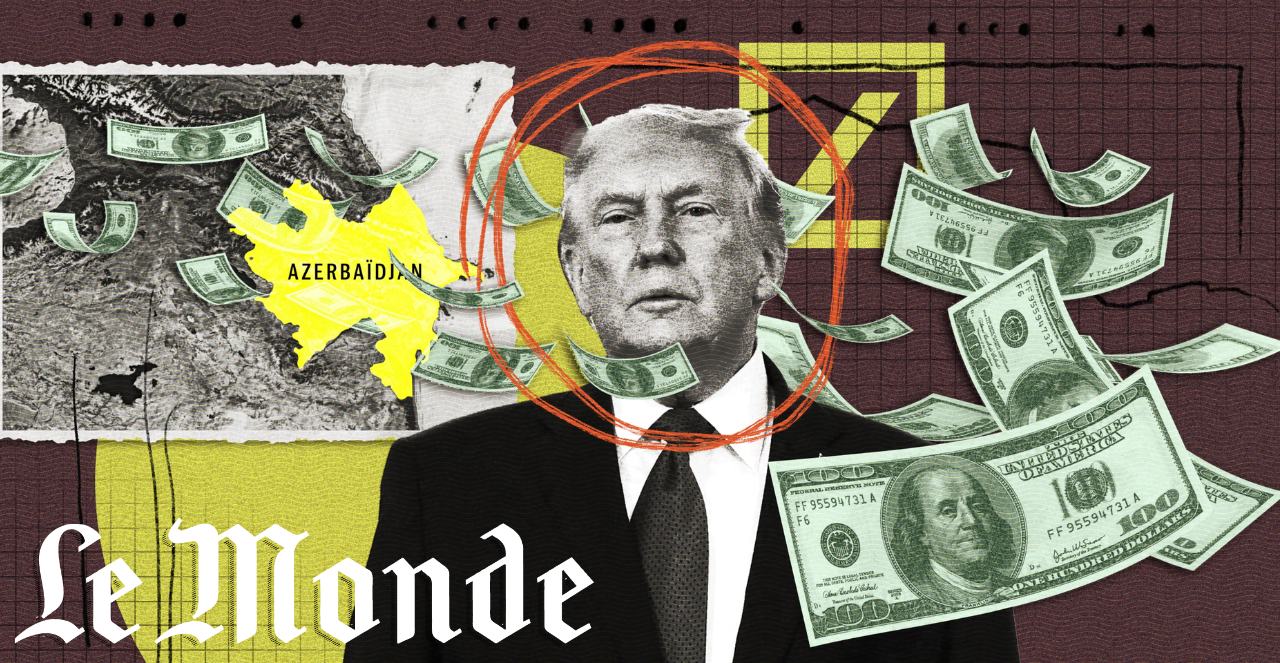
Money moved through the Azerbaijani Laundromat reached 2 companies owned by Donald Trump in the spring of 2015, routed through a Scottish shell company with no offices and no employees, and Deutsche Bank later named both companies in a suspicious activity report over their connection to the scheme, according to a leak of the bank’s internal files reported by Le Monde and an international consortium of journalists, reports Zartonk Media.
The investigation, called Inside Deutsche Bank, is built on more than 15 million internal files covering the bank from the early 2010s onward. Le Monde reports the leak came from 2 whistleblowers and was obtained by Indian journalist and author Josy Joseph and South African investigative journalist Khadija Sharife, then shared with more than 230 journalists at over 50 outlets. Le Monde, one of the consortium’s partners, describes the records as linking Trump to dirty Azerbaijani money.
The Azerbaijani Laundromat was a secret fund of nearly $3 billion, exposed in 2017 by the Organized Crime and Corruption Reporting Project and Le Monde. Through the 2010s it was used to buy political influence abroad and to move public money for the benefit of Azerbaijan’s elite in Baku. Much of that influence spending was directed at European politicians on the Azerbaijani government’s behalf.
In the spring of 2015, weeks before he announced his run in the Republican primary, Trump was involved in a luxury hotel project in the Azerbaijani capital, the Trump International Hotel & Tower Baku.
On April 16 of that year, DT Marks Baku LLC, a Delaware company owned by Trump that collected licensing fees for use of the Trump brand on the project, was sent a wire of $141,261.82 described only as payment against an invoice number. Le Monde reports the transfer failed because of a data entry error in the beneficiary account number, and the money went back to its sender.
That sender was Faberlex LP, a Scottish shell company with no offices and no employees. Le Monde reports Faberlex was funded by Baktelecom, Azerbaijan’s state-owned telecom company, through an account at the Estonian branch of Danske Bank, the institution at the center of the Laundromat.
The next day the identical sum, to the cent, went to an offshore shell company called Datemile Alliance under a different description. Twelve days later Faberlex sent the same amount to THC Baku Services, another Trump-owned company, under a third description.
Both Faberlex and Datemile were central to the Azerbaijani Laundromat, and an internal Deutsche Bank document describing the scheme says Faberlex played a central role in it. The same figure moving through 4 accounts in 2 weeks under 3 different explanations is a pattern investigators associate with laundering, because multiplying transfers and changing payment descriptions breaks the trail between where money comes from and where it ends up.
Deutsche Bank’s New York branch was the correspondent bank standing between Danske Bank Estonia and Capital One, where Trump’s companies held their accounts. Le Monde reports the transfers passed unnoticed among the millions the branch processed daily.
After the 2016 election the bank moved in the opposite direction. Trump owed it more than $300 million at the time, and in December 2016 it created a category for him and his associates called “covered client,” with encrypted communications, files open to only a handful of staff, masked beneficiary names and paper records kept in a safe.
Alerts on those accounts were marked “Confidentiality = 99” and were visible to very few analysts inside the bank. Le Monde reports that an aide to the chief executive wrote to the risk management team that piecing together the Trump entities was difficult because the anti-money-laundering data was scattered and incomplete.
The Azerbaijani connections surfaced only years later. When the Democratic majority in the House of Representatives demanded a decade of records in the spring of 2019, the bank accelerated an internal audit begun in 2017, and that review turned up the Azerbaijani links and passed them to its investigators.
On January 16, 2020, the bank’s US branch filed a suspicious activity report naming DT Marks Baku and THC Baku for their connection to the Azerbaijani Laundromat. A confidential memo written in May 2020 by Brian Hagerty, the bank’s American head of financial intelligence, recorded that filing and stated that Trump himself was not identified as a suspect.
Hagerty’s reconstruction found that entities reported to be associated with the Azerbaijani and Russian Laundromat operations had paid the 2 Trump companies at least $3 million before September 2015. A separate report filed in June 2017 covered other companies linked to Trump for a total of $5.2 million, and in that case too Trump was not identified as owning or controlling the entities involved.
The documents do not establish that Trump took part in money laundering, and no finding of wrongdoing has been made against him or against his Azerbaijani partners in the hotel project.
Deutsche Bank announced it was severing ties with Trump 5 days after the assault on the US Capitol on January 6, 2021. Capital One monitored the flows under its own confidential program and closed more than 300 accounts linked to him in the spring of 2021, citing money laundering suspicions that included Azerbaijan. Trump sued the bank in 2025, saying he had been cut off for political reasons.
Asked about its relationship with Trump, Deutsche Bank told the consortium it does not comment on actual or potential client relationships. The Trump Organization did not respond to questions about the transactions, including why hotel royalties were collected through a shell company with no connection to the hotel business. Capital One did not respond to requests for comment.