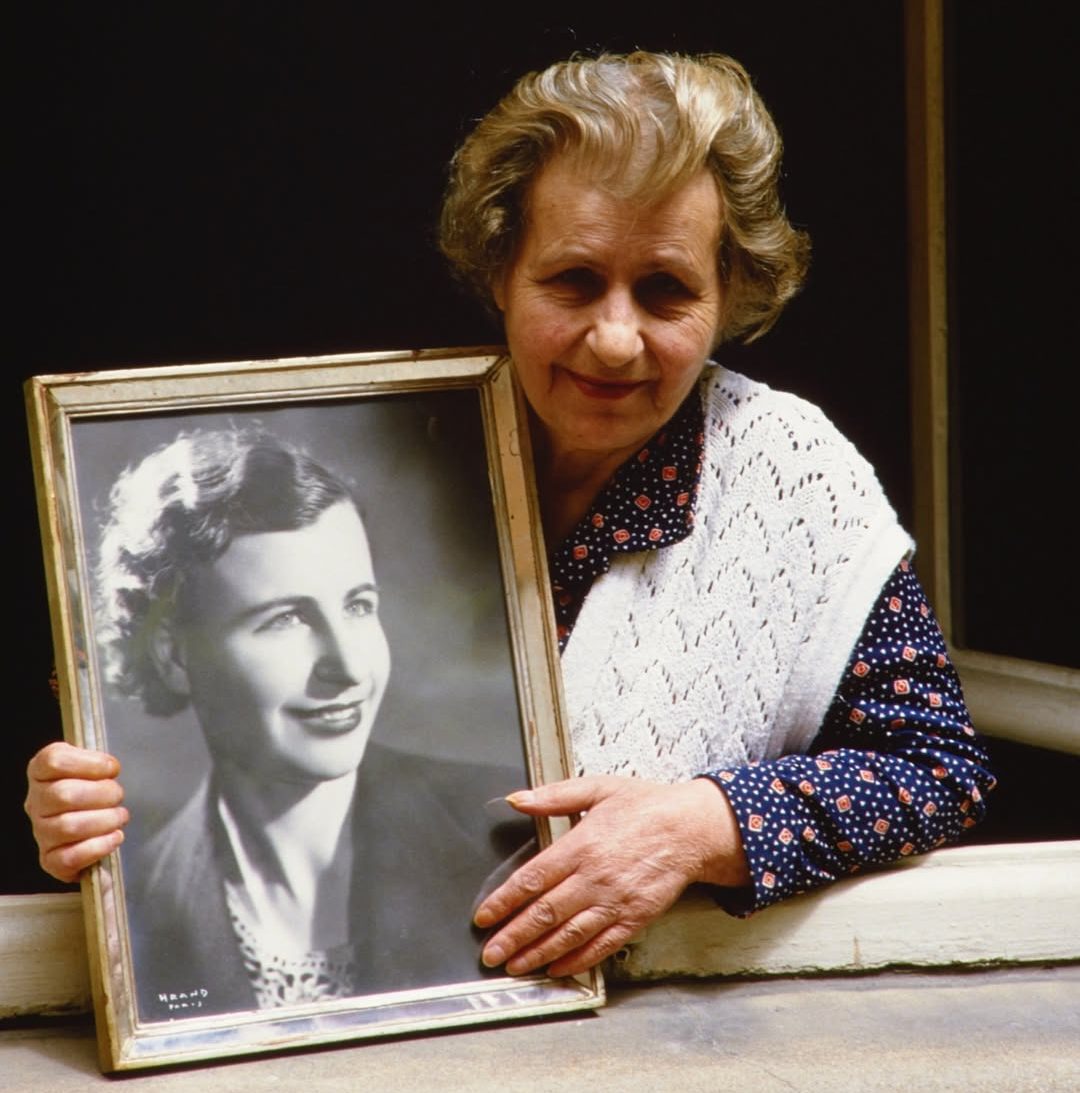

Today we honor Mélinée Manouchian, Armenian Genocide survivor, heroine of the French Resistance, and devoted wife of Missak Manouchian, on what would have been her 113th birthday.
Mélinée Manouchian was born Mélinée Soukémian on November 13, 1913 in Constantinople. As a child, she survived the Armenian Genocide, losing her parents. She and her elder sister were taken to a Protestant orphanage in Smyrna, and later moved to Corinth, Greece. In 1926 she was sent to Marseille through the American Committee for Armenian and Syrian Relief, where she learned French, studied accounting, and began rebuilding her life.
In 1929 she enrolled at the Franco-Armenian school École Tebrotzassère, where she studied Armenian language and history, received her certificate of primary studies with honors, and trained as an accountant secretary. It was in France that Mélinée found both her identity and her purpose.
In 1934 she met her future husband, Missak Manouchian, the poet, intellectual, and leader of the famed Manouchian Group of the French Resistance. In 1935 she became secretary of the Armenian Relief Committee and developed a close connection with the Aznavourian family, the parents of Charles Aznavour, who would later risk their lives to shelter her during the war. She married Missak in 1936.
A Heroine of the French Resistance
During World War II, Mélinée became an indispensable member of the Resistance alongside her husband. She worked undercover, tracking enemy movements and distributing clandestine anti-fascist literature. She posed as a bystander at the scenes of guerrilla attacks to gather intelligence under the eyes of German soldiers. She also helped advocate for Missak’s release from a prison camp in 1941, long before his final arrest.
Missak went on to lead the FTP-MOI, the Francs-Tireurs et Partisans, Main-d’Œuvre Immigrée, a famed Resistance unit composed largely of foreign-born anti-Nazi fighters, Armenians, Jews, Poles, Italians, Spaniards, and others who fought for the liberation of France.
When Missak was arrested for the first time, Mélinée traveled by bicycle with Micha Aznavourian to the Compiègne camp, managing to pass food to her husband, prisoner number 351, and visiting him twice under dangerous conditions.
After Missak’s final arrest, which led to the infamous “Affiche Rouge” propaganda campaign used by the Nazi occupiers to turn public opinion against the Resistance, Mélinée was sentenced to death in absentia. The Aznavourian family hid her and saved her life.
Missak’s Final Letter to Mélinée
Hours before his execution on February 21, 1944, Missak wrote his final letter to Mélinée. It remains one of the most moving testimonies of devotion, courage, and patriotism from the Resistance:
“My dear Mélinée, my beloved little orphan,
In a few hours I will no longer be of this world. We are going to be executed today at 3:00. This is happening to me like an accident in my life; I don’t believe it, but I nevertheless know that I will never see you again.
What can I write you? Everything inside me is confused, yet clear at the same time.
I joined the Army of Liberation as a volunteer, and I die within inches of victory and the final goal. I wish for happiness for all those who will survive and taste the sweetness of the freedom and peace of tomorrow. I’m sure that the French people, and all those who fight for freedom, will know how to honor our memory with dignity. At the moment of death, I proclaim that I have no hatred for the German people, or for anyone at all; everyone will receive what he is due, as punishment and as reward. The German people, and all other people, will live in peace and brotherhood after the war, which will not last much longer. Happiness for all … I have one profound regret, and that’s of not having made you happy; I would so much have liked to have a child with you, as you always wished. So I’d absolutely like you to marry after the war, and, for my happiness, to have a child and, to fulfill my last wish, marry someone who will make you happy. All my goods and all my affairs, I leave them to you and to my nephews. After the war you can request your right to a war pension as my wife, for I die as a regular soldier in the French army of liberation.
With the help of friends who’d like to honor me, you should publish my poems and writings that are worth being read. If possible, you should take my memory to my parents in Armenia. I will soon die with 23 of my comrades, with the courage and the serenity of a man with a peaceful conscience; for, personally, I’ve done no one ill, and if I have, it was without hatred. Today is sunny. It’s in looking at the sun and the beauties of nature that I loved so much that I will say farewell to life and to all of you, my beloved wife, and my beloved friends. I forgive all those who did me evil, or who wanted to do so, with the exception of he who betrayed us to redeem his skin, and those who sold us out. I ardently kiss you, as well as your sister and all those who know me, near and far; I hold you all against my heart.
Farewell. Your friend, your comrade, your husband,
Manouchian Michel”
“P.S. I have 15,000 francs in the valise on the rue de Plaisance. If you can get it, pay off all my debts and give the rest to Armenia. MM”
Missak asked that any remaining money be given to Armenia. Despite his wish that she remarry and have children, Mélinée never did. She honored him for the rest of her life.
A Life Dedicated to Preserving His Memory
Following World War II, Mélinée lived and worked for a period in Yerevan before returning to Paris in the 1960s. She wrote her memoirs of Missak, later published as Manouchian in 1974, and compiled a collection of his poems, preserving his sacrifice and honoring the vital Armenian role in the French Resistance. Through her writing she ensured that the story of the Manouchian Group, Armenians, Jews, Poles, Italians, Spaniards, and other immigrant fighters who gave their lives for France, would never be forgotten.
Mélinée was portrayed in major films about the Manouchian Group, including L’Affiche Rouge (1976) and L’Armée du Crime (2009), in which she was played by French actress Virginie Ledoyen.
Mélinée Manouchian passed away on December 6, 1989 in Fleury-Mérogis, France, at the age of 76.
Entry Into the Panthéon, 80 Years After Missak’s Execution
On February 21, 2024, exactly 80 years to the day after Missak was executed by Nazi firing squad at Fort Mont-Valérien, Mélinée and Missak Manouchian were inducted into the Panthéon in Paris. Missak became the first foreign-born and first communist Resistance fighter to be honored there, and Mélinée was laid to rest beside him.
“A grateful France welcomes you, Missak and Mélinée,” French President Emmanuel Macron said in his induction address. “The France of 2024 owes you this honour.”
From an Orphanage in Smyrna to the Panthéon in Paris
Mélinée Manouchian’s legacy carries the full weight of what Armenians have endured and overcome in the 20th century. A Genocide survivor who rose to become a heroine of the French Resistance, she embodied the unbroken spirit of our people. She devoted her life to preserving her husband Missak’s memory and the story of the Manouchian Group, becoming a symbol of moral courage in the darkest of times. Today she stands among the most inspiring figures of the Armenian diaspora and of the French anti-Nazi Resistance.