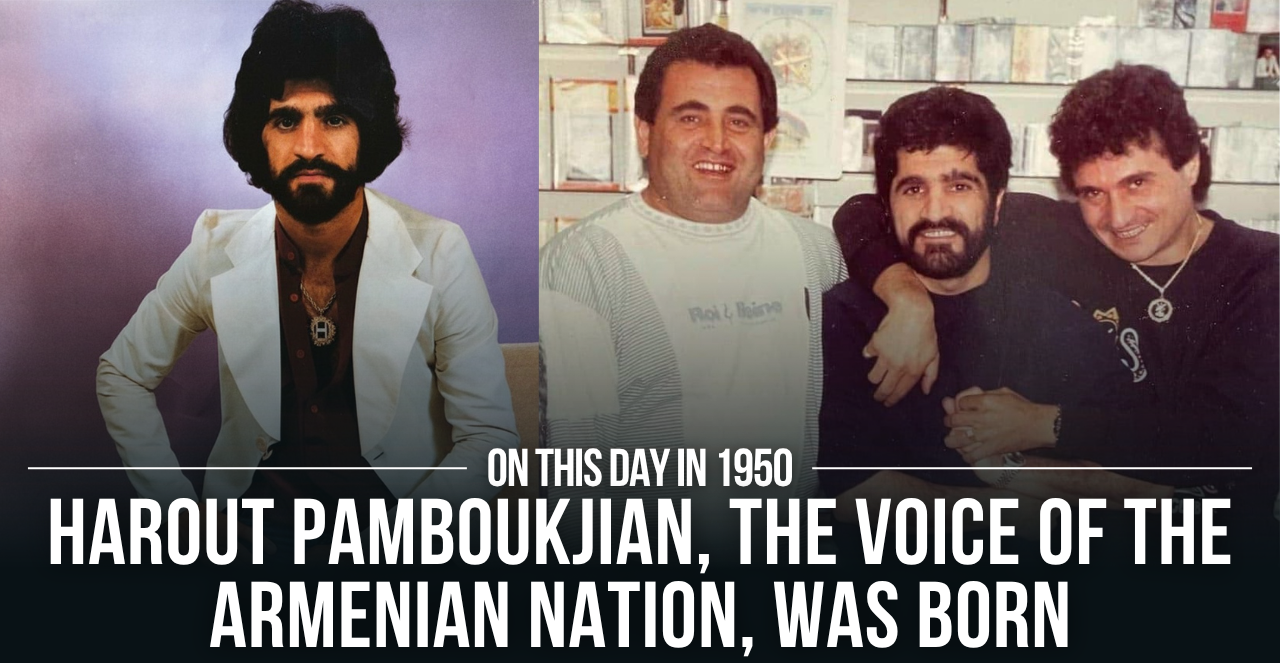

76 years ago today, on July 1, 1950, Harout Pamboukjian, the Armenian singer and multi-instrumentalist known across the Armenian world as Dzakh Harut, and the man who has served as the connective tissue of the global Armenian nation for more than five decades, was born.
His 28 concerts after the 1988 earthquake became a cultural moment for the Armenian nation.
From Yerevan to Erebouni
Harout Pamboukjian was born on July 1, 1950 in Yerevan’s Nor Aresh neighborhood, the son of two Armenian Genocide survivors. His father, Yesayi Pamboukjian, was born in 1901 in Zeitun. His mother, Tsaghik Shahakyan, was born in 1907 in Tigranakert. After the Genocide, both families fled to Beirut, and in 1946 they made the journey to Soviet Armenia. Four years later, Harout was born in the homeland his parents had crossed a sea to reach.
His mother was a singer. She was his first influence. In his early teens, he took up the guitar, the bouzouki and the saz, the dhol, and the piano. He would play left-handed for the rest of his life, a habit that gave him his stage name: Dzakh Harut, “Left Harout.”
He attended School No. 43 in Yerevan and enrolled at the Terlemezyan Art School, where he trained as a painter and sculptor. He graduated in 1968. He then served two years in the Soviet Army in Konotop, Ukraine.
In the late 1960s, he formed a band called Erebouni. They played weddings, universities, and village gatherings across Soviet Armenia. Their repertoire blended Charles Aznavour, Deep Purple, and Elvis Presley alongside centuries-old Armenian folk tunes. In an era when Soviet cultural policy imposed strict oversight on what could and could not be performed, Erebouni was a working example of an Armenian musical identity that quietly refused to be flattened.
The Exit
In 1975, under the political restrictions of the Soviet system, Harout Pamboukjian and most of his family left Soviet Armenia. He spent a year in Lebanon, the same country his parents had fled to after the Genocide two generations earlier. Then he crossed the Atlantic to Los Angeles, where the Armenian diaspora was gathering into what would become one of the largest and most concentrated Armenian communities in the world.
Where Were You, God?
Only two months after his arrival in Los Angeles, Pamboukjian went into the Quad Teck studio in Koreatown and recorded his first album. He called it “Our Eyir Astvats” — “Where Were You, God?”
The album, whose title track was written by Arthur Meschian, was about the Armenian Genocide. His parents had survived it. He had grown up on their stories.
His first act as an artist in America was to name the wound the world had told his people to forget.
The Wedding Singer
The first album made him a fixture in the Los Angeles Armenian community, and from there in the diaspora at large. He built his career at Armenian engagement parties, baptisms, fairs, and dinner dances, where he was expected to sing for five to six hours at a stretch.
Fathers-of-the-bride from as far away as France would pay thousands of dollars for an hour of his time. He earned the nickname “The Armenian Wedding Singer.” He played the Rose Bowl, the Shrine, and the Palladium.
But it was in the banquet halls, at the community centers, and at the family celebrations that his voice found its truest audience. His voice became the sound of a global nation. He was the sound Armenians heard at their happiest moments and their most difficult ones.
The 28 Nights
In 1988, a catastrophic earthquake struck northern Armenia. More than 25,000 people were killed. More than 500,000 were left homeless.
One year later, hundreds of thousands of Armenians gathered at the Hrazdan Stadium and the Karen Demirchyan Complex in Yerevan to hear Harout Pamboukjian sing. He performed 28 concerts. It was a cultural moment of the modern Armenian nation: an entire people looking for something to hold onto and finding it in the voice of a man who had left them fourteen years earlier and come home to sing.
He has been coming home ever since.
The Anthems
The songs that carried Harout Pamboukjian across the Armenian diaspora were not his own compositions. They were the centuries-old folk tunes about protecting the soil and fighting in the highlands: “Antranik Pasha,” “Sassouni Orore,” “Msho Aghchig,” “Msho Dashter,” “Hey Jan Ghapama.” He gave them the voice they had been waiting for.
His most beloved patriotic songs became the anthems the Armenian diaspora still sings together at rallies, at protests, and at community events across every corner of the world. He collaborated with Ruben Hakhverdyan, Arthur Meschian, Robert Amirkhanian, and Karnig Sarkissian. He has released more than 20 albums.
When Armenians organize for their causes — for Genocide recognition, for Syrian Armenian relief, for the victims of the Beirut port explosion, for the wounded of the Artsakh Wars, for the children being treated for cancer at the Yerevan Hematology Center — Harout Pamboukjian shows up. He sings for them. He always has.
A Nation’s Voice
In 2015, the Republic of Armenia formally named him an Honored Artist of the Republic. The city of Los Angeles, where he had rebuilt his life, declared November 26 “Harout Pamboukjian Day.”
The state gave him a title. The city gave him a day. The nation he had never stopped serving gave him something bigger: a place as a cultural institution in the memory of every household in the diaspora.
Today, on his 76th birthday, Dzakh Harut is still singing. The Armenian nation, wherever it is, still gathers around his voice.
Long may he sing.