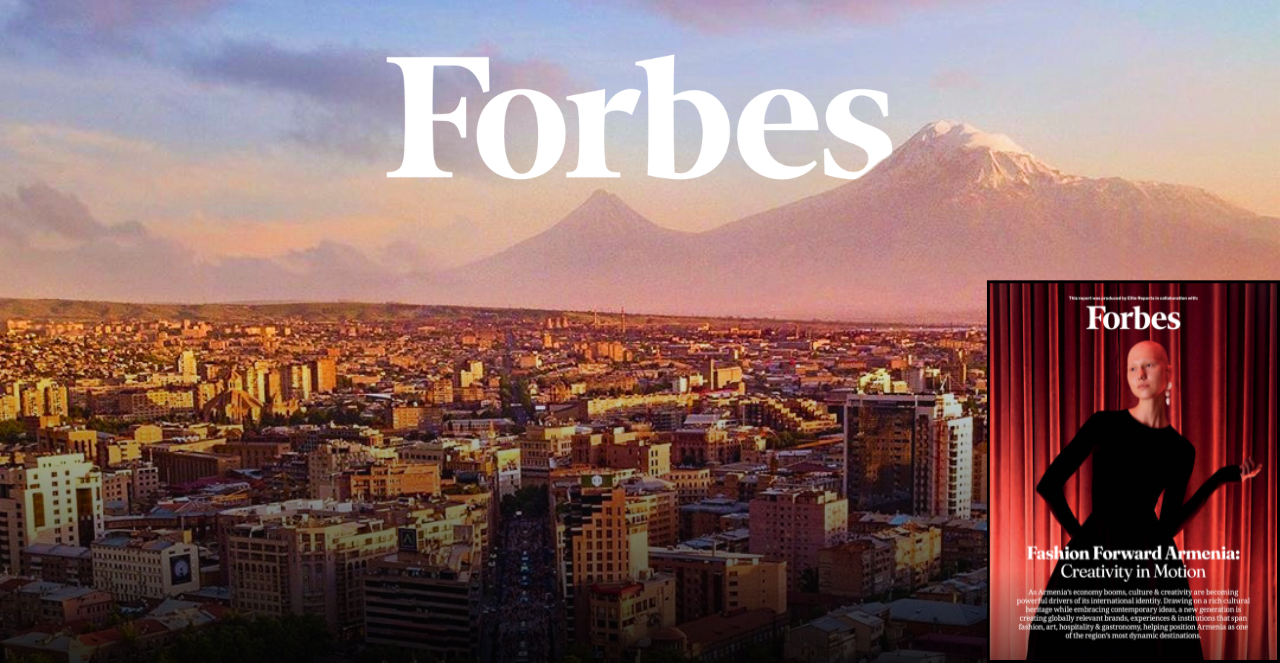

Forbes has dedicated a 27-page feature spotlighting Armenia’s emergence as one of the region’s most dynamic creative destinations, presenting the country through the lens of fashion, art, cuisine, design, and hospitality. Published in the Austrian edition of Forbes and produced by the agency Elite Reports with the support of the Tourism Committee of Armenia, the report marks the first time Armenia is presented this way to an international audience, charting a fast-rising creative culture that is increasingly shaping how the world sees Yerevan.
Titled “Fashion Forward Armenia: Creativity in Motion,” the feature explores Armenia’s creative community, entrepreneurs, and cultural leaders who are redefining how the country is perceived internationally, not simply as a place of history and craftsmanship, but as a destination of innovation and meaningful cultural exchange. It was edited by Jeb Adams, who also wrote its central essays, with much of the accompanying fashion photography shot by Mariam Kach, and the wider Elite Reports team behind the project included Managing Director Melinda Snider, Production Manager Carla De Malezieux du Hamel, Creative Director Paulo Couto, and Production Assistant Íñigo López González. Structured around a long opening travel essay and a series of profile interviews, the report hands the microphone to many of the founders, designers, chefs, and artists shaping the country’s creative life.
The feature opens by acknowledging the lens through which Armenia has long been viewed internationally, one defined by history, geopolitics, diaspora, and resilience, before arguing that another story has become impossible to ignore. A generation of designers, chefs, architects, artists, musicians, and entrepreneurs, many of whom spent years abroad before returning, is reshaping the country’s cultural identity in a way that feels organic rather than manufactured, Adams writes, describing a contemporary scene where the boundaries between industries remain fluid and where some of the most important conversations still happen informally, over long dinners and chance encounters.
Fashion anchors the report. Elen Manukyan, co-founder and team lead of the Fashion Chamber of Armenia and a driving force behind Yerevan Fashion Week, frames the stakes simply. “Culture builds identity, and fashion is one of the most visible languages of culture,” she said. The feature traces a maturing ecosystem of concept stores and independent platforms, from the 5 Concept Store, which works with more than 70 designers and marks its tenth anniversary this year under creative director Irina Kavanyan, to Rien-à-Porter, the Yerevan platform now expanding internationally through its parent company Maison Marom, led by cultural strategist Mareta Gevorkyan. Designers including Arevik Simonyan of Kivera Naynomis and the founders of the cultural zine DASEIN, Vanane Borian alongside Anna Vahrami and Ina Abrahamyan, round out a portrait of an industry built on individuality rather than imitation. “Armenian fashion always existed,” Kavanyan said. “What was missing was belief.”
Design and innovation form another thread. The report profiles Anna K. Gargarian, head of strategy, design, and development at the Fine Arts Academy Dilijan Campus, who makes the case for reconnecting Armenian craftsmanship, textiles, and material knowledge with contemporary ideas around sustainability and ecological design, while pointing to a creative economy that increasingly runs parallel to Armenia’s growing technology sector and companies such as Picsart, Krisp, and Renderforest. That sensibility runs across the feature, from the architecture of the country’s new hotels and resorts to the concept stores that double as design spaces, where Armenian makers are shown reinterpreting heritage through silhouette and material rather than using it decoratively.
The report devotes equal attention to hospitality and Armenian cuisine, presenting Yerevan as a city increasingly defined by experience and positioning Armenia as a serious gastronomy and wine destination for a new kind of lifestyle traveler. It profiles The Alexander, a Luxury Collection Hotel, whose general manager Lasaro Ryumin describes a property intertwined with the life of the city, and the nearly century-old Grand Hotel Yerevan, where general manager Gurgen Muradyan frames the hotel as a place where guests experience part of Armenia’s history. Both feature alongside Seven Visions Resort and The Dvin, whose founder Artak Tovmasyan describes a vision of “Monaco glamour, Vegas energy, Macau prestige, yet uniquely Armenian,” reborn through contemporary architecture, entertainment, and immersive experiences.
On the food and nightlife side, Yeremyan Group, with two decades and 18 restaurants across 13 concepts behind it and represented by deputy general director Lusine Yeremyan, anchors the cuisine story through its farm-to-table philosophy and its immersive dining destination Livingston, where live music and choreographed performances turn dinner into theater. The Lebanese-Armenian founders of Turntables Hospitality Group, Aren Deyirmenjian and Nareg Sfeir, behind the restaurant Camilla, and Pabló beverage director Nareg Aroyan round out a scene built around atmosphere, entertainment, and community.
Armenia’s art world is given its own platform. Nina Hovnanian and Fabio Lenzi, co-founders of the Yerevan Biennial Art Foundation, make the case for the city as a contemporary art center, with Lenzi noting that Armenia has become a recognized hub for technology, innovation, and entrepreneurship and arguing that “the Caucasus’ next cultural chapter begins in Yerevan.” The feature also profiles artists including Arshak Sarkissian, Kevork Mourad, Armine Harutyunyan, and Baron Scancelli, alongside luxury entrepreneur Armen Pogossian, whose brands include Jardins d’Arménie, each presented as evidence of a country whose creative voice is increasingly visible on the international stage.
Running through the entire report is a single argument, that Armenia’s creative momentum is less a passing trend than a long-term investment in the country itself, powered by a returning diaspora and a belief that culture creates identity, influence, and economic value. The feature closes where much of its reporting seems to have happened, around a dinner table at Camilla, where one of the founders explained why the city’s creative community felt less like a business and more like a family. “That is our secret ingredient,” he said. “Community.”
For Armenia, the feature marks a notable shift in international framing, placing the country on one of the world’s most recognizable business platforms not as a story of survival, but as a story of creation.