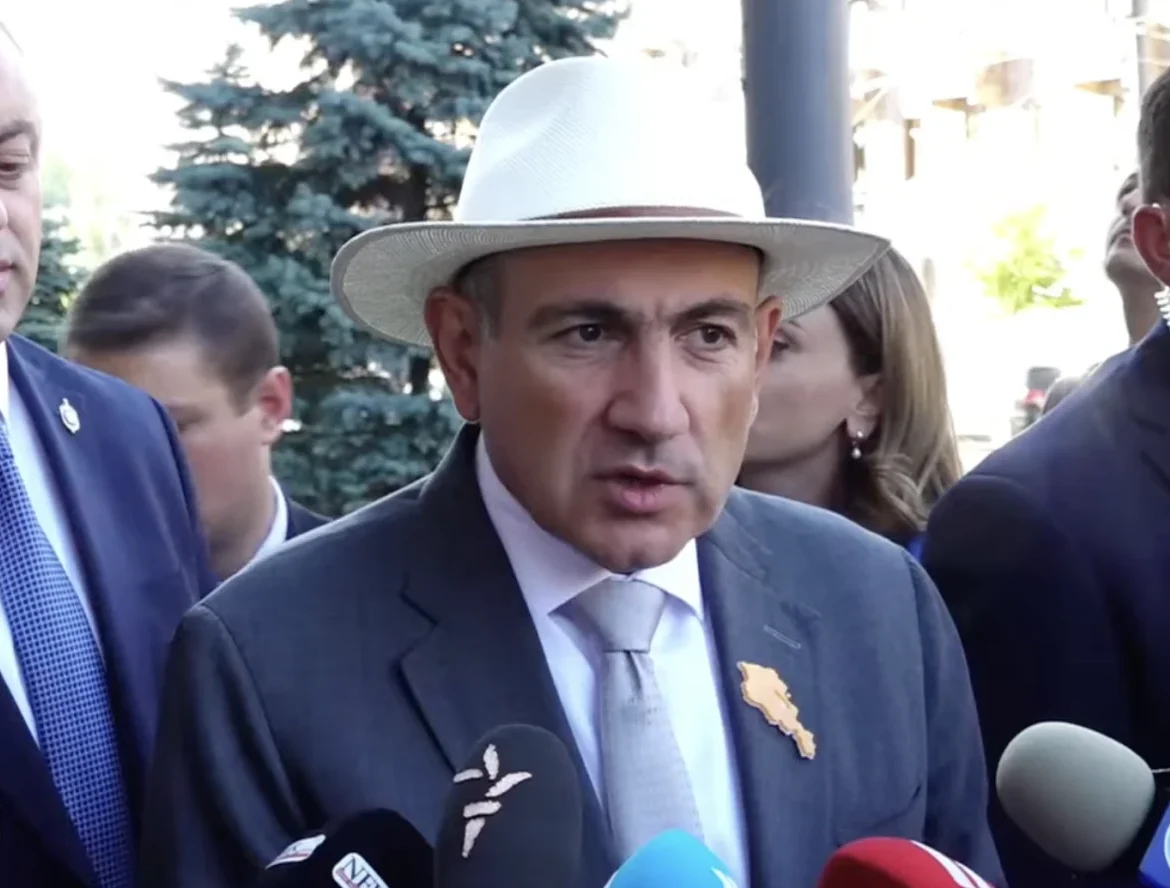

Armenian Prime Minister Nikol Pashinyan said on Monday that his government saw no need to respond to Israel’s recognition of the Armenian Genocide, telling reporters that staying out of what he described as the weaponization of the issue was in Armenia’s national interest.
“We see no need to respond, because we believe that refraining from entering into the issue of the weaponization of the Armenian Genocide is in the interests of the Republic of Armenia,” Pashinyan said, speaking to reporters following a meeting of the board of his ruling Civil Contract party. Reporters had pressed him on why official Yerevan had stayed silent in the face of the sharp condemnations issued by Baku and Ankara.
The remark ended a day of conspicuous silence from the Armenian government. The Foreign Ministry had not commented since the decision was announced, and officials from Civil Contract had declined to respond to questions about it. Justice Minister Srbuhi Galyan had earlier declined to comment, saying she had “no desire” to provide a statement, while two Civil Contract MPs who sit on the parliamentary Armenia-Israel friendship group also declined, citing different reasons.
The posture stood in sharp contrast to the Armenian opposition, which welcomed the recognition. Arthur Khachatryan, an MP from the opposition Armenia Alliance, called it “a positive development” and said the whole world should recognize and condemn the Armenian Genocide. It also stood apart from the reaction abroad, where both Azerbaijan and Turkey condemned the Israeli vote. Baku demanded Israel reverse the decision, dismissing it as the “so-called” genocide, while Ankara branded it a “political” maneuver to divert attention from Gaza.
Monday’s remark reflected a calculation that has shaped Pashinyan’s broader policy since the 2023 loss of Artsakh. His government has pursued a high-level normalization track with both Azerbaijan and Turkey, working toward a peace agreement with Baku and the reopening of borders and establishment of diplomatic relations with Ankara, and the prime minister has increasingly argued that the Armenian Genocide should not be used as a political instrument. That shift, away from a recognition campaign that was long a pillar of Armenian foreign policy, has drawn sustained criticism from diaspora organizations and opposition figures who see recognition as a national cause. In October 2024, Foreign Minister Ararat Mirzoyan said international recognition was no longer the country’s top priority, citing regional peace and normalization instead.
In January 2025, speaking to diaspora Armenians in Switzerland, Pashinyan questioned why the Genocide became an international issue only in the decades after 1915 and said Armenians needed to understand “what happened and why it happened,” remarks that historians, opposition figures, and church leaders condemned as echoing Turkish denialist framing. He has repeatedly rejected that characterization, insisting he does not deny the Genocide and is not helping Ankara to do so. In his April 2026 commemoration address, he leaned on the older Armenian term Meds Yeghern, or “Great Crime,” rather than the word genocide, and warned that the issue must not become “a tool in the hands of international actors,” language critics read as a further softening of Armenia’s historic position. Rather than explicitly emphasizing the responsibility of the Ottoman Turkish authorities for organizing and carrying out the extermination campaign, Pashinyan suggested that Armenians of the Ottoman Empire were drawn into the “international intrigues” of external powers during World War I, framing the catastrophe as a consequence of broader geopolitical rivalries rather than a deliberate Ottoman campaign to destroy the Armenian population.
Israel’s government voted unanimously on Sunday to formally recognize the genocide, following the resolution brought by Foreign Minister Gideon Sa’ar late last week. The measure now heads to the Knesset for a vote, though its path is uncertain, as the parliament is expected to begin its pre-election recess on July 16, with new elections scheduled for the autumn.