
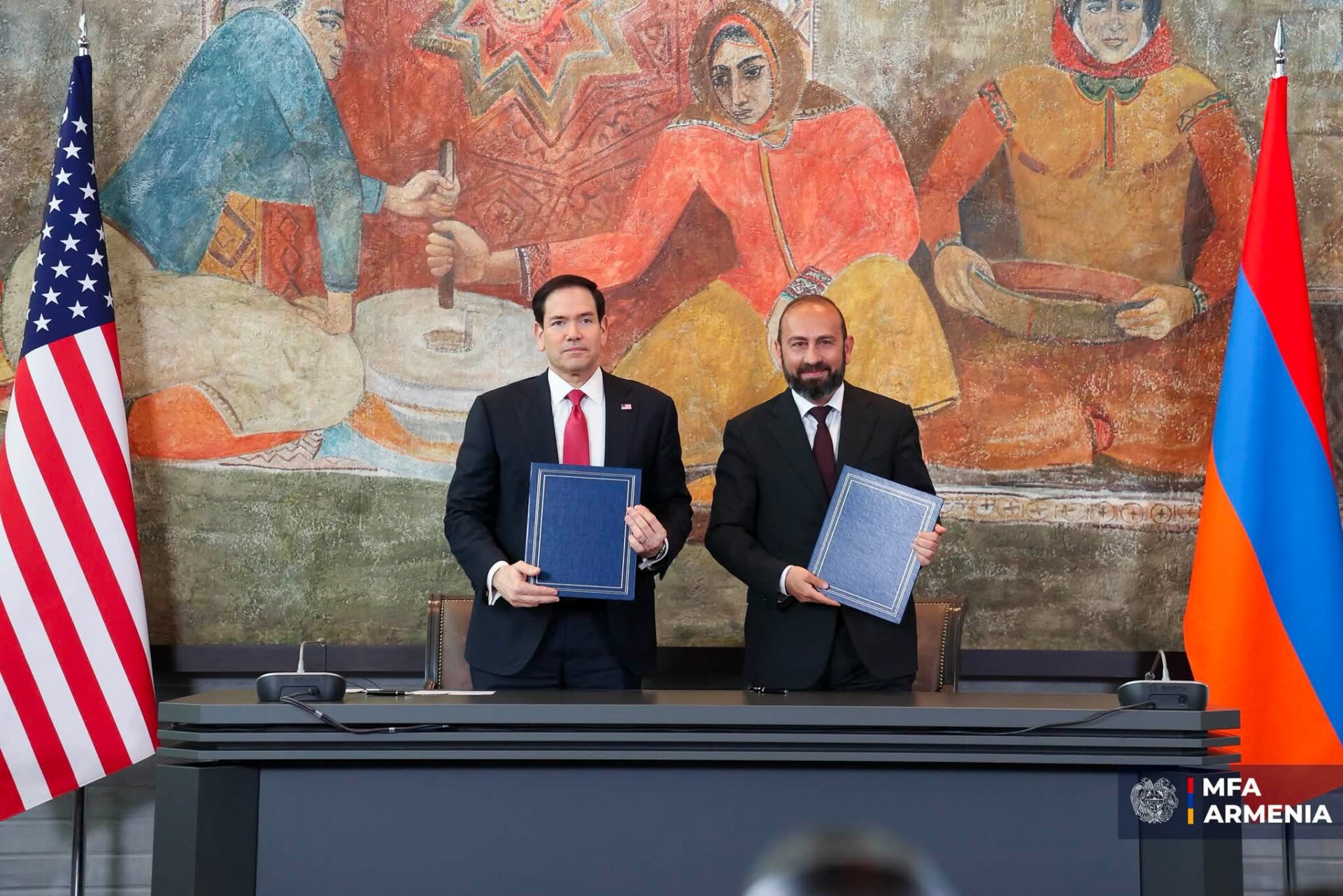

Armenia and the United States elevated their relationship to a Comprehensive Strategic Partnership and initialed a framework agreement on the Trump Route for International Peace and Prosperity (TRIPP) during the visit of U.S. Secretary of State Marco Rubio to Yerevan on Tuesday.
Over the course of a visit lasting roughly one hour, Armenian Foreign Minister Ararat Mirzoyan and Rubio initialed the Framework Agreement on Strategic Cooperation Concerning TRIPP, signed the Charter on Comprehensive Strategic Partnership, and signed a memorandum titled the Framework for Securing Supply in the Mining and Processing of Critical Minerals and Rare Earths. Together the documents build on the Washington Peace Summit hosted by President Donald Trump on August 8, 2025, and the TRIPP Implementation Framework released in Washington in January 2026, and they set out a broad agenda spanning diplomacy, security, defense, trade, energy, technology, education, and cultural exchange.
The Visit
Rubio arrived in Yerevan on a working visit, flying in from India on his way back to Washington, D.C. He was accompanied by his wife, Jeanette Dousdebes Rubio. He landed at Zvartnots International Airport, where the couple was welcomed by Armenian Foreign Minister Ararat Mirzoyan and his wife, Gohar Abajyan. The expanded-format meeting between the two sides also took place at the airport, followed by the signing ceremony and a joint press briefing.
Rubio’s visit marks the third time in Armenia’s history that a U.S. secretary of state has visited the country. The first visit took place in February 1992, when then Secretary of State James Baker traveled to Armenia. This was followed by two visits from former Secretary of State Hillary Clinton, in July 2010 and June 2012.
The TRIPP Framework Agreement
The Framework Agreement on Strategic Cooperation Concerning TRIPP sets out the structure for implementing the transit project that emerged from the August 2025 Washington summit. The agreement provides for the creation of a joint venture known as the TRIPP Development Company, intended to support implementation of the project. Under the terms published by Armenia’s Foreign Ministry, a U.S. entity incorporated in Delaware as a wholly owned subsidiary of the United States International Development Finance Corporation would hold a 74 percent controlling stake in the company, while Armenia would hold 26 percent. The development rights are set for an initial term of 49 years, with an option for the parties to extend for an additional 50 years, at which point Armenia’s stake would rise to 49 percent.
The agreement repeatedly affirms that Armenia retains full sovereignty, territorial integrity, and jurisdiction over all TRIPP project areas within its territory, as well as full sovereignty and jurisdiction over its borders and customs operations. It describes TRIPP as a means of establishing unimpeded, multimodal transit connectivity across Armenian territory, with project modalities that may include rail, road, oil and gas pipelines, fiber optic, and electricity. The route is intended to connect the main part of Azerbaijan with its Nakhchivan exclave and to form a link in the Trans-Caspian trade route while generating connectivity benefits for Armenia. The United States intends to notify Congress and obtain approval from the Development Finance Corporation’s board before establishing the company.
Rubio described the agreement as the most significant step yet toward realizing the project. “This agreement marks the biggest step to date on making this historic route a reality, on advancing peace and on increasing prosperity in Armenia and, frankly, in the region,” he said, calling the broader effort a “courageous path” toward peace in the South Caucasus. He added that Trump views the initiative and broader U.S.-Armenia cooperation as an important part of his second-term legacy.
The Comprehensive Strategic Partnership Charter
The Charter on Comprehensive Strategic Partnership establishes a broad framework for cooperation and serves as the overarching structure for the memoranda of understanding signed by Prime Minister Nikol Pashinyan and Trump in Washington on August 8, namely on the Crossroads of Peace Capacity Building Partnership, the AI and Semiconductor Innovation Partnership, and the Energy Security Partnership.
The Charter sets out cooperation across economic, trade, energy, space, and mining sectors, including the further development of a civil nuclear program with the highest standards for safety and nonproliferation, potential small modular reactor deployment, and access to U.S. nuclear technologies. It addresses semiconductor supply chains and artificial intelligence, the reconstruction of the Gyumri-Kars railway as a connectivity step, and expanded space cooperation beyond the Artemis Accords. On defense and security, it covers the potential sale of U.S. defense articles through Foreign Military Sales, professional military education, cyber resilience, and counter-trafficking efforts. It also commits both sides to people-to-people and scientific exchanges, the potential establishment of an Armenia-U.S. binational science foundation, and joint initiatives for the preservation of Armenian cultural and religious heritage. To oversee implementation, the Charter establishes a Comprehensive Strategic Partnership Commission.
Mirzoyan described the elevation of the partnership format as the most significant outcome of the talks. “Together with Secretary Rubio, we elevated our strategic partnership to a new level just a short while ago by renaming it a Comprehensive Strategic Partnership,” he said, adding that the new framework significantly expands opportunities for cooperation, particularly in artificial intelligence and other strategic areas.
Critical Minerals and Rare Earths
The two sides also signed a memorandum titled the Framework for Securing Supply in the Mining and Processing of Critical Minerals and Rare Earths. Rubio described access to and processing of strategic resources as increasingly essential for technological development and economic competitiveness. “Countries that are able to do that are going to be able to find economic independence and place themselves at the center of innovation,” he said. He stressed that the value lies not only in access to these minerals but in the ability to process and refine them into usable goods, which he called essential to economic independence in the 21st century. He noted that cooperation in the sector would help ensure reliable access to resources for both countries while supporting long-term economic growth.
Mirzoyan said the document opens new opportunities in artificial intelligence and other important domains, and assured that it is beneficial for Armenia and opens unprecedented horizons for the country.
A Deepening Phase in Armenia-U.S. Relations
Mirzoyan framed the visit as part of a broader acceleration in relations between the two countries. “Our comprehensive strategic relations between our two countries are stronger today than ever before,” he said, adding that Armenia and the United States have entered a “historically unprecedented phase” marked by frequent developments across their bilateral agenda. He noted that the two countries had already undertaken commitments in artificial intelligence, semiconductor technologies, and nuclear energy, and praised the Trump administration’s role in advancing peace efforts in the South Caucasus.
Earlier this year, in February, U.S. Vice President JD Vance made a historic visit to Yerevan, marking the first time a sitting American vice president had traveled to Armenia. During that visit, Armenia and the United States reached understandings on expanding cooperation in nuclear energy safety and civil nuclear development, artificial intelligence and digital infrastructure, as well as defense and high-technology sectors.
Support for Armenia’s Leadership
Following the meeting, Rubio offered direct support for Pashinyan and his government 12 days before Armenia’s June 7 parliamentary elections. He framed the visit as a show of confidence in Armenia’s direction, saying the prime minister, Mirzoyan, and their team are “blazing the trail toward a brighter and more independent future for Armenia.”
Rubio said the United States was in Yerevan to back the Armenian leadership’s courage, vision, and dedication, adding that Washington was proud to be part of the effort and could not wait to do more together.


