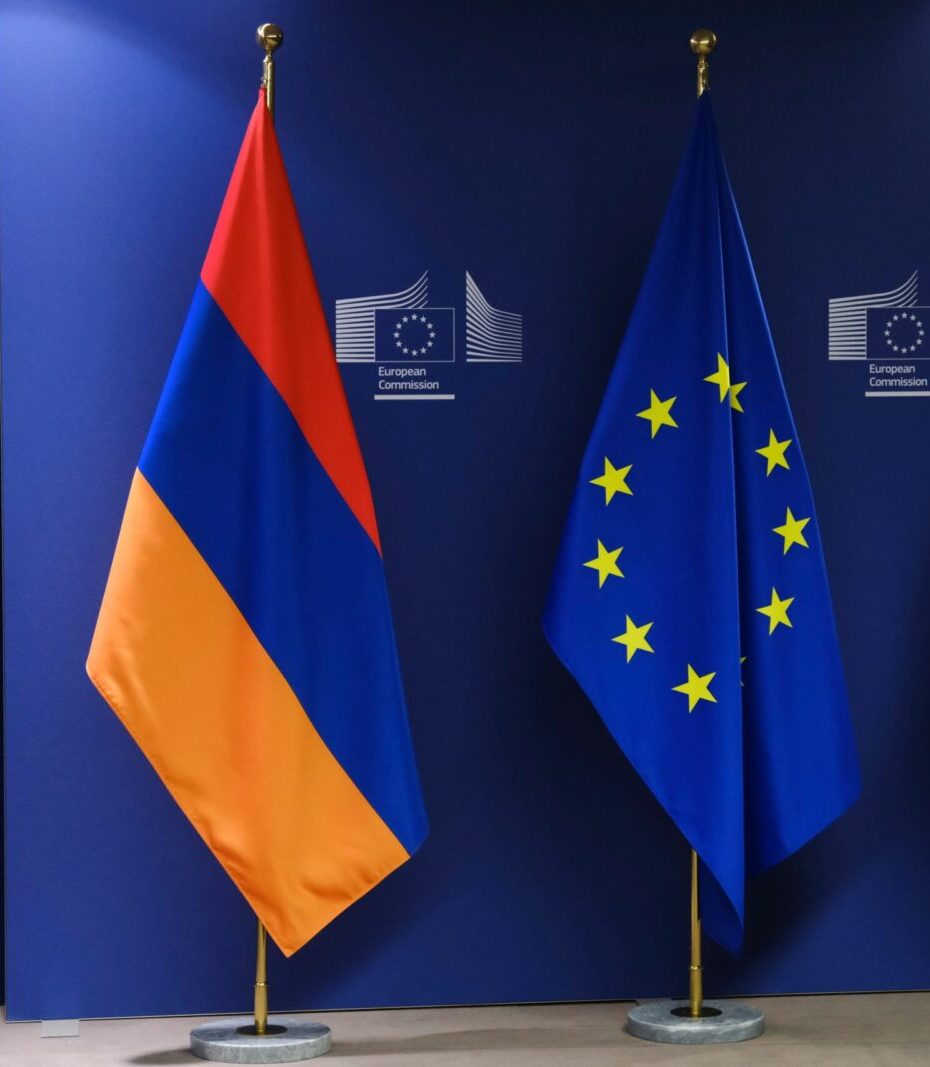

The Council of the European Union agreed on Wednesday to suspend import duties on around 80 percent of Armenian exports for 2 years, a response to the trade restrictions Russia has imposed on Armenia since the spring. It came a day after Prime Minister Nikol Pashinyan met President Vladimir Putin in Bishkek, where the Russian leader pressed Armenia to choose between the EU and the Eurasian Economic Union.
The tariff-free access covers most of what Armenia lost to the Russian bans. The measures span almost 99 percent of Armenia’s exports of fresh fruit, vegetables and plants to Russia, and more than 91 percent of beverages and spirits, according to the Council.
“Europe stands with Armenia and its people, who have chosen a clear path for reform and closer cooperation with the European Union. Today’s decision sends a clear message: when faced with economic coercion, the EU will respond. We will create new opportunities and stand with our partners,” said Helen McEntee, Ireland’s Minister for Foreign Affairs and Trade.
The move delivers on a promise European Commission President Ursula von der Leyen made in Yerevan on July 2, when she said the EU would open its market to Armenian agricultural products. The regulation suspends import duties on a broad range of Armenian goods, including selected agricultural products subject to tariff-rate quotas, and runs for 2 years from entry into force.
Access comes with conditions. Armenia must comply with rules of origin, cooperate administratively with the EU, refrain from imposing new trade restrictions on EU imports, and respect the essential elements of the Comprehensive and Enhanced Partnership Agreement, including democratic principles, the rule of law and human rights. The arrangement carries safeguards allowing the EU to act if the imports adversely affect European producers.
The Council endorsed the Commission’s proposal without changes. The European Parliament is expected to adopt its position without amendments during its September plenary session, after which the Council will approve it and the regulation enters into force the day after publication in the Official Journal of the EU.
Russia began restricting Armenian imports on May 23, when it banned Jermuk mineral water, two wine brands, and a cognac, days after Pashinyan hosted two European summits in Yerevan and reaffirmed his government’s intention to seek eventual EU membership. On May 29, Putin and the leaders of Belarus, Kazakhstan, and Kyrgyzstan warned that Armenia’s EU preparations carried serious risks for their bloc, and Russia recalled its ambassador from Yerevan days later. The bans widened from June to reach fish, flowers, vegetables, fruits, berries, grapes, potatoes, dried fruits, dairy, and further beverages and alcohol, and Russia blocked the transit of Armenian-origin goods through its territory to other members of the Eurasian Economic Union. Moscow cited violations of phytosanitary requirements.
Armenian exports fell 7.9 percent over the first 7 months of 2026 to $4.04 billion, Economy Minister Gevorg Papoyan said on Wednesday, with July down 15.7 percent against the same month last year, though up 5.3 percent over June. Agricultural exports excluding fresh fruit and vegetables came to $849 million, down 1.9 percent from $865 million a year earlier. Armstat recorded agriculture, forestry and fisheries contracting 15.3 percent year-on-year in the first half of 2026, a sector that accounts for 6.6 percent of GDP.
The EU was Armenia’s fourth largest trading partner in 2024, taking 4.7 percent of Armenian exports and accounting for 7.5 percent of total trade in goods. Meeting Pashinyan in Bishkek, Putin put Russia’s share of Armenian trade at roughly 30 percent and bilateral turnover at $2.5 billion for the first half of the year.
Pashinyan, who has called the Russian restrictions ungrounded, has urged Armenian businesses to treat the disruption as a chance to diversify. His government approved subsidies in June and August for farmers and agribusinesses that find new export markets, and Papoyan said the search for those markets continues. Armenia signed a memorandum on August 27 to export up to 40 tons of fresh fruit and vegetables a week to the United Arab Emirates starting this month, and the Food Safety Inspectorate reported on Wednesday that 60 tons of fish and fish products had been shipped there.