
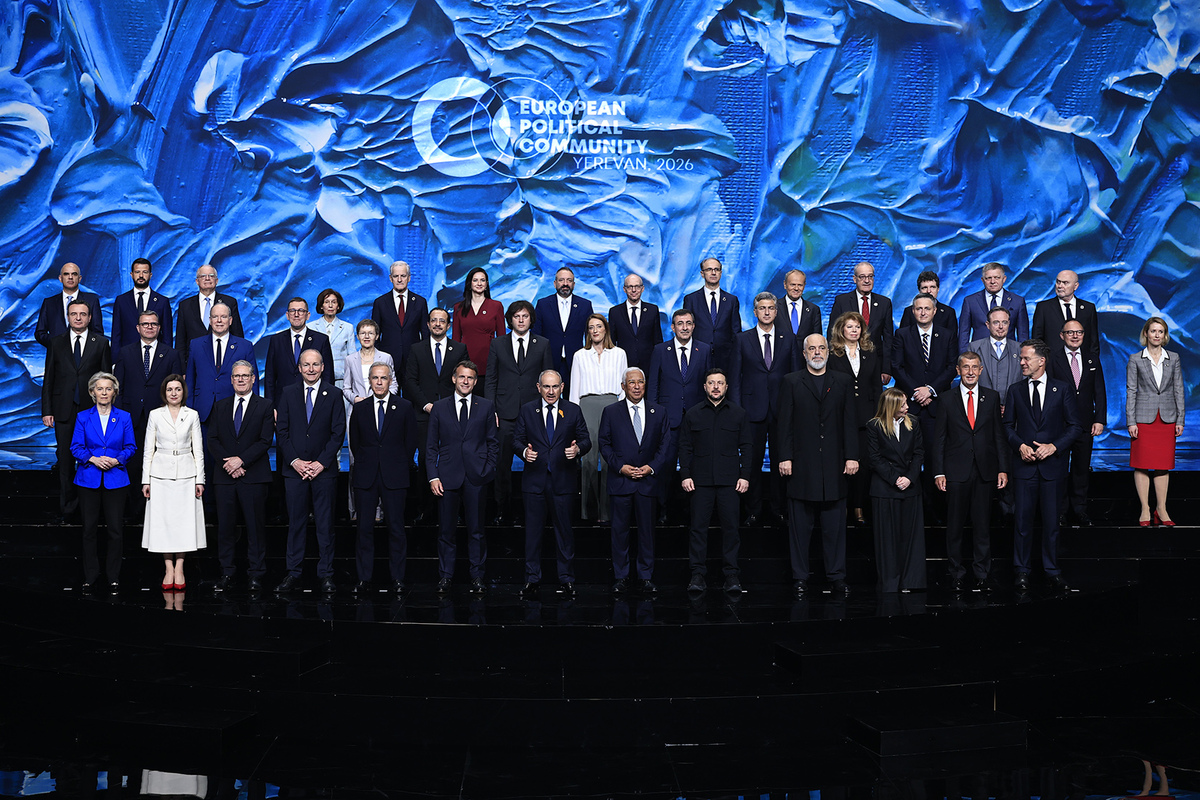

Armenia on Monday hosted the 8th European Political Community (EPC) Summit in Yerevan, bringing together nearly 50 world leaders and international organizations. It is the first time a Caucasus country has hosted the summit since its launch in 2022, and the largest diplomatic gathering ever held in Armenia. The summit was co-chaired by Prime Minister Nikol Pashinyan and European Council President António Costa under the theme “unity and stability in Europe.”
Discussions focused on democratic resilience, regional security, economic and energy cooperation, and connectivity. Attendees included UK Prime Minister Keir Starmer, Canadian Prime Minister Mark Carney, and Ukrainian President Volodymyr Zelenskyy, marking his first visit to Armenia and the first Ukrainian presidential visit since 2002. Turkey was represented by Vice President Cevdet Y?lmaz, while German Chancellor Friedrich Merz did not attend, citing prior commitments.
In a virtual address to the summit, Azerbaijani President Ilham Aliyev congratulated Pashinyan on hosting the EPC Summit, noting that Armenia and Azerbaijan had reciprocally supported each other’s bids to host future summits, with Baku expected to host in 2028. Aliyev said this reflects that “peace has become a reality,” adding that the two countries are “learning to live in peace” following progress in the peace process initiated in Washington last August.
He also stated that Azerbaijan had lifted transit restrictions imposed since the 1990s, claiming that cargo shipments and fuel deliveries had already begun reaching Armenia through Azerbaijani territory. Aliyev further described the TRIPP transport project as a key outcome of the peace agenda, while also criticizing certain EU institutions over their positions on Azerbaijan and Artsakh (Nagorno-Karabakh), which he dismissed as “falsehoods,” while thanking the European Commission for its approach to the peace process.
His remarks prompted a response from European Parliament President Roberta Metsola, who rejected accusations that the EU legislature had sabotaged the peace process or adopted “anti-Azerbaijani” positions. Aliyev had referred to 14 European Parliament resolutions adopted between 2021 and 2026, including a recent resolution supporting Armenia’s democratic resilience and addressing issues related to displaced Armenians from Artsakh, cultural heritage protection, and the safe return of displaced populations. He described these as “defamation and falsehoods.”
Metsola stressed that the European Parliament is a democratically elected body whose resolutions are adopted by majority vote. She added that while such decisions may cause discomfort, “we will never change the path we are following, and we will defend the positions we adopt.”
Ahead of the summit, EU foreign policy chief Kaja Kallas reiterated that Armenia alone will decide its future direction regarding a potential EU membership path, stating that “Armenia makes its own decisions” and that “the European perspective is on the table.”
The summit also saw a series of major bilateral developments. Armenia signed strategic partnership and cooperation agreements with the United Kingdom, Croatia, and Bulgaria, while France signalled plans for a deeper strategic partnership following a meeting between President Emmanuel Macron and Prime Minister Nikol Pashinyan. Armenia also marked the opening of the Belgian Embassy in Yerevan during the visit of Belgian Prime Minister Bart De Wever.
Pashinyan also met OSCE Secretary General Feridun Sinirlio?lu ahead of the summit, and held multiple bilateral engagements on the sidelines. The EU described the EPC gathering and the upcoming inaugural EU–Armenia Summit as a “significant step forward” in relations, reaffirming support for Armenia’s sovereignty, resilience, and reform agenda.
In Russia, state-aligned commentators criticized Ukrainian President Volodymyr Zelenskyy’s visit to Yerevan, framing it within broader geopolitical tensions. The Kremlin has not officially commented.
At the same time, unverified allegations resurfaced regarding alleged Ukrainian arms transfers to Azerbaijan, including claims linked to white phosphorus from the 2020 war. These claims remain unsubstantiated, and Ukrainian authorities have repeatedly denied any transfer of chemical weapons or illicit arms to Azerbaijan.
On the domestic front, parallel protests were held in Yerevan during the summit. A group of demonstrators, including representatives of displaced Armenians from Artsakh, demanded the release of Armenian prisoners held in Azerbaijan and called for stronger international guarantees for the protection of Armenian cultural and religious heritage in the region.
Alongside these rallies, anti-government protests also continued in the capital.


