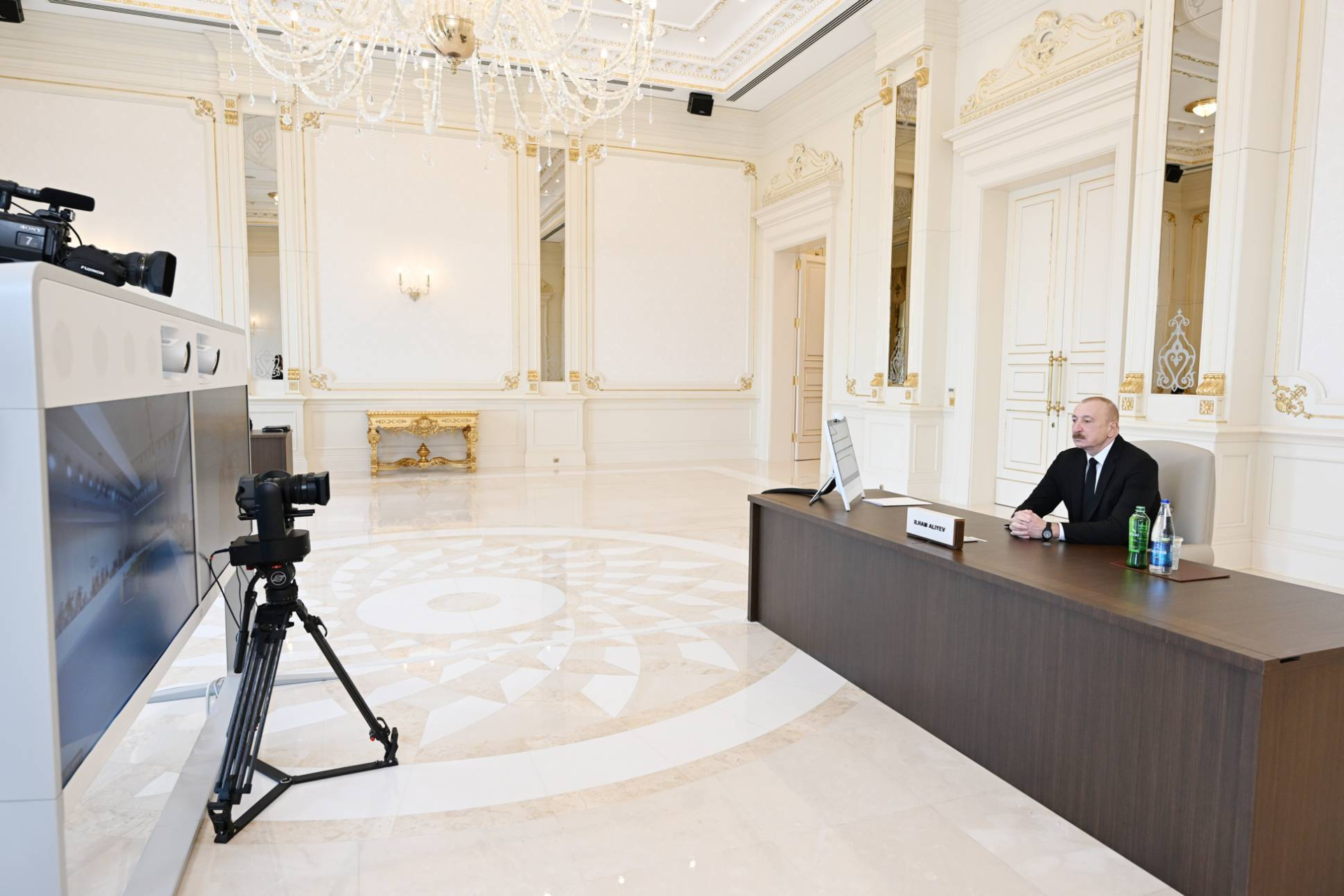

Azerbaijani President Ilham Aliyev addressed the 8th European Political Community (EPC) Summit in Yerevan via video link on Monday, using the platform to justify Azerbaijan’s September 2023 ethnic cleansing and ongoing occupation of Artsakh (Nagorno-Karabakh), attack the European Parliament and the Parliamentary Assembly of the Council of Europe (PACE) over their resolutions affirming Armenian rights, and announce that Azerbaijan’s parliament had voted the previous day to sever all ties with the European Parliament.
Aliyev wrapped his remarks in a peace narrative, declaring that “peace has become a reality” between Armenia and Azerbaijan after nine months of what he framed as normalization following the joint declaration signed in Washington last August.
Speaking remotely after declining to attend in person, Aliyev opened by congratulating Pashinyan on hosting the summit and noted that Armenia and Azerbaijan had reciprocally supported each other’s bids to host future EPC summits, with Baku set to host in May 2028. He thanked European Council President António Costa for the invitation and recalled that the details of his virtual participation had been agreed during Costa’s recent visit to Baku. Aliyev argued that mutual support for hosting future summits reflected normalization between the two countries, calling Armenia’s backing of Azerbaijan’s candidacy “a clear indication that peace between Azerbaijan and Armenia is a reality,” and adding that the two sides were “learning to live in peace.”
Aliyev described the post-Washington period as the start of a new phase, claiming that Azerbaijan had “unilaterally lifted all transit restrictions to Armenia imposed in the beginning of the 90s.” He said 28,000 tons of cargo had since been delivered to Armenia through Azerbaijani territory, and that Azerbaijan had begun exporting petroleum products to Armenia “for the first time,” with 12,000 tons of gasoline and diesel supplied to date. He hailed the Trump Route for International Peace and Prosperity (TRIPP) as what he called a key outcome of the peace agenda, describing it as a corridor that would link mainland Azerbaijan with its Nakhichevan exclave and form part of the Middle Corridor.
The most pointed segment of his address was directed at European institutions. While praising the U.S. administration under President Donald Trump and the European Commission for supporting the peace process, Aliyev said “not all European institutions demonstrate the same approach.” He singled out the European Parliament for sustained attack, telling the summit: “Now, regarding the European Parliament, this body, instead of supporting the peace process, prefers to sabotage it.” He accused the institution of spreading “slander and lies” about Azerbaijan and of adopting 14 resolutions “full of insults and lies about Azerbaijan” between May 2021 and April 30, 2026, dismissing them as “defamation and falsehoods.” He argued that the European Parliament should focus on internal EU challenges such as “xenophobia, Islamophobia, antisemitism, migration, competitiveness, and homelessness” rather than on Azerbaijan.
The most recent of those resolutions, adopted just four days before the summit, demanded the immediate release of Armenian prisoners held in Baku, reaffirmed the right of forcibly displaced Artsakh Armenians to return to their homeland under international guarantees, and called for those responsible for the destruction of Armenian cultural and religious heritage to be held accountable.
Aliyev announced that in response, Azerbaijan’s Milli Majlis had voted on May 1 to suspend all cooperation with the European Parliament, cease participation in the EU-Azerbaijan Parliamentary Cooperation Committee, and begin the process of withdrawing from Euronest. He extended his criticism to PACE, describing “double standards” as a “modus operandi” of the Strasbourg-based assembly and arguing that Azerbaijan’s territorial integrity should be treated equally to that of other states. The PACE criticism follows the sanctions imposed on the Azerbaijani delegation after the September 2023 offensive against Artsakh.
On Artsakh itself, Aliyev claimed that Azerbaijan had “ended separatism” in September 2023 and “implemented UN Security Council resolutions,” language that omits the forcible displacement of more than 100,000 indigenous Armenians from their ancestral homeland over the course of a single week, the nine-month blockade that preceded it, and the ongoing destruction of Armenian churches, cemeteries, and cultural sites that has been documented by Caucasus Heritage Watch and named in successive European Parliament resolutions.
European Parliament President Roberta Metsola, attending the summit in person, responded directly to Aliyev’s accusations. She rejected the suggestion that the legislature had sabotaged the peace process or adopted positions hostile to Azerbaijan, noting that the European Parliament is a democratically elected body whose resolutions are passed by majority vote. While such decisions “may cause inconvenience to many,” Metsola said, the chamber “will never change our working methods and the positions we adopt.” Her remarks were delivered as several dozen Armenian refugees from Artsakh demonstrated outside the summit venue, demanding the release of Armenian prisoners held in Azerbaijan and stronger international guarantees for the protection of Armenian heritage in the territory.
Aliyev closed by congratulating Pashinyan once again, saying that “despite all the efforts of those who want to hinder the process, Azerbaijan is committed to the peace agenda,” and adding that “the remarks of my Armenian colleague clearly demonstrate that.”