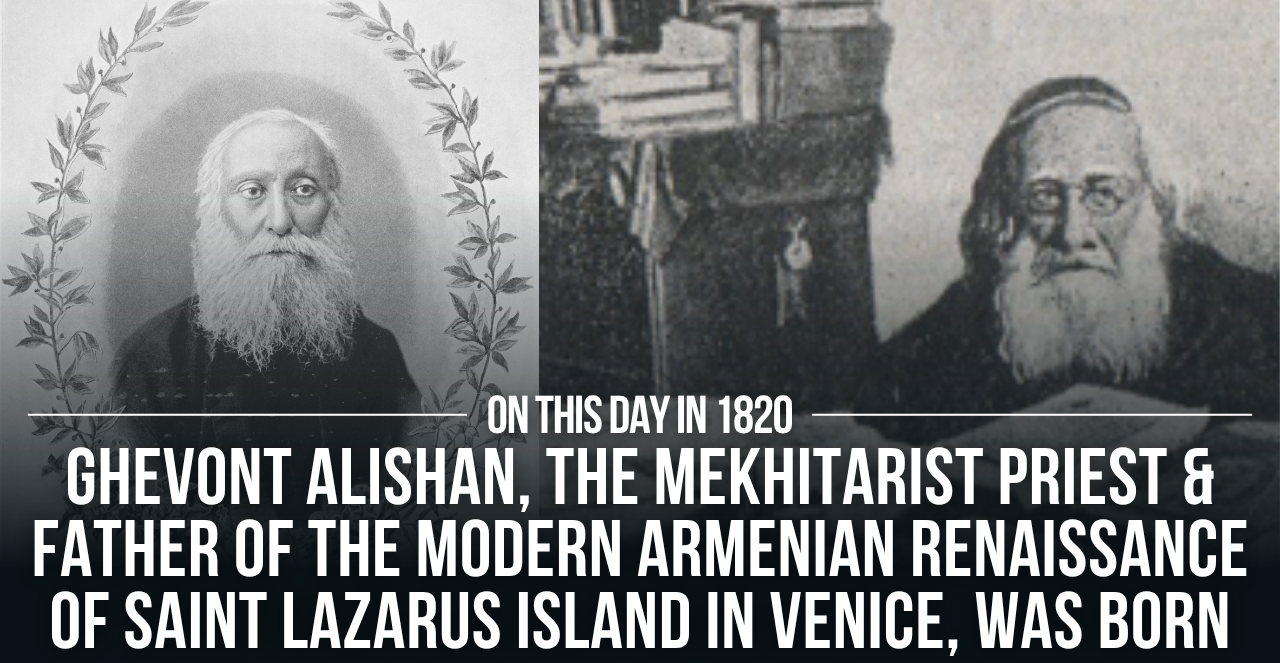

206 years ago today, on July 6, 1820, Ghevont Alishan, the Constantinople-born Mekhitarist priest, poet, historian, and scholar who spent nearly seven decades at the Armenian Catholic monastery on Saint Lazarus Island in Venice, was born.
He co-founded the first scholarly journal in the history of the Armenian press, pioneered Armenian Romantic poetry, authored monumental studies of the historical Armenian provinces, designed the first modern Armenian flag, and whose life’s work helped anchor the modern Armenian Renaissance.
From Constantinople to Venice
Ghevont Alishan was born Kerovpe Alishanian on July 6, 1820, in Constantinople, into an Armenian Catholic family. His father, Bedros-Markar Alishanian, was a numismatist and archaeologist who spent his life among ancient coins and Armenian historical artifacts. Ghevont would inherit the scholar’s instinct and take it further than any Armenian of his generation.
Alishan received his primary education at the Chalikhian School in Constantinople from 1830 to 1832. In 1832, at age twelve, he was sent to Venice to continue his studies at the academy of the Armenian Catholic Mekhitarist Congregation on Saint Lazarus Island — the small monastic island in the Venetian lagoon where Abbot Mekhitar had founded the Congregation more than a century earlier as a scholarly refuge for the preservation of the Armenian language and heritage.
Alishan would spend nearly seven decades on that island. He would never return to Constantinople to live.
He joined the Mekhitarist order in 1840 and was ordained as a priest, taking the name Ghevont — the Armenian form of Leontius. Across Europe, he would sometimes sign his scholarly work under Italianized, Gallicized, or Anglicized forms of his name: Leo, Léonce, Leonzio.
Founding Bazmavep
In 1843, together with his fellow Mekhitarist and future archbishop Gabriel Aivazovsky — the older brother of the painter Ivan Aivazovsky — Alishan co-founded Bazmavep, meaning “Polymath.” It was the first scholarly publication in the history of the Armenian press.
Bazmavep would become the flagship intellectual journal of the Mekhitarist Congregation, publishing works of history, philology, botany, archaeology, and literature in Armenian for the first time on a systematic scholarly basis. Alishan served as its editor from 1848 to 1851 and remained one of its most prolific contributors for the rest of his life.
The journal is still in print in Venice today, more than 180 years after Alishan and Aivazovsky brought it into existence.
The Poet
Alishan is regarded as one of the first Armenian Romantic poets and one of the foundational voices of nineteenth-century Armenian literature.
He wrote primarily in Classical Armenian on patriotic and religious themes, publishing his first poems in Bazmavep in the 1840s. His verse emphasized the concept of homeland, the natural beauty of the Armenian landscape, and the heroic episodes of Armenian history. Between 1857 and 1858, his poems were collected into a five-volume series titled Nvagk — “Songs.”
His most celebrated poem was set to music around 1850 by the Venetian violinist Pietro Bianchini and titled “Bam Porotan” — “Boom, They Roar.” In the decades that followed, especially after the Armenian Genocide of 1915, “Bam Porotan” would become a quasi-anthem of the Armenian diaspora, sung at community events across three continents.
Alishan gave up poetry in his early thirties. His farewell to the form was a poem titled “A Final Word to the Singing Spirit.”
The Scholar
After 1872, Alishan devoted himself entirely to scholarship.
He planned twenty to twenty-two volumes covering every historical province and district of Armenia. He would live to complete four, but each was monumental: Shirak (1881), Sisuan (1885), Ayrarat (1890), and Sisakan (1893). These volumes gathered the history, geography, topography, customs, folklore, and plant life of each region into what remain, more than a century later, foundational primary sources for Armenian studies.
Alongside these regional studies, he authored a dictionary of the flora of the Armenian provinces (1895), a study of the pre-Christian religious practices of ancient Armenians (1895), a monograph on Nerses Shnorhali (1873), and dozens of other works spanning theology, philology, and comparative literature.
He was also a translator. He rendered Canto IV of Lord Byron’s Childe Harold’s Pilgrimage into Classical Armenian, along with works by Schiller, Malherbe, Lamartine, and Chateaubriand. His translations of American poets — N.P. Willis, William Cullen Bryant, Andrews Norton, and John Greenleaf Whittier — were collected in a volume titled Knar Amerikean, “American Lyre.”
The First Modern Armenian Flag
In 1885, the Armenian Students Association of Paris asked Ghevont Alishan to design a modern Armenian flag.
He submitted two designs. The first was a horizontal tricolor of red, green, and white — the red representing the first Sunday of Easter in the Armenian Church calendar, called “Red Sunday,” the green representing “Green Sunday,” and white completing the triptych. The second design, inspired by his time in France, was a tricolor of red, green, and blue, meant to evoke the band of colors that Noah is said to have seen after the Ark came to rest on Mount Ararat.
Neither design became today’s Armenian flag. But Alishan’s 1885 sketches were the first modern attempts to visually distill the Armenian nation into a flag, decades before the First Republic of Armenia adopted its red-blue-orange tricolor in 1918.
A European Voice
By the last decades of his life, Ghevont Alishan had become one of the most internationally recognized Armenian scholars alive.
The French Academy named him a laureate of the Legion of Honor in 1886. The Philosophical Academy of Jena awarded him an honorary doctorate and membership. The Asian Society of Italy, the Archeological Society of Moscow, the Venice Academy, and the Archeological Society of Saint-Petersburg all elected him to their ranks.
The English art critic and social thinker John Ruskin, one of the most influential intellectual voices in Victorian Europe, said of him: “I always looked upon Padre Alishan as a sort of saint.” Ruskin added that Alishan had been his friend for many years.
Saint Lazarus Island
Ghevont Alishan died on November 9, 1901, at the Mekhitarist monastery on Saint Lazarus Island. He was 81 years old. He was buried on the island where he had lived for nearly seven decades.
He had come to Venice at age twelve. He never left. From a small island in the Venetian lagoon, he helped translate, publish, and study the Armenian nation into a form the modern world could recognize.
His bust, sculpted by Andreas Ter-Marukian in 1903, stands today in the National Gallery of Armenia in Yerevan. Bazmavep still publishes in Venice. His regional studies still teach. His 1885 flag sketches still mark the visual origin of the modern Armenian tricolor.
The Renaissance he anchored is still unfolding.