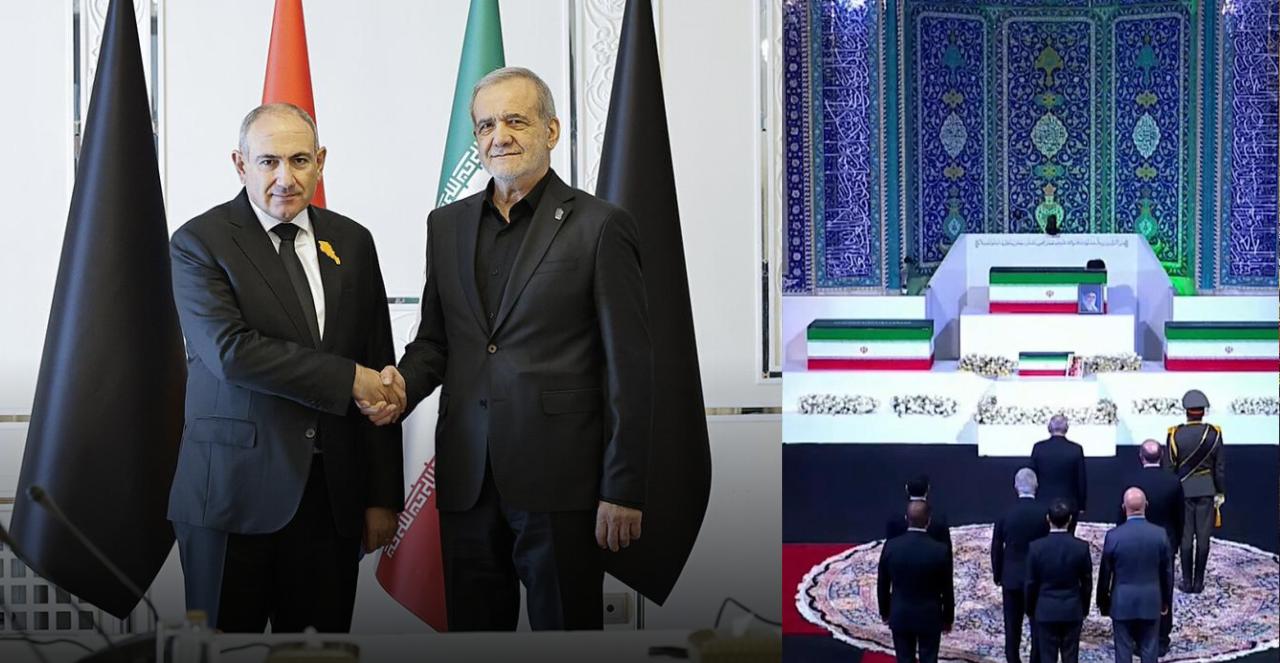

Armenian Prime Minister Nikol Pashinyan, on a one-day working visit to Tehran, attended the official farewell ceremony for Iran’s late Supreme Leader Ali Khamenei at Tehran’s Mosalla Mosque, where he paid tribute to the late leader and met with Iranian President Masoud Pezeshkian.
Their talks touched on Armenia’s condolences over Khamenei’s death, appreciation for Yerevan’s stance during the recent U.S.-Israeli war on Iran, the future of bilateral relations, a warning against “foreign interference” in ties between the two countries, and Armenia’s assurances over Iran’s security, according to official readouts from the Armenian and Iranian governments.
Pashinyan was welcomed earlier at Tehran’s Mehrabad International Airport by Iranian Vice President Seyyed Hamid Pourmohammadi. He was accompanied on the visit by Deputy Prime Minister Mher Grigoryan, Security Council Secretary Armen Grigoryan, Deputy Foreign Minister Vahan Kostanyan, and other officials.
The Tehran farewell opens a series of funeral and memorial ceremonies taking place across several cities in Iran and Iraq, home to the main Shiite holy sites. Participation is reportedly planned from representatives of around 100 countries, and Iranian authorities estimate that between 15 and 20 million people will attend.
At the ceremony, Pashinyan signed the book of condolences and conveyed his sympathies to President Masoud Pezeshkian, First Vice President Mohammad Reza Aref, and members of Khamenei’s family.
On the sidelines of the ceremony, Pashinyan met with Pezeshkian. According to the Armenian government, the prime minister once again expressed Armenia’s condolences over Khamenei’s death, stressing that Armenia shares the grief of the Iranian people. Pezeshkian thanked Pashinyan for traveling to Tehran to attend the official farewell ceremony, saying Iran highly appreciates the position adopted by the Armenian government during that difficult period, as well as the humanitarian assistance Armenia provided. The Iranian president also congratulated Pashinyan on his victory in Armenia’s recent parliamentary elections and expressed confidence that bilateral relations would continue to consistently develop and strengthen.
The two leaders exchanged views on issues of regional importance, emphasizing the need for continued efforts to promote peace, stability, and regional cooperation, according to the Armenian government’s statement, which did not elaborate further.
The Iranian readout of the talks offered a fuller account of what that discussion entailed. According to it, Pezeshkian stressed that Iran-Armenia relations should develop independently of foreign actors and based on the common will of the two countries, warning that the interventions of “extra-regional powers” have not helped resolve regional issues and in many cases have complicated challenges and caused instability. He called for the comprehensive Iran-Armenia cooperation treaty to be finalized and signed as soon as possible, pointing to customs, transport, and transit infrastructure as areas of particular importance, and affirmed Iran’s respect for national sovereignty, territorial integrity, and international borders. Pezeshkian described the “Zionist regime” (Israel) as the main driver of insecurity in West Asia, citing its actions against Lebanon, Gaza, Syria, and Iran.
Such concerns from Tehran have surfaced repeatedly in recent years, particularly regarding the planned Trump Route for International Peace and Prosperity (TRIPP), a U.S.-administered transit corridor for Azerbaijan that would run along the Armenian-Iranian border. Tehran fears the route could lead to a U.S. security presence near its border, and a senior aide to Khamenei described it in December as a serious security threat to Iran. Yerevan has repeatedly said the corridor will not compromise Armenian sovereignty over the area.
Per the Iranian readout, Pashinyan assured Pezeshkian that Armenia has not and will not take part in any plan, project, or action against Iran’s interests or security. “We do not hide anything in our interactions with different countries and are always ready to discuss any possible concerns or worries of Iranian friends and provide necessary explanations,” he said. He added that Armenia considers Iran’s security to be of particular importance, and that current relations between the two countries are at their highest level since Armenia’s independence, describing them as built on trust, friendship, and mutual respect. Recalling two meetings he had held with the late Iranian leader, Pashinyan said the news of his death was deeply felt in Armenia.
Khamenei was killed on February 28, the first day of U.S.-Israeli strikes on Iran, with his death officially confirmed on March 1. He was succeeded as Supreme Leader by his son, Mojtaba.
Earlier on Friday, Iranian state media reported that Khamenei’s body had been transferred to Tehran, with large-scale public farewell ceremonies beginning as the country started paying tribute to the late ayatollah.
According to reports, three coffins were placed on the platform of Tehran’s Grand Mosalla Mosque, including those of Ali Khamenei, his 14-month-old granddaughter Zahra, and his daughter Boshra.
In Tehran, memorial events are scheduled from July 4 to 6, followed by ceremonies in Qom on July 7. On July 8, Khamenei’s body is expected to be transferred to Iraq, and on July 9 he will be buried in his hometown of Mashhad. Tehran’s airspace will be fully closed on July 6 for the funeral procession, with no flights permitted, according to Iran’s Civil Aviation Organization.