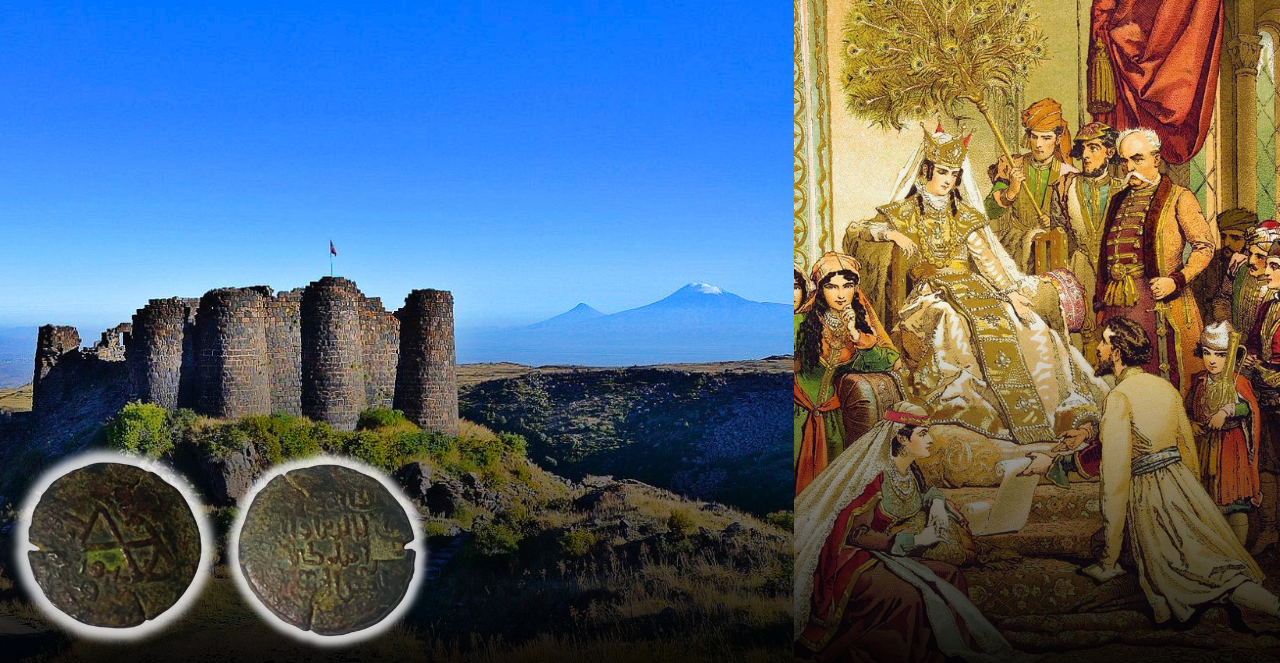

A rare coin from the reign of Queen Tamar of Georgia, known as Tamar the Great, who ruled from 1184 to 1213, along with a young person’s skeleton and pieces of a medieval board game, were uncovered at Armenia’s Amberd Fortress, where crews carrying out restoration and cleanup works in Aragatsotn Province turned up the finds, according to Armenia’s Preservation Service SNCO under the Ministry of Education, Science, Culture and Sports.
The human skeleton was discovered on the outer side of the fortress’s inner tower wall, approximately one meter east of its central section. Nearly 90 percent of the bones were found in place, with only the finger bones missing. Based on the condition of the teeth, researchers believe the individual was a young adult, though further analysis is required to determine identity, precise dating, and circumstances of death.
Alongside the burial, archaeologists also uncovered fragments believed to belong to a medieval board game known as tama, a game similar to checkers or backgammon. The find provides evidence of everyday leisure activities within the fortress during the Middle Ages, complementing its military and defensive function.
The coin, minted during the reign of Queen Tamar, is considered an artifact of high historical value. It dates to a period when the Kingdom of Georgia was at the height of its power, while Amberd was held by the Armenian Zakarian dynasty, a noble family that ruled much of northern and central Armenia as vassals of the Georgian crown. The dynasty’s founders, the brothers Zakare and Ivane Zakarian, served as Tamar’s leading generals and led the campaigns that drove Muslim rulers from much of the region, capturing Amberd and a string of fortresses across the Armenian highlands.
Perched on the southern slopes of Mount Aragats at an altitude of around 2,300 meters (7,500 feet), Amberd Fortress is among Armenia’s best-preserved medieval complexes. Dating primarily to the 7th century, it includes defensive walls, a citadel, a bathhouse, and the 11th-century Vahramashen Church. Its strategic position overlooking the confluence of the Amberd and Arkashen rivers made it a key military and administrative center throughout the Middle Ages. The fortress passed to the Zakarian dynasty in the late 12th century, after a joint Armenian-Georgian campaign drove out Seljuk forces and brought the region under Georgian political influence.
Restoration, conservation, and archaeological work at the site are ongoing.